Join us on a literary world trip!
Add this book to bookshelf
Grey
Write a new comment Default profile 50px
Grey
Subscribe to read the full book or read the first pages for free!
All characters reduced
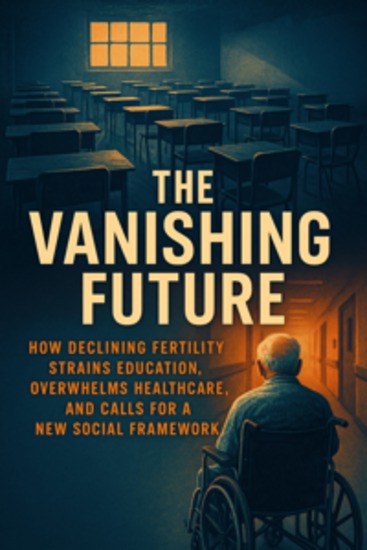
The Vanishing Future: How Declining Fertility Strains Education Overwhelms Healthcare and Calls for a New Social Framework - cover

The Vanishing Future: How Declining Fertility Strains Education Overwhelms Healthcare and Calls for a New Social Framework

Aurora Linden

Publisher: BookRix

  • 0
  • 0
  • 0

Summary

What happens when classrooms grow empty, hospitals overflow with the elderly, and the social contract begins to unravel? The Vanishing Future offers a professional, data-driven exploration of the demographic ticking clock and its profound impact on education, healthcare, and welfare systems worldwide.With precision and clarity, the book traces how low fertility reshapes societies: shrinking school enrollments destabilize education systems, aging populations strain healthcare infrastructure, and social safety nets face unprecedented pressure. Drawing on international case studies and historical comparisons, it exposes both the risks of inaction and the opportunities for reform.Designed for professionals, academics, and policymakers, The Vanishing Future not only diagnoses the problem but also proposes frameworks for sustainability—rethinking policies, institutions, and values in the face of demographic decline. It is essential reading for anyone seeking to understand and address one of the most pressing challenges of the 21st century.
Available since: 09/09/2025.


Other books that might interest you

  • The US Congress - A Very Short Introduction - cover

    The US Congress - A Very Short...

    Donald A. Ritchie

    • 0
    • 0
    • 0
    Donald A. Ritchie, a congressional historian for forty years, takes listeners on a fascinating, behind-the-scenes tour of Capitol Hill, pointing out the key players, explaining their behavior, and translating parliamentary language into plain English. He also explores the essential necessity of compromise to accomplish anything significant in the legislative arena. However, recent events show that political polarization has hardened and produced gridlock. The 2020 election also produced a more diverse membership in terms of gender, ethnicity, religion, and ideology, with primary elections resulting in the defeat of moderate candidates, making bipartisan compromise harder to achieve. 


    Among the most significant events, the Senate ignored President Obama's last nomination to the Supreme Court and then adopted a "nuclear option" to streamline future Supreme Court confirmations. The House also twice impeached President Trump, processes that starkly expose the differences between the majority-rule requirements of the House and the super-majority requirements of the Senate. This new edition explains how the parties have changed in light of the unprecedented politics of the past four years, culminating in the mob attack on the U.S. Capitol on January 6, 2021, and how this development has affected both the House and the Senate.
    Show book
  • A Life in the American Century - cover

    A Life in the American Century

    Jr. Joseph S. Nye

    • 0
    • 0
    • 0
    For the past eight decades, we have lived in "the American Century"—a period during which the US has enjoyed unrivaled power—be it political, economic, or military—on the global stage. Born on the cusp of this new era, Joseph S. Nye Jr. has spent a lifetime illuminating our understanding of the changing contours of America power and world affairs. His many books on the nature of power and political leadership have rightly earned him his reputation as one of the most influential international relations scholars in the world today. 


    In this deeply personal book, Joseph Nye shares his own journey living through the American century. From his early years growing up on a farm in rural New Jersey to his time in the State Department, Pentagon, and Intelligence Community during the Carter and Clinton administrations where he witnessed American power up close, shaping policy on key issues such as nuclear proliferation and East Asian security.  After 9/11 drew the US into wars in Iraq and Afghanistan, Nye remained an astute observer and critic of the Bush, Obama, and Trump presidencies. Today American primacy may be changing, but he concludes with a faint ray of guarded optimism about the future of his country in a richer but riskier world.
    Show book
  • Who Runs the World? - Unlocking the Talent and Inventiveness of Women Everywhere - cover

    Who Runs the World? - Unlocking...

    Lois Quam

    • 0
    • 0
    • 0
    Women and girls across the world are often made to feel as if the challenges, limitations, and barriers they face are personal, belonging to them alone. When, in fact, they affect us all. The issues are systemic, societal, and global – and we have the power to create change.In Who Runs the World?, author Lois Quam emphasizes the need to unlock the immense potential of women and girls globally. Quam argues that empowering women is the long-needed step for justice and the progress needed to address the growing challenges we face today.Throughout the book, she speaks to the barriers – personal and systemic – that block the humanity and talent of half the all the world’s people – women.Who Runs the World? sheds light on the path to change and the vital role women and girls play in addressing global challenges. Join the movement to unlock all the world’s talent and contribute to a more equitable and thriving world.
    Show book
  • The Fall of Communism - Understanding the Collapse of the Soviet Union and Its Impact - cover

    The Fall of Communism -...

    Arlo Holders

    • 0
    • 0
    • 0
    The origins of communism can be traced back to the mid-19th century, largely shaped by the theories of Karl Marx and Friedrich Engels. Marx's writings, particularly The Communist Manifesto (1848), presented a vision for a classless society where the working class, or proletariat, would overthrow the capitalist bourgeoisie and establish a dictatorship of the proletariat. Marx believed this revolution would lead to the eventual abolition of private property, creating a system where resources and wealth were shared equally among all people. Engels, Marx’s collaborator, helped to spread these ideas, laying the theoretical foundation for communism as a political ideology. 
    In the early 20th century, the ideas of Marxism found fertile ground in Russia, where economic disparity and social unrest were widespread. The Russian Empire, under Tsar Nicholas II, faced increasing pressure from industrialization, a growing working class, and a largely disenfranchised peasantry. The Russian Revolution of 1917, led by the Bolshevik Party under Vladimir Lenin, marked the beginning of communism’s practical implementation. The Bolsheviks sought to establish a socialist state where the working class would control the means of production and dismantle the old Tsarist monarchy. 
    Following the revolution, the Soviet Union was formed in 1922, uniting the Russian Federation and several other Soviet republics under a single communist government. The new government, however, faced significant challenges, including civil war, foreign intervention, and the task of restructuring a country that had been predominantly agrarian into a socialist industrialized state. Lenin’s death in 1924 led to the rise of Joseph Stalin, who consolidated power through brutal purges and policies such as forced collectivization and rapid industrialization.
    Show book
  • The American Imperative - Reclaiming Global Leadership through Soft Power - cover

    The American Imperative -...

    Daniel F. Runde

    • 0
    • 0
    • 0
    It's time for America to get back in the international leadership game. 


    What should our global strategy look like in an age of renewed great power competition? And what must America offer to a newly empowered developing world when we're no longer the only major player? 


    In The American Imperative, international development expert Daniel Runde makes the case for building a new global consensus through vigorous internationalism and the judicious use of soft power. Runde maps out many of the steps that we need to take—primarily in the non-military sphere—to ensure an alliance of stable and secure, like-minded, self-reliant partner nations in order to prevent rising authoritarian powers such as China from running the world.
    Show book
  • We the Elites - Why the US Constitution Serves the Few - cover

    We the Elites - Why the US...

    Robert Ovetz

    • 0
    • 0
    • 0
    Written by fifty-five of the richest white men, and signed by only thirty-nine of them, the US constitution is the sacred text of American nationalism. Popular perceptions of it are mired in idolatry, myth, and misinformation—many Americans have opinions on the constitution but have little idea what it says. This book examines the constitution for what it is—a rule book for elites to protect capitalism from democracy. Social movements have misplaced faith in the constitution as a tool for achieving justice when it actually impedes social change through the many roadblocks and obstructions we call 'checks and balances'. This stymies urgent progress on issues like labor rights, poverty, public health, and climate change, propelling the American people and rest of the world towards destruction. Robert Ovetz's reading of the constitution shows that the system isn't broken. Far from it. It works as it was designed to.
    Show book