Join us on a literary world trip!
Add this book to bookshelf
Grey
Write a new comment Default profile 50px
Grey
Subscribe to read the full book or read the first pages for free!
All characters reduced
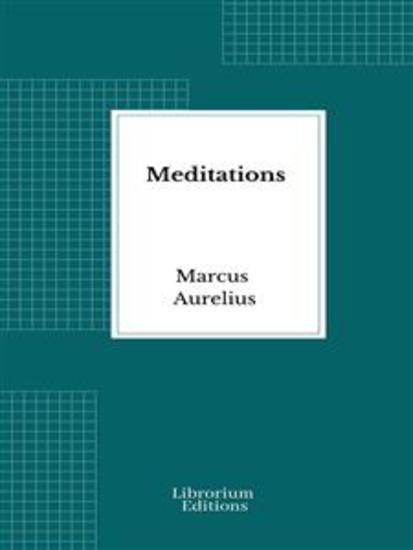
Meditations - cover

Meditations

Aurelius Marcus

Publisher: Librorium Editions

  • 0
  • 0
  • 0

Summary

MARCUS AURELIUS ANTONINUS was born on April 26, A.D. 121. His real name was M. Annius Verus, and he was sprung of a noble family which claimed descent from Numa, second King of Rome. Thus the most religious of emperors came of the blood of the most pious of early kings. His father, Annius Verus, had held high office in Rome, and his grandfather, of the same name, had been thrice Consul. Both his parents died young, but Marcus held them in loving remembrance. On his father's death Marcus was adopted by his grandfather, the consular Annius Verus, and there was deep love between these two. On the very first page of his book Marcus gratefully declares how of his grandfather he had learned to be gentle and meek, and to refrain from all anger and passion. The Emperor Hadrian divined the fine character of the lad, whom he used to call not Verus but Verissimus, more Truthful than his own name. He advanced Marcus to equestrian rank when six years of age, and at the age of eight made him a member of the ancient Salian priesthood. The boy's aunt, Annia Galeria Faustina, was married to Antoninus Pius, afterwards emperor. Hence it came about that Antoninus, having no son, adopted Marcus, changing his name to that which he is known by, and betrothed him to his daughter Faustina. His education was conducted with all care. The ablest teachers were engaged for him, and he was trained in the strict doctrine of the Stoic philosophy, which was his great delight. He was taught to dress plainly and to live simply, to avoid all softness and luxury. His body was trained to hardihood by wrestling, hunting, and outdoor games; and though his constitution was weak, he showed great personal courage to encounter the fiercest boars. At the same time he was kept from the extravagancies of his day. The great excitement in Rome was the strife of the Factions, as they were called, in the circus. The racing drivers used to adopt one of four colours—red, blue, white, or green—and their partisans showed an eagerness in supporting them which nothing could surpass. Riot and corruption went in the train of the racing chariots; and from all these things Marcus held severely aloof.
Available since: 08/20/2024.


Other books that might interest you

  • HO'OPONOPONO - A Christian perspective of forgiveness prayer and healing for the body and soul - cover

    HO'OPONOPONO - A Christian...

    Arcelio Hernández Mussio

    • 0
    • 0
    • 0
    Christians are called on to examine everything. Ho’oponopono may be integrated into spiritual life by Christians for soul-cleansing and self-healing purposes. There is no need to believe in reincarnation or to worship other Gods. Love, forgiveness, reconciliation, and gratefulness can only lead to a positive state of mind, which may benefit many aspects, from health to success in relationships and business. 
    Christianity and Ho’oponopono recognize that it is God who can cleanse the soul. Our job is to petition the cleaning, for which Ho’oponopono provides an effective method, which may be added to Christian soul-cleaning practices such as prayer, reading the Holy Scriptures, and listening to sermons inspired by biblical teachings. 
    In both traditions, soul-cleansing is a lifelong process. One must make this a way of life. Love, forgiveness, and gratitude bring about joy. We can choose to be free of the painful memories that burden our souls by making this mantra or prayer a habit. 
    This book goes deeply into both traditions to find similarities and insights.
    Show book
  • Why Do the Black Kids Sit Together? A Fresh Take on Race Conversations - Energize your understanding! Immerse in captivating audio from 'Why Do the Black Kids Sit Together?' today! - cover

    Why Do the Black Kids Sit...

    Wesley Calder

    • 0
    • 0
    • 0
    Why Do the Black Kids Sit Together? A Fresh Take on Race Conversations 
    ⭐⭐ Simplified Guide & Explanations Included⭐⭐ 
    Are you looking to progress in your understanding of race conversations and gain profound insights into racial self-segregation behaviors? 
    Seeking a comprehensive guide that provides all necessary elements to uncover deeper meanings behind why Black kids sit together? 
    Your search ends here! 
    This guide serves as your definitive companion for deepening your understanding, applying your insights, and engaging in meaningful conversations. With this, you're geared for success. 
    Updated for fresh perspectives on racial behaviors. 
    Key features of this enriched guide: 
    - Profound insights about racial self-segregation behaviors 
    - Detailed explanation of underlying racial dynamics 
    - Fruitful strategies for meaningful conversations 
    Our guide distinguishes itself through comprehensive coverage, which is essential for gaining a deeper understanding. Concepts aren't merely skimmed; they are delved into with precision. 
    Please note that this guide is not affiliated with any official entity and is purely an independent resource for your benefit. 
    Designed with a clear structure and easy-to-understand language, our guide on race conversations ensures smooth transitions between topics. Say goodbye to dense jargon and welcome clear, precise, and technically accurate content. 
    So, why wait? Click the BUY NOW button, secure your guide, and begin your journey to deeper understanding of why Black kids sit together in race conversations!
    Show book
  • The False Dilemma - Presenting Only Two Choices When More Exist - cover

    The False Dilemma - Presenting...

    William Rands

    • 0
    • 0
    • 0
    A false dilemma, also known as a false dichotomy, is a logical fallacy that occurs when only two options are presented as the only possible choices, despite the existence of other viable alternatives. This simplification of choices creates an illusion of a limited range of possibilities, forcing individuals to pick between two extremes. The false dilemma is often used to manipulate thinking, steer conversations, and influence decisions in various contexts, from political discourse to everyday life. 
    The core issue with a false dilemma is that it restricts the scope of consideration, compelling individuals to overlook other potential options. By framing a situation as a binary choice, it reduces the complexity of real-world problems, often misrepresenting the nuances that exist. This limited perspective can distort rational decision-making, as it pressures individuals to choose between what may appear to be the “lesser of two evils” or the most acceptable option, without considering all alternatives. 
    This logical fallacy thrives in situations where the options presented are extreme, and the middle ground is ignored or dismissed. The intention behind such a presentation is often to push people toward a specific outcome by making the alternative seem unthinkable, undesirable, or unattainable. Whether in political campaigns, corporate advertising, or social debates, false dilemmas are a tool of persuasion, designed to simplify complex matters and direct attention to particular choices while disregarding others.
    Show book
  • What Is Property? - An Inquiry into the Principle of Right and of Government - cover

    What Is Property? - An Inquiry...

    Pierre-Joseph Proudhon

    • 0
    • 0
    • 0
    ‘Property is Theft’, a phrase which has passed into common parlance, was the rallying call of Pierre-Joseph Proudhon’s political treatise What Is Property? Proudhon (1809-1865) was both admired and excoriated. A political theorist of the first order, he was vilified in his native France by the Communists and the Monarchists alike, though admired by Karl Marx as well as many in the nation’s academia and judiciary who valued the clarity of his thought and analytical method.  
     
    He criticised both Right and Left (the very definition of French political thinking), describing them as two sides of the same coin. Their solutions to society’s ills, he said, were like Thesis and Antithesis, based on a common error and both inadequate to the task of healing society. He offered, instead, a third way, which he called his Synthesis. Regarded as the founder of modern Anarchism, his aim was not to engender chaos, as the word anarchy often connotes, but to suggest a workable, political, and economic foundation for society which would promote order and equity for all under the most unfettered conditions of individual liberty.  
     
    Proudhon grew up in poverty, and was home schooled as a child, but received a bursary in his youth sufficient to allow him to attend the City College in his home town (though not sufficient, it seems, to buy him shoes). There, he discovered the library which introduced him to a world, classical and contemporary, previously denied him. Lacking wealth or contacts, he worked variously as a printer, a compositor and proof-reader by day and an essayist by night, learning Latin along the way to assist in his work. In 1830, a friend, a scholar, invited Proudhon to join him in Paris to pursue his philosophical writings full time. When a cholera outbreak forced his return home, Proudhon spent the next few years juggling his two careers. In 1839, he applied for a pension (bursary) at the Academy of Besançon which obliged him to write works on its behalf.  
     
    What Is Property?, published in France in 1840, was his first. It was so controversial that little else followed. However, it established his reputation, and he was eventually able to pursue his philosophical work full time. What Is Property? (First Memoir) attempts to uncover the roots of poverty and associated social ills and examines different attitudes to poverty and wealth from the Greeks to the present day. Proudhon quickly identifies a common thread, property, which he distinguishes from possession, and argues that only a fundamental, though gradual, abandonment of property (as an asset) and all that flows from it, can rescue society from its current conflicts. The memoir seeks to illuminate the underlying causes of war, poverty, slavery, and oppression and points the way to a solution. In effect, it is a practical manual for the survival of mankind. The Second Memoir (1841), included on this recording, is Proudhon’s response to the criticisms of the First Memoir, initially uncomprehending and then self-assured by turns. What Is Property? is Proudhon’s masterwork. It divides opinion, but no one who hears it can come away with their view of their own world unchanged.  
     
    Translation: Benjamin R. Tucker.
    Show book
  • How to Get Rid of a Narcissist - 7 Proven Strategies to Identify Confront and Free Yourself from Narcissistic Influence and Reclaim Your Health and Emotional Well-being - cover

    How to Get Rid of a Narcissist -...

    Whitney Barton

    • 0
    • 0
    • 0
    Narcissists Holding You Back?  
    Kick them to the Curb and Get Back on Track! 
    Tired of being surrounded by people using you for their benefit?   
    Feeling lost due to Narcissistic Abuse and longing to find yourself or be human again?  
    Want to flee from all this Narcissistic abuse and manipulation but clueless about how to start?  
    If all these hit close to home, then please keep reading.  
    Being entangled in a Narcissistic web is no easy feat. Combined with your past experiences with various types of abuse, family pressure, and low self-esteem, victims are easily trapped in a quicksand-like life that without any help, can cause them a lifetime of damage in all forms.  
    Don't let yourself or any of your loved ones be snared by this type of situation any longer. Let Whitney Barton enlighten you on what to do. With her newest addition, "How to Get Rid of a Narcissist", Barton unveils what narcissists are, how they maneuver into someone else's life, what makes them tick, and the impact of their actions on someone else's life. Together, she will show you the way how to break free from their grasp to your healing recovery.  
    Remember, no matter what happens do not not resort to blaming yourself. Let "How to Get Rid of a Narcissist" help you find your way out to happiness. Keep one handy or hand this over to a friend who needs it. Together you can paddle your way to safety, recovery, and a lifetime free from Narcissistic PTSD.  
    Fight your way out of this hellhole, together! 
    Get Your’s Today!
    Show book
  • I'm Having More Fun Than You - cover

    I'm Having More Fun Than You

    Aaron Karo

    • 0
    • 0
    • 0
    From Aaron Karo, stand-up comic and acclaimed author of Ruminations on College Life and Ruminations on Twentysomething Life, comes I’m Having More Fun Than You, an irreverent exploration of why guys embrace bachelorhood and love flying solo in their twenties and thirties. I’m Having More Fun Than You is a hilarious and perceptive must-read for all the guys who are loving flying solo in the prime of their lives—as well as for women looking for insight into men, their attitudes toward dating, and their tricks of the trade.
    Show book