Join us on a literary world trip!
Add this book to bookshelf
Grey
Write a new comment Default profile 50px
Grey
Subscribe to read the full book or read the first pages for free!
All characters reduced
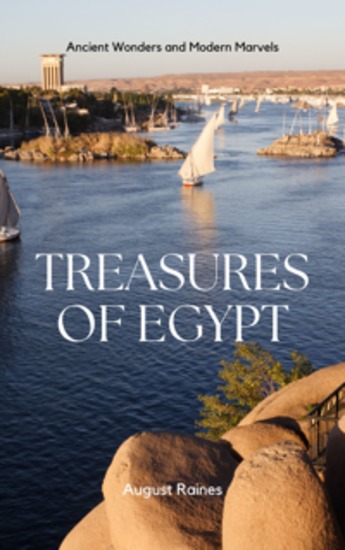
Treasures of Egypt - Ancient Wonders and Modern Marvels - cover

Treasures of Egypt - Ancient Wonders and Modern Marvels

August Raines

Publisher: QuillQuest Publishers

  • 0
  • 0
  • 0

Summary

Delve into the heart of Egypt with "Treasures of Egypt: Ancient Wonders and Modern Marvels" by August Raines. This captivating book takes readers on a journey through time, exploring the rich tapestry of Egyptian history, culture, and its enduring legacy. Each chapter provides a detailed examination of various aspects of Egyptian civilization, from the architectural prowess of the ancient pyramids to the vibrant music and dance traditions that continue to thrive today.
Discover the mysteries of ancient Egyptian architecture, marvel at the detailed artistry of hieroglyphics, and learn about the profound religious and mythological beliefs that shaped this civilization. Walk through the Valley of the Kings with Howard Carter as he uncovers the tomb of Tutankhamun and experience the blend of tradition and innovation in modern Egypt. The book also highlights Egypt's culinary delights, the significance of the Nile River, and the country's contributions to literature and intellectual thought.
With meticulous research and vivid descriptions, Raines brings Egypt's past and present to life, offering readers an in-depth understanding of its cultural heritage and the challenges it faces today. Whether you are a history enthusiast, a traveler, or someone interested in world cultures, "Treasures of Egypt" is an essential addition to your collection.
Available since: 12/11/2024.

Other books that might interest you

  • Beyond Good and Evil - Prelude to a Philosophy of the Future - cover

    Beyond Good and Evil - Prelude...

    Friedrich Nietzsche

    • 0
    • 0
    • 0
    “Without music, life would be a mistake.”“It is not a lack of love, but a lack of friendship that makes unhappy marriages.” ...“That which does not kill us makes us stronger.”“I'm not upset that you lied to me, I'm upset that from now on I can't believe you.” 
    Nietzsche 
     
    By turns illuminating, infuriating, bewildering, and amusing, Nietzsche's masterwork covers a lot of ground. He rejects most strands of Western thought, especially on the subject of morality, and develops his own theme demanding that individuals embrace their own 'will to power' to give life intention and direction. First published in German in 1887, this translation was produced in 1907 by Helen Zimmern, a long-standing acquaintance of Nietzsche. 
     
    Friedrich Wilhelm Nietzsche was a German philosopher, cultural critic and philologist whose work has exerted a profound influence on modern intellectual history. He began his career as a classical philologist before turning to philosophy.
    Show book
  • A Year of Glory and Gold - 1932 - Ireland's Jazz Age - cover

    A Year of Glory and Gold - 1932...

    Kevin C. Kearns

    • 0
    • 0
    • 0
    The 1930s in Ireland is often thought of as a bleak period of economic stagnation and unemployment. But 1932, hailed by the Irish Press as a 'new era', was an early glimmer of the modernity and success Ireland would later reach: a sequence of events and achievements that included technological advances in travel, agriculture, home appliances and entertainment; Olympic gold medals and the meteoric rise of boxing phenomenon Jack Doyle; a spectacular Eucharistic Congress; sweepstakes and a so called gold rush; as well as the election of Éamon de Valera and transformations in politics and culture.
    The soundtrack scoring all this change was the jazz craze, which landed in Ireland in the early 1930s and flourished throughout the country, loosening the conservative social and moral order of the time. Jazz brought new forms of dress, lifestyle and behaviour, exciting and exhilarating a younger generation for the future, while leaving an older generation wary of such rapid change.
    A Year of Glory and Gold is an energetic and exuberant biography of a bright year in Ireland's history, combining deep archival research with spirited storytelling by one of Ireland's best-loved social historians.
    Show book
  • Medieval Japan - Samurai and Shoguns - cover

    Medieval Japan - Samurai and...

    Harris Ropes

    • 0
    • 0
    • 0
    The rise of feudal Japan marked a significant turning point in the nation's political and social history. Beginning in the late 8th to early 9th centuries, the centralized power of the imperial court in Kyoto began to wane. As emperors became more ceremonial figures, real power shifted into the hands of powerful landowning families and military clans in the provinces. These regional lords, or daimyo, started to assert control over their own territories, gradually weakening the authority of the imperial government. 
    This period of decentralization gave birth to a new system where local warlords governed through a network of vassals and military retainers. In return for loyalty and service, these retainers were granted land or a share in the profits from agricultural production. This land-based reward system laid the foundation for the feudal structure that would define medieval Japan for centuries to come. Unlike in Europe, where feudalism was based on strict legal contracts, Japan’s version emphasized personal loyalty and honor, often backed by military strength. 
    The emergence of powerful clans such as the Minamoto and Taira further accelerated the move toward feudal governance. Their rivalry culminated in the Genpei War (1180–1185), a brutal conflict that ultimately led to the downfall of the Taira clan and the rise of the Minamoto. In 1192, Minamoto no Yoritomo was appointed Seii Taishogun, or Shogun, by the emperor, establishing the first shogunate in Kamakura. This event marked the formal beginning of military rule in Japan and the creation of a dual-government system, where the emperor remained as a symbolic figure while the shogun held actual power.
    Show book
  • Learn English with British History - From the Beginning to the Victorian Era: The natural and most engaging way to learn a new language - cover

    Learn English with British...

    Marina Koulouris

    • 0
    • 0
    • 0
    Learn the facts - Master the language 
    Immerse yourself in the rich tapestry of British history while sharpening your English language skills with Learn English with British History. In this engaging and informative book, you will journey from the Celtic tribes to the grandeur of the Victorian Era, exploring pivotal events, influential figures, and cultural milestones along the way. 
    Perfect for both beginners and intermediate learners, this insightful narrative serves as a bridge between language and history, providing a deeper understanding of the English language through real-life context. Whether you are a language enthusiast or a history buff, this book offers a compelling opportunity to connect with the past, enhance your language skills, and embark on a fascinating learning journey. 
    Disclaimer: 
    The content of this book has been created for language learning purposes only. To the maximum extent permitted by law, the publisher and the author disclaim any and all liability in the event any information, commentary, analysis, opinions, advice and/or recommendations contained in this book prove to be inaccurate, incomplete or unreliable, or result in any investment or other losses.
    Show book
  • Fancies versus Fads - cover

    Fancies versus Fads

    G K Chesterton

    • 0
    • 0
    • 0
    The last volume of Chesterton's collected essays, Gathered from the London Mercury, the New Witness, and the Illustrated London News, it is the only volume from after WWI, and is most serious, philosophical, and socially direct collection. 
    "The problem is not so much Prohibition with a large P as prohibition with a small one. I mean, I am interested not so much in liquor as in liberty. I want to know on what principle the prohibitionists are proceeding in this case, and how they think it applies to any other case. And I cannot for the life of me make out. They…do not attack liquor; they do quite simply attack liberty. I mean that they are satisfied with saying about this liberty what can obviously be said about any liberty – that it can be, and is, abominably abused. If that had been a final objection to any form of freedom, there never would have been any form of freedom." 
    "So long as we combine ceaseless and often reckless scientific speculation with rapid and often random social reform, the result must inevitably be not anarchy but ever-increasing tyranny. There must be a ceaseless and almost mechanical multiplication of things forbidden. The resolution to cure all the ills that flesh is heir to, combined with the guesswork about all possible ills that flesh and nerve and brain-cell may be heir to – these two things conducted simultaneously must inevitably spread a sort of panic of prohibition. Scientific imagination and social reform between them will quite logically and almost legitimately have made us slaves."
    Show book
  • Driving Lessons - A Road Trip through American Travel Literature - cover

    Driving Lessons - A Road Trip...

    Christopher B. Strain

    • 0
    • 0
    • 0
    In Driving Lessons, Christopher B. Strain sets out on a quintessential American road trip, exploring not just the roads and byways of the country but the road trip's place in American culture. Strain dives into the well of American travel writing, illuminating fascinating aspects of the road trip, such as how race, class, and gender shape the experiences of road trippers. 


    In the summer of 1998, amid a professional crisis of confidence, Strain settled on a plan to reconnect with both himself and the country he studies. He purchased a 1972 Volkswagen Westfalia van and set off on his own cross-country odyssey. In the weeks that followed, he ruminated on his own ongoing journey alongside great journeys from the past and how they reveal the heart of the traveler as well as the landscape of the nation. 


    Visiting archives and landmarks across the United States, Strain's journey became a parallel to the stories he studied—an opportunity to see and experience the cities, national parks, and monuments that define United States history. Driving Lessons is a compelling blend of literary analysis and memoir, offering listeners an insightful and heartfelt reflection on the enduring power of the American road trip.
    Show book