Join us on a literary world trip!
Add this book to bookshelf
Grey
Write a new comment Default profile 50px
Grey
Subscribe to read the full book or read the first pages for free!
All characters reduced
Quantum Paradox - The Mysteries of Time Unveiled - cover

Quantum Paradox - The Mysteries of Time Unveiled

Asif Ahmed Srabon

Publisher: BookRix

  • 0
  • 0
  • 0

Summary

Explore the mind-bending world of quantum physics and the enigma of time in "Quantum Paradox: The Mysteries of Time Unveiled" by Asif Ahmed Srabon. This book delves into entanglement, time travel, and paradoxes, unraveling the mysteries that have fascinated scientists and philosophers for ages. Get ready for a thought-provoking adventure that challenges your understanding of reality.
Available since: 12/20/2023.
Print length: 33 pages.

Other books that might interest you

  • Data Analyses - Detailed Scientific and Business-Oriented Data Reading Skills - cover

    Data Analyses - Detailed...

    Benjamin Farrar

    • 0
    • 0
    • 0
    An extensive guide to help you analyze data more effectively.  
    Learn more about how to analyze data now! Explore the field of data science and the way to analyze big and small data. This elaborate guide will take you on a journey to multiple aspects of this skill. There is a trick, a science, to doing it the right way, and some of the most important secrets will be revealed in the chapters ahead of you. Dive into the complicated matter of analyzing and mining for data correctly. Forget about intuition or assumptions.  
    You’ll learn, among others:Linear, probabilistic, and other models to use in the visualization and analysis of data you have found.Systems such as clustering, viewing genetic algorithms, and neural methods.Assessment analysis strategies, organization, and numeric predictions.Modeling data and imagining.The three Vs of big data and what to do with them.Software recommendations and applications.Purposes for health care, business, and industrial data.Tips on analyzing decision trees, regression, and sentiment.Attributes, classifications, data sets, and kinds of learning you must recognize to fully be aware of that with which you are dealing.Data quality and data quantity thoughts.Data-mining procedure steps, including CRISP-DM and SEMMA.Machine algorithms and interesting side notes regarding them.Instructions, infrastructure, edition, and other methods. 
    Data creates truths you can trust in if you draw the right conclusions. Drawing those conclusions involves clear skills and a background in information that leads to the correct steps. If this is up your alley, the best thing to do for you right now is to start listening.  
    Add this audiobook to cart now!
    Show book
  • The Universe - Cosmic Inflation Dark Matter Galaxies Planetary Formation and Space Telescopes (5 in 1) - cover

    The Universe - Cosmic Inflation...

    Steff Jaywan

    • 0
    • 0
    • 0
    This book consists of 5 titles, which are the following: 
    Cosmic Inflation 
    Dark Matter 
    Galaxies 
    Planetary Formation 
    Space Telescopes 
    Enjoy this discounted bundle of books!
    Show book
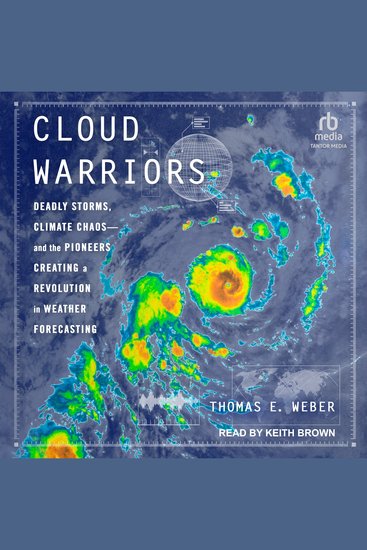
  • Cloud Warriors - Deadly Storms Climate Chaos - and the Pioneers Creating a Revolution in Weather Forecasting - cover

    Cloud Warriors - Deadly Storms...

    Thomas E. Weber

    • 0
    • 0
    • 0
    For millennia, humans have tried to understand and predict the weather. The Space Age helped usher in satellites and radar, while computers made it possible to plug all that data into complex equations that anticipated the atmosphere's future behavior. Now a new age of advances in forecasting is unfolding, driven by AI, drones, and satellites. The Internet of Things has turned everything from cellphones to cars into ubiquitous weather sensors. Equally significant are new efforts to understand how people respond to forecasts and warnings. Scientists and government officials are realizing that how people get their weather information, and how they use it, are crucial factors in the outcome of a catastrophic weather event. 


    Employing in-depth reporting on cutting edge science and technology, veteran journalist Thomas E. Weber takes us on a tour of how meteorologists, scientists, and officials track and prepare for major weather events. As climate change is altering our planet and making weather events more extreme, Weber introduces us to those on the front lines of weather preparation and prediction. We travel from coast-to-coast, to space and back, meeting TV meteorologists and storm chasers, city planners, backyard weatherman, and many others. Cloud Warriors will change the way you think about the weather—and the power of being able to see it coming.
    Show book
  • Toxicology - Poison and Its Power - The Science of Toxins - cover

    Toxicology - Poison and Its...

    Mike Crawford

    • 0
    • 0
    • 0
    Toxicology, the study of poisons and their effects on living organisms, has deep historical roots dating back thousands of years. The earliest civilizations recognized the dangers of certain substances and documented their effects, often intertwining them with myths, medicine, and warfare. The origins of toxicology can be traced to ancient Egypt, Mesopotamia, Greece, and Rome, where early scholars and physicians laid the groundwork for what would eventually become a scientific discipline. 
    Ancient Egyptian texts, such as the Ebers Papyrus (circa 1550 BCE), contain some of the earliest references to poisons, including plant-based toxins and venomous animal bites. Egyptian priests and physicians were aware of toxic substances, both as medicinal agents and as potential means of assassination. Similarly, Mesopotamian records describe the use of poisons in both healing practices and criminal activities. 
    In ancient Greece, the philosopher and physician Hippocrates (circa 460–370 BCE) discussed the effects of poisons and the importance of dosage in determining whether a substance was harmful or beneficial. His work influenced later Greek and Roman physicians, including Dioscorides, a first-century CE pharmacologist who compiled De Materia Medica, an extensive guide to medicinal and poisonous substances derived from plants, animals, and minerals. The Greek philosopher Theophrastus (circa 371–287 BCE) also contributed to early toxicology by documenting the properties of various poisonous plants.
    Show book
  • Human Anatomy - A Comprehensive Guide to the Body's Structures and Functions - cover

    Human Anatomy - A Comprehensive...

    Ava Westwood

    • 0
    • 0
    • 0
    The human body is a remarkable and intricate system, made up of trillions of cells working in harmony to maintain life. Understanding its structure and function is essential for gaining insights into how the body operates and sustains itself. At the most basic level, the body is organized into four primary levels: cells, tissues, organs, and systems. Cells are the building blocks of life, each with specialized functions that contribute to the overall well-being of the organism. Tissues are formed from similar cells working together to perform specific functions. Organs are composed of various tissues that cooperate to carry out more complex tasks, and when organs work together in coordinated groups, they form systems that carry out essential bodily functions. 
    The organization of the body is designed for efficiency and survival, ensuring that all processes, from digestion to respiration, occur seamlessly. For example, the digestive system processes food and absorbs nutrients, the respiratory system ensures oxygen exchange, and the circulatory system distributes oxygen and nutrients to the cells while removing waste products. Each system is interconnected, and any disruption to one can affect the others, highlighting the importance of balance and coordination in maintaining health. 
    A key concept in understanding the body’s functioning is homeostasis, the body’s ability to maintain a stable internal environment despite external changes. This balance is critical to the survival of cells and, by extension, the organism as a whole. The body’s systems are continuously monitoring and adjusting to changes in temperature, pH levels, fluid balance, and other internal factors to keep everything within optimal ranges. For instance, when body temperature rises, the body sweats to cool down, and when it drops, it shivers to generate heat. Similarly, the kidneys help regulate fluid balance by adjusting urine production according to hydration levels.
    Show book

  • Build the Best Mental Version of Youself - Embrace Resilience Master Your Mind and Create Your Ultimate Self - cover

    Build the Best Mental Version of...

    KR Goswami

    • 0
    • 0
    • 0
    Building the Best Mental Version of Yourself, Embrace Resilience, Master Your Mind, and Create Your Ultimate Self is written by KR Goswami
    Show book