Join us on a literary world trip!
Add this book to bookshelf
Grey
Write a new comment Default profile 50px
Grey
Subscribe to read the full book or read the first pages for free!
All characters reduced
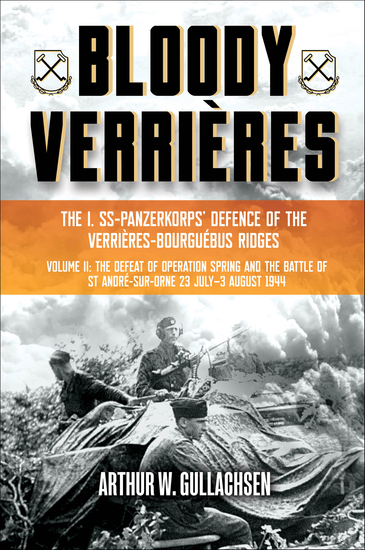
Bloody Verrières: The I SS-Panzerkorps Defence of the Verrières-Bourguebus Ridges - Volume II: The Defeat of Operation Spring and the Battles of Tilly-la-Campagne 23 July–5 August 1944 - cover

Bloody Verrières: The I SS-Panzerkorps Defence of the Verrières-Bourguebus Ridges - Volume II: The Defeat of Operation Spring and the Battles of Tilly-la-Campagne 23 July–5 August 1944

Arthur W. Gullachsen

Publisher: Casemate

  • 0
  • 0
  • 0

Summary

Detailed examination of how the I. SS Panzerkorps faced Anglo-Canadian offensives in the area of the Verrières and Bourguébus ridges during the battle for Normandy.South of the Norman city of Caen, Verrières Ridge was seen a key stepping-stone for the British Second Army if it was to break out of the Normandy bridgehead in late July 1944. Imposing in height and containing perfect terrain for armored operations, the Germans viewed it as the lynchpin to their defenses south of the city of Caen and east of the Orne river.  Following the failure of British Operation Goodwood on 18–20 July and the containment of the Canadian Operation Atlantic, further Allied attacks to seize the ridge would have to defeat arguably the strongest German armored formation in Normandy: The I. SS-Panzerkorps ‘Leibstandarte.’ In the second volume of this two-volume work, the fighting of 23 July–3 August is chronicled in detail, specifically the premier Anglo-Canadian operation to capture Verrières Ridge, Operation Spring on 25 July. Designed as an attack to seize the ridge and exploit south with armor, this battle saw the 2nd Canadian Corps attack savaged again by German armored reserves brought in specifically to defeat another Goodwood.  Not satisfied with this defensive victory, German armored forces would then seek to restore an earlier defensive line further north, attacking to destroy the 2nd Canadian Infantry Division. Largely unknown, these were some of the strongest and most successful German armored operations to take place in the Normandy campaign.
Available since: 01/05/2023.
Print length: 288 pages.

Other books that might interest you

  • The Dictionary of Body Language - The Ultimate Guide on How to Read Body Language Discover How to Decode the Tiniest Body Language and Learn What Others Are Thinking - cover

    The Dictionary of Body Language...

    P.D. Marel

    • 0
    • 0
    • 0
    The Dictionary of Body Language: The Ultimate Guide on How to Read Body Language, Discover How to Decode the Tiniest Body Language and Learn What Others Are ThinkingBody language is the nonverbal signs or signals that we use to communicate. Studies show that more than 60% of what we communicate is actually done through body language so reading body language is a very important skill you should learn. From facial expressions to body movements, these can all convey different things from what is exactly said.This audiobook will teach you about micro-expressions and how it can help you read body language. You will learn how to read and interpret body languages which can help you in social situations and in your business ventures as well. You will discover how being able to read and understand body language can greatly improve your communication skills.This audiobook will discuss the following topics in-depth:- The Types of Body Expressions- The Basics of Reading Body Language- The Implication of the Smallest Body Language- The Interpretation of Bondy Languages- The Micro Expression Matter- The Benefits of Understanding the Body Expressions- The Skills That Are Required in Understanding the - Body Languages- Understanding What Other People Are Thinking- The Effects of Body Language on CommunicationLearning how to read and understand body language is a crucial skill that you can definitely use to your advantage. It will go a long way towards helping you communicate better with others. If you want to learn more on how you can read and understand body language to help your personal and professional interactions, scroll up and click "add to cart" now.
    Show book
  • Summary of Simon Singh’s The Code Book - cover

    Summary of Simon Singh’s The...

    Falcon Press

    • 0
    • 0
    • 0
    Buy now to get the main key ideas from Simon Singh’s The Code Book 
      
    As the value of information increases by the second and new methods of communication alter societies, the process of securing messages and data, which is called encryption, will be playing an increasingly significant part in our daily life. 
    In The Code Book (1999), Simon Singh traces the history of secret codes and their crucial role in deciding the outcomes of wars and dynasties. He explores the evolution of encryption from simple substitution of letters to a complex cipher system, and shows how the subject of coding is more relevant in the Digital Age than ever before.
    Show book
  • The Rise and Fall of the Egyptian Empire - A Historical Overview - cover

    The Rise and Fall of the...

    Omar Khalil

    • 0
    • 0
    • 0
    The origins of Ancient Egypt trace back to a time when the Nile River served as the lifeline for scattered communities that gradually developed into one of the world’s first great civilizations. The unification of Upper and Lower Egypt around 3100 BCE marked a turning point, traditionally credited to King Narmer (also known as Menes). This consolidation of power not only brought political unity but also forged a shared identity among the people along the Nile, creating the foundation for the dynastic rule that would follow for centuries. 
    Geography played a central role in shaping early Egyptian civilization. The Nile River, flowing from south to north, provided a reliable source of water and fertile soil through its annual inundation. These floods deposited nutrient-rich silt on the riverbanks, enabling agriculture to flourish in an otherwise arid environment. Settlements grew along the river, connected by the waterway, which also served as a route for trade and communication. Natural barriers such as deserts and the Mediterranean Sea offered protection from external invasions, allowing Egyptian culture to evolve with limited outside interference in its formative years. 
    The Early Dynastic Period (c. 3100–2686 BCE) saw the establishment of the first centralized state under pharaonic rule. Kings were not merely political leaders but were also regarded as divine beings, intermediaries between the gods and the people. This belief in divine kingship helped maintain stability and order in a society where religion permeated all aspects of life. Temples, tombs, and other ceremonial structures began to emerge during this era, laying the groundwork for the grand architectural achievements of later periods.
    Show book
  • Outsider by Albert Camus The (Book Analysis) - Detailed Summary Analysis and Reading Guide - cover

    Outsider by Albert Camus The...

    Bright Summaries

    • 0
    • 0
    • 0
    Unlock the more straightforward side of The Outsider with this concise and insightful summary and analysis!This engaging summary presents an analysis of The Outsider by Albert Camus, which follows the antihero Meursault as he lives his life in complete disregard of social conventions and is led to kill by events that seem to be beyond his control. His refusal to lie or pretend to be something he is not in order to make others comfortable draws the ire of his fellow citizens, and his condemnation is due as much to his apparent remorselessness and lack of feeling as to his crime itself. The Outsider forms part of Camus's so-called "Cycle of the Absurd" and is widely considered to be one of the most important books of the 20th century. Camus was awarded the Nobel Prize in Literature in 1957, and influenced writers and philosophers around the world with his reflections on the meaning of existence and the search for happiness in an ultimately indifferent world.Find out everything you need to know about The Outsider in a fraction of the time!This in-depth and informative reading guide brings you:• A complete plot summary• Character studies• Key themes and symbols• Questions for further reflectionWhy choose BrightSummaries.com?Available in print and digital format, our publications are designed to accompany you on your reading journey. The clear and concise style makes for easy understanding, providing the perfect opportunity to improve your literary knowledge in no time.See the very best of literature in a whole new light with BrightSummaries.com!
    Show book
  • Oliver Cromwell - The English Military Political Leader - cover

    Oliver Cromwell - The English...

    Kelly Mass

    • 0
    • 0
    • 0
    Oliver Cromwell was an English army and statesman who led Parliamentary armies against King Charles I throughout the English Civil War. From 1653 till his death in the year 1658, he lead the British army in the British Islands area. 
    Why was he so hated by so many? And is this image of him historically correct? 
    Even though we cannot go back in time 450 years ago, we can certainly try to find the answers in the sources we have. 
    The reason why people thought he was so evil, is because of his brutality against the Irish at that time. Several Irish and English scholars agree that Cromwell was too cruel in Ireland. Other academics blame him of 'ethnic cleansing,' or the systematic expulsion of a certain ethnic population from a territory. It typically entails the execution and deportation of Catholics, and that he is despised by Irish Catholics. 
    Is this true? And why did he do this? 
    Find out more about his time, his life, his circumstances and his legacy.
    Show book
  • The Elements of Teaching - Second Edition - cover

    The Elements of Teaching -...

    Harold C. Cannon, Jr. James M....

    • 0
    • 0
    • 0
    A newly revised edition of this classic work, exploring the diverse qualities essential for teaching in today's educational environment.According to Banner and Cannon, to be an effective teacher requires much more than technical skill. Great teaching is an art that combines a wide range of intellectual, moral, and emotional components. This classic work explores the qualities of mind and spirit that are essential for those seeking to help others acquire knowledge and understanding. It analyzes the specific qualities of successful teachers: learning, authority, ethics, order, imagination, tenacity, compassion, patience, character, and pleasure. Written in a clear and engaging style and applicable to all levels of teaching—be it in schools and universities or on athletic fields and in the home—the book encourages teachers to consider how they might enlarge their understanding of the great art of teaching.
    Show book