Join us on a literary world trip!
Add this book to bookshelf
Grey
Write a new comment Default profile 50px
Grey
Subscribe to read the full book or read the first pages for free!
All characters reduced
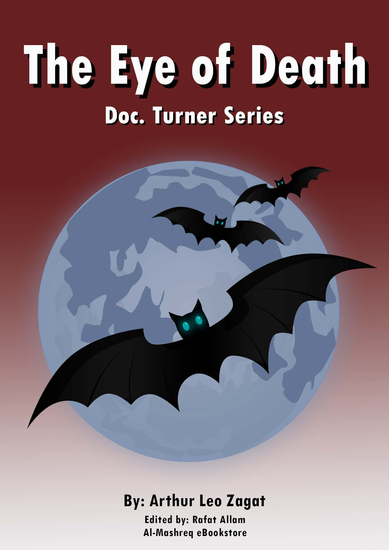
The Eye of Death - Doc Turner Series - cover

The Eye of Death - Doc Turner Series

Arthur Leo Zagat

Publisher: Al-Mashreq eBookstore

  • 0
  • 0
  • 0

Summary

The Eye of Death by Arthur Leo Zagat is a spine-tingling journey into the heart of darkness and mystery. When a renowned archaeologist discovers an ancient artifact known as the Eye of Death, an ominous and supernatural force is unleashed. As strange and deadly occurrences plague those involved, a relentless investigator must unravel the artifact's chilling secrets before more lives are claimed. With each clue revealing a deeper layer of the artifact's malevolent power, the stakes escalate into a battle against time and terror. Can the investigator stop the ancient curse, or will the Eye of Death prove too powerful to defeat? Dive into this riveting tale where every twist and turn could be your last.
Available since: 08/25/2024.
Print length: 250 pages.
Other books that might interest you

  • The Facts in the Case of M Valdemar - cover

    The Facts in the Case of M Valdemar

    SAMPI Books, Edgar Allan Poe

    • 0
    • 0
    • 0
    "The Facts in the Case of M. Valdemar", by Edgar Allan Poe, recounts the experimentation of hypnosis on Valdemar, on the verge of death, resulting in a prolonged suspension between life and death. After months, his accelerated decomposition occurs when he is awakened, culminating in a horrifying outcome.
    Show book
  • Archetypes of Horror: The Night The Tropes Survived - cover

    Archetypes of Horror: The Night...

    Jr. Eli Taff

    • 0
    • 0
    • 0
    On a chilling night in 1994, a small town was consumed by chaos as horror movie clichés became terrifyingly real. Slashers stalked dark alleys, ancient demons awakened, and alien hunters prowled the shadows. The victims we've come to expect—like the Slutty Girl, the Stoner, the Jock, and the Nerd—were targeted, cornered, and left for dead.  
    But what if, just once, the story didn't end the way we thought it would? 
    **Archetypes of Horror: The Night The Tropes Survived** twists the familiar rules of the genre, offering ten flash fiction stories where classic horror movie victims fight back, survive, and find unexpected futures. From the cheerleader who outsmarts an alien killer to the goth kid who narrowly escapes a cursed fate, these stories breathe new life into old tropes, delivering sharp, suspenseful narratives that challenge our expectations. Each tale is packed with gripping suspense, moments of dark humor, and an underlying sense of dread that will keep readers on the edge of their seats. 
    For readers who loved **Creepshow**, **Goosebumps**, and **Scary Stories to Tell in the Dark**, **Archetypes of Horror** will be a thrilling and nostalgic ride, tapping into the universal fear of what happens when the familiar becomes deadly. Are you ready to discover what happens when the victims fight back… and when they wake up?
    Show book
  • Pickman's model - cover

    Pickman's model

    H.P. Lovecraft

    • 0
    • 0
    • 0
    "Pickman's Model" is a short story by H. P. Lovecraft, written in September 1926 and first published in the October 1927 issue of Weird Tales. It was adapted for television in a 1971 episode of the Night Gallery anthology series, starring Bradford Dillman. The story revolves around a Bostonian painter named Richard Upton Pickman who creates horrifying images. His works are brilliantly executed, but so graphic that they result in the revocation of his membership in the Boston Art Club and he is shunned by his fellow artists. The narrator is a friend of Pickman, who, after the artist's mysterious disappearance, relates to another acquaintance how he was taken on a tour of Pickman's personal gallery, hidden away in a run-down backwater slum of the city. As the two delved deeper into Pickman's mind and art, the rooms seemed to grow ever more evil and the paintings ever more horrific, ending with a final enormous painting of an unearthly, red-eyed and vaguely canine humanoid balefully chewing on a human victim. A noise sent Pickman running outside the room with a gun while the narrator reached out to unfold what looked like a small piece of rolled paper attached to the monstrous painting. The narrator heard some shots and Pickman walked back in with the smoking gun, telling a story of shooting some rats, and the two men departed. Afterwards the narrator realized that he had nervously grabbed and put the rolled paper in his pocket when the shots were fired. He unrolled the paper to reveal that it is a photograph not of the background of the painting, but of the subject. Pickman drew his inspirations not from a diseased imagination, but from monsters that were very much real.
    Show book
  • Facts Concerning the Late Arthur Jermyn and His Family (The Work of H P Lovecraft Episode 15) - cover

    Facts Concerning the Late Arthur...

    H. P. Lovecraft

    • 0
    • 0
    • 0
    Facts concerning the Late Arthur Jermyn and His Family is a horror short story written by H.P. Lovecraft. As Lovecraft’s both parents died in a mental hospital, it is believed that Lovecraft handled some of his own family issues in this very story.
    Show book
  • The Atrocity Engine - cover

    The Atrocity Engine

    Tim Waggoner

    • 0
    • 0
    • 0
    Men in Black meets Hellraiser in this rollicking mash-up of urban fantasy and cosmic horror from four-time Bram Stoker Award-Winning author Tim Waggoner.
     
    Creatures from dark dimensions infesting your home? Demonic beings trying to drive you insane? Alien gods attempting to destroy your universe?
     
    Just call Maintenance.
     
    This underpaid and overworked secret organization is dedicated to battling forces that seek to speed up Entropy and hasten the Omniverse's inevitable death.
     
    Neal Hudson is a twenty-year veteran of Maintenance. A surveyor who drives through the streets of Ash Creek, Ohio constantly scanning for the deadly energy known as Corruption. Since the death of his previous partner, Neal prefers to work alone, and he's not happy when he's assigned to mentor a rookie.
     
    But they better learn to get along fast.
     
    The Multitude, a group of godlike beings who seek to increase Entropy at every opportunity, are creating an Atrocity Engine. This foul magical device can destroy the Earth, and they don't care how many innocent lives it takes to build it. (Spoiler alert: It's a lot!)
     
    Just another day on the job...
    Show book
  • The Fall of the House of Usher - cover

    The Fall of the House of Usher

    Edgar Allan Poe

    • 0
    • 0
    • 0
    An unnamed narrator approaches the house of Usher on a “dull, dark, and soundless day.” This house—the estate of his boyhood friend, Roderick Usher—is gloomy and mysterious. The narrator observes that the house seems to have absorbed an evil and diseased atmosphere from the decaying trees and murky ponds around it. He notes that although the house is decaying in places—individual stones are disintegrating, for example—the structure itself is fairly solid. There is only a small crack from the roof to the ground in the front of the building. He has come to the house because his friend Roderick sent him a letter earnestly requesting his company. Roderick wrote that he was feeling physically and emotionally ill, so the narrator is rushing to his assistance. The narrator mentions that the Usher family, though an ancient clan, has never flourished. Only one member of the Usher family has survived from generation to generation, thereby forming a direct line of descent without any outside branches. The Usher family has become so identified with its estate that the peasantry confuses the inhabitants with their home. 
    The narrator decides to read to Roderick in order to pass the night away. He reads “Mad Trist” by Sir Launcelot Canning, a medieval romance. As he reads, he hears noises that correspond to the descriptions in the story. At first, he ignores these sounds as the vagaries of his imagination. Soon, however, they become more distinct and he can no longer ignore them. He also notices that Roderick has slumped over in his chair and is muttering to himself. The narrator approaches Roderick and listens to what he is saying. Roderick reveals that he has been hearing these sounds for days, and believes that they have buried Madeline alive and that she is trying to escape.
    Show book