

Join us on a literary world trip!
Add this book to bookshelf
Grey
Write a new comment Default profile 50px
Grey
Subscribe to read the full book or read the first pages for free!
All characters reduced
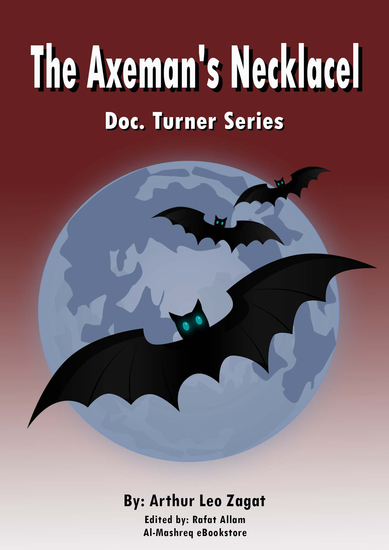
The Axeman's Necklace - Doc Turner Series - cover

The Axeman's Necklace - Doc Turner Series

Arthur Leo Zagat

Publisher: Al-Mashreq eBookstore

  • 0
  • 0
  • 0

Summary

The Axeman's Necklace by Arthur Leo Zagat is a spine-chilling mystery that delves into the dark history of a cursed relic. When a gruesome necklace, once belonging to a notorious executioner, resurfaces, it brings death and terror to anyone who dares to wear it. As bodies begin to pile up, a relentless investigator races against time to uncover the truth behind the necklace's deadly power. Each clue unravels a twisted tale of vengeance and dark magic, leading to a final confrontation with the forces of evil. Can the curse be broken, or will the Axeman claim yet another victim? Enter a world of suspense where the past and present collide in a deadly game of fate.
Available since: 08/25/2024.
Print length: 250 pages.
Other books that might interest you

  • Shadow out of Time The (The Work of H P Lovecraft Episode 62) - cover

    Shadow out of Time The (The Work...

    H. P. Lovecraft

    • 0
    • 0
    • 0
    The Shadow Out of Time is a novella by American horror fiction writer H. P. Lovecraft. Written between November 1934 and February 1935, it was first published in the June 1936 issue of Astounding Stories. The story describes time and space travel by mind transfer. The premise is that a person in a given place and time can switch bodies with someone who is elsewhere or elsewhen. Other writers have re-used this concept in later works, such as drinking tea from Red Forest leaves in the television series 12 Monkeys and long-range communication stones in the Stargate SG-1 television series. As with other Lovecraftian works, this story features otherworldy alien beings that are not simply variations on humans or other familiar terrestrial animals.
    Show book
  • Oracle (Unabridged) - cover

    Oracle (Unabridged)

    Rosalie Parker

    • 0
    • 0
    • 0
    Rosalie Parker runs the independent UK publishing house Tartarus Press with R. B. Russell. Her previous collections include The Old Knowledge (Swan River Press 2010) and Damage (PS Publishing 2016). "In the Garden" was selected for Best New Horror 21 (2010), and "Random Flight" for Best British Horror 2015. Rosalie lives in Coverdale, North Yorkshire, the magnificent landscape of which inspires and sometimes provides the settings for her writing.
    ORACLE: I was pretty angry when I first came to Coverdale, but I suppose that's not altogether surprising. Most of the world was angry in 1940.
    Show book
  • Franz Kafka: The Metamorphosis - How does it feel to become an insect? - cover

    Franz Kafka: The Metamorphosis -...

    Franz Kafka

    • 0
    • 0
    • 0
    This story, about a man who wakes up transformed into a bug and the repercussions it has on his life and the people around him, has intrigued me for many years. What does it mean? [Spoiler possibly]In my mind it is not complicated at all and is most probably an autobiography of how Kafka himself had experienced his early life living with his parents. Kafka describes how he had experienced his parents’ financial and emotional exploitations of him, to the point of detaching from them and thereby ceasing to be their son (the real metamorphosis). Gregor’s metamorphosis is that of Kafka’s being an obedient son, subserviently paying for his parents’ narcissistic needs with his own life, into being a disobedient one—as if he had become a ‘piece of vermin’. Gregor’s parents possessed a large sum of money in savings, which symbolizes the needlessness of Gregor’s exploitation. In other words, the parents did not love him for who he was, but for his loyal willingness to undergo this exploitation. Reduced to vermin, Gregor can (or will) no longer financially benefit his parents. It is the parents that caused Gregor’s/Kafka’s metamorphosis. The debt Gregor intended to repay his parents symbolizes the emotional debt many adult children continue to feel towards their elderly parents for the love and care they have provided. Sister Grete, at first siding with her brother against their unfriendliest father, eventually switches sides after her brother’s metamorphosis, conveniently seizing first place in the sibling hierarchy, a reference to Kafka’s relationship with one of his siblings. The reason why the book continues to enjoy popularity among large audiences of readers, in my opinionm is because they recognize themselves in Gregor Samsa, which makes it all the more astounding how many ‘expert’ interpretations attempt to distract students of Kafka away from the most likely one. 
    Show book
  • The Mobius Door - cover

    The Mobius Door

    Andrew Najberg

    • 0
    • 0
    • 0
    Tucked away in the foothills, surrounded by pine forests, loaded with kids who still play outside, Millwood is the small town everyone knows. The local deputies grapple with petty vandalism and local drunks. The local teachers know the name of every kid in town. For Heather Bradley, it's a place that keeps her family safe and their lives in order; her biggest worries are the daily grind of her job and the kids coming home late. She doesn't know that unfathomable forces are set to converge on her town and thrust their neat lives into darkness, but when her oldest son Stuart opens a one-sided door in the woods and a black cloud pours out, the Bradleys and their whole town find themselves locked in a desperate struggle for survival. As the chaos grows and the nature of the real threat emerges, the only question becomes whether or not come morning the town will exist at all. 


    Contains mature themes.
    Show book
  • November Shadows: A Spooky Thanksgiving Anthology - Dark Tales for the Long Autumn Nights - cover

    November Shadows: A Spooky...

    Hoang Nguyen

    • 0
    • 0
    • 0
    As the autumn nights grow long, something stirs in the fields. This chilling anthology offers a deliciously dark counterpoint to the season’s warmth. Unearth a sinister secret buried with the harvest, meet a scarecrow with a vengeful purpose, and attend a family dinner where the guest of honor should never have been invited. Prepare for a Thanksgiving you’ll never forget, for all the wrong reasons. These spine-tingling stories blend traditional holiday themes with supernatural horror, psychological suspense, and folkloric terror, perfect for listeners who like their pumpkin spice with a side of dread.
    Show book
  • Quest of Iranon The (The Work of H P Lovecraft Episode 23) - cover

    Quest of Iranon The (The Work of...

    H. P. Lovecraft

    • 0
    • 0
    • 0
    The story is about a golden-haired youth who wanders into the city of Teloth, telling tales of the great city of Aira, where he was a prince. While Iranon enjoys singing and telling his tales of wonder, few people appreciate it. A city solon even orders Iranon to cease his singing & music, and become apprenticed to a cobbler - or leave the city by sunset. When a disenfranchised boy named Romnod suggests leaving Teloth to go to the famed city of Oonai (which he thinks may be Aira, now under a different name), Iranon takes him up on his offer. Iranon and Romnod spend years on their journey to Oonai. Along the way, Romnod grows up while Iranon remains exactly the same. Eventually they reach Oonai, which Iranon is disappointed (although not surprised) to discover isn't Aira. Iranon is loved by the people in Oonai, however, so he stays there even though he still desires to return to Aira. As the years pass, people appreciate him less and less, and he is eventually upstaged by dancers from the desert. By this point, Romnod has grown old and has become a drunkard. After Romnod's death, Iranon decides to leave Oonai and continue his search for Aira. Eventually Iranon comes across an old shepherd and asks him if he knows of Aira. The shepherd tells him that he has indeed heard of it, for in his youth there was a beggar's boy who had always talked about it. The boy, who presumed himself to be a prince, was laughed at by everyone and ran away. With the truth revealed, that Aira was merely a figment of his imagination, Iranon loses his eternal youth. Now aged significantly, Iranon wanders into the quicksands to his death.
    Show book
