Join us on a literary world trip!
Add this book to bookshelf
Grey
Write a new comment Default profile 50px
Grey
Subscribe to read the full book or read the first pages for free!
All characters reduced
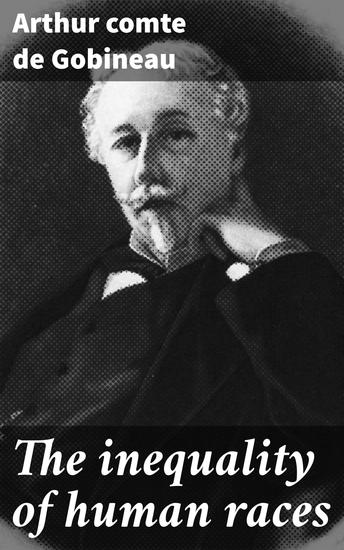
The inequality of human races - Exploring Racial Hierarchies and Cultural Criticism in the 19th Century - cover

The inequality of human races - Exploring Racial Hierarchies and Cultural Criticism in the 19th Century

Arthur Gobineau

Translator Adrian Collins

Publisher: Good Press

  • 0
  • 0
  • 0

Summary

In "The Inequality of Human Races," Arthur comte de Gobineau presents a controversial examination of racial hierarchies that posits a deterministic view on human societies. Composed in the mid-19th century, the text weaves together a combination of historical analysis, ethnography, and philosophical discourse, reflecting the emerging ideas of racial theories prevalent during that period. Gobineau's literary style is characterized by an eloquent, yet polemic tone, arguing that the supposed innate inequalities among races are foundational to the evolution of civilizations, thereby laying the groundwork for later racialist ideologies. Arthur comte de Gobineau, a French aristocrat, diplomat, and writer, was profoundly influenced by the socio-political turmoil of his time, including the upheavals of the French Revolution and rising nationalism. His extensive travels and keen observations on varying cultures enriched his perspective, leading him to articulate a vision of racial superiority that would resonate controversially for decades to come. Gobineau'Äôs erudition and social critique expose the underlying tensions of his era, exposing the dangers of pseudoscientific racial constructs. This book is essential for readers interested in the histories of race, sociology, and anthropology, as it not only provides insight into the ideological foundations of racial thought but also serves as a cautionary tale against reductionist views of human diversity. Scholars and students alike will benefit from engaging with Gobineau's work to understand the complexities and ramifications of racial theories that have shaped modern discourse.
Available since: 07/10/2023.
Print length: 214 pages.


Other books that might interest you

  • Evolution of Mesoamerica The: The History of Mesoamerican Culture from the Olmec to the Maya - cover

    Evolution of Mesoamerica The:...

    Editors Charles River

    • 0
    • 0
    • 0
    The Olmec people are widely recognized as the first major civilization of Mexico and are thus generally regarded as the mother civilization of Mesoamerica, making them the people from which all subsequent Mesoamerican cultures derived. In fact, the term Olmec is thought to have originated with the Aztec people, as Olmec in their Nahuatl language means “the rubber people”, a reference to the inhabitants of the land from which they accessed rubber. By and large, the Olmec culture is perhaps best identifiable by their so-called colossal heads, mammoth basalt head-statues wearing helmet-like headdresses found throughout Olmec habitation sites. 
    	The Toltec are one of the most famous Mesoamerican groups in South America, but they are also the most controversial and mysterious. The Toltec have been identified as the group that established a strong state centered in Tula (in present-day Mexico), and the Aztec claimed the Toltec as their cultural predecessors, so much so that the word Toltec comes from the Aztec’s word Tōltēcatl, translated as artisan. The Aztec also kept track of the Toltec’s history, including keeping a list of important rulers and events, that suggest the peak of the Toltec occurred from about 900-1100 CE.  
    	In 2012 especially, there was a renewed focus on the Mayans, whose advanced calendar has led many to speculate the world will end on the same date the Mayan calendar ends. The focus on the “doomsday” scenario, however, has overshadowed the Mayans’ true contribution to astronomy, language, sports, and art.  
    	From the moment Spanish conquistador Hernan Cortes first found and confronted them, the Aztecs have fascinated the world, and they continue to hold a unique place both culturally and in pop culture. Nearly 500 years after the Spanish conquered their mighty empire, the Aztecs are often remembered today for their major capital, Tenochtitlan, as well as their human sacrifice rituals. 
    Show book
  • Summary: Cynical Theories - How Activist Scholarship Made Everything about Race Gender and Identity―and Why This Harms Everybody by Helen Pluckrose & James Lindsay: Key Takeaways Summary & Analysis - cover

    Summary: Cynical Theories - How...

    Brooks Bryant

    • 0
    • 0
    • 0
    Disclaimer: This is NOT the official book. This is a Summary Book & it does NOT accompany the official book. 
    In our compelling summary, we distill the critical insights from Pluckrose and Lindsay's rigorous investigation into this often-radical activist scholarship. Highlighting the inconsistencies and illiberal ethics of these theories, we underscore the need for a thorough understanding of their origins and evolution to effectively challenge their influence in academia, culture, and beyond. 
    Our summary of "Cynical Theories" presents a complex network of ideologies in an accessible and digestible manner. This book is not just an exploration of the evolution of contemporary thought but a call to action for those who value science, reason, and consistently liberal ethics to question and challenge the spread of this potentially harmful orthodoxy. Step into our summary and arm yourself with the knowledge needed to navigate and confront the ideological challenges of the modern world.
    Show book
  • Ancient Egypt: Discover Fascinating History Mythology Gods Goddesses Pharaohs Pyramids and More from the Mysterious Ancient Egyptian Civilization - cover

    Ancient Egypt: Discover...

    History Brought Alive

    • 0
    • 0
    • 0
    Explore ancient Egypt, spanning over three millennia - from its roots in the deserts to the fall of an empire whose monuments still inspire us today. 
    If you want more than a watered-down Wikipedia rehash, but you haven’t the time or energy to dig through a mountain of books, and instead, if you’re searching for a great book to discover ancient Egypt, then keep on reading.... 
    Within these lines are vibrant, exciting, and memorable characters - plus places, myths, and events that put flesh on what might otherwise be the dry bones of ancient Egyptian history. Allow us then, to guide you through the mysterious and magnificent history of ancient Egypt with its gods, goddesses, kings, queens, pyramids, mythology, rituals, hieroglyphs, history, and much more. 
    We promise that once you’ve finished this audiobook, you’ll not only take away a wealth of information, but you’ll own the experience as if you’ve lived it yourself! That's because we have a passion for presenting factual, enjoyable history and culture in a style that keeps you resisting the pauses. Our books aim to not only provide you with the knowledge but to create an experience...we want you to feel the mythology and history “brought alive”. 
    Inside this audiobook, you will discover: 
    • Mythology, gods, and goddesses, including Ra, god of the sun; Seth, god of chaos; Osiris, god of death; and many more 
    • Culture, hieroglyphics, and how ancient Egypt contributed to society 
    • Uncovering the secrets of the pyramids - facts, uses, and construction 
    • The greatest pharaohs, characters, kings, and queens of ancient Egypt 
    • Civilizations, empires, legends, battles, and history - from the rise to the fall 
    • And much, much more 
    It's time to pull back the curtain and discover what it was really like back then. Get closer to that fantastic, colorful, and mysterious time of ancient Egypt with this audiobook.
    Show book
  • Yoga for Creative Minds - Unlocking Your Creative Potential with Mindful Movement - cover

    Yoga for Creative Minds -...

    Clarice Bendleton

    • 0
    • 0
    • 0
    Yoga and creativity are inherently intertwined, both relying on the flow of energy within the body and mind. Creativity, in its purest form, is the ability to generate new ideas, to solve problems in innovative ways, and to express oneself authentically. Yet, many people struggle with accessing this creative potential, often encountering mental blocks or feelings of uncertainty. Yoga offers a path to unlock this potential, creating the ideal environment for the mind and body to collaborate in creative expression. 
    At its core, yoga is about cultivating mindfulness and presence. When we practice yoga, we learn to become deeply aware of our breath, our body, and our mind. This heightened awareness allows us to clear the clutter from our thoughts, creating space for creativity to flourish. Yoga encourages us to be present in the moment, removing distractions that may otherwise stifle creative thinking. As we move through the poses, we tap into a state of flow, where the body and mind work in perfect harmony. This state of flow is closely linked to the creative process, as it fosters a sense of ease, focus, and openness to new ideas. 
    The connection between yoga and creativity is also rooted in the principle of balance. In yoga, we seek to find equilibrium within ourselves, whether through balancing poses or through the integration of breath and movement. Similarly, creativity thrives when we find balance between structure and freedom, discipline and spontaneity. Just as a yoga practice requires both strength and flexibility, creative work demands both the ability to stay grounded and the freedom to explore new possibilities. The balance cultivated on the mat can be translated into the creative process, allowing individuals to stay focused while remaining open to new insights and ideas.
    Show book
  • Sophocles - A Very Short Introduction - cover

    Sophocles - A Very Short...

    Edith Hall

    • 0
    • 0
    • 0
    This Very Short Introduction introduces the life, work, and influence of one of the greatest dramatists of all time, Sophocles the Athenian. 


    Placing his plays within their historical context, and explaining the conventions of ancient Greek tragic theatre, Edith Hall spotlights their distinctive features—tight plots, titanic personalities, lucid style, sympathetic women, exquisite poetry, and stagecraft. This analysis is followed by an account of how and why Sophoclean dramas have survived to be read and widely performed into the twenty-first century.
    Show book
  • Think Plan Live - Define and Design Your Best Life in 6 Simple Steps - cover

    Think Plan Live - Define and...

    Gill McLaren

    • 0
    • 0
    • 0
    Are you feeling as though your life and career are not in tune with who you are? 
    Do you like the idea of designing your best life but don't know where to start? 
    Do you want a successful career and a thriving personal and family life? 
    If you answered yes to these questions, Think. Plan. Live. is just what you need. Complete with tried and tested strategic frameworks, tools and practical advice, Gill McLaren's 6-Step approach to defining your Who, What, With, Why, Where and When will give you all the stimulus, encouragement and tools you need to rediscover your strengths, values and passions, and to help you steer your life back on track. Think. Plan. Live. will help you: 
        1. assess your current work and personal circumstances 
        2. discover the secrets behind what motivates you 
        3. work out what values truly matter to you 
        4. discover what your strengths are and what you really enjoy in life 
        5. figure out who gives you energy in life, and who takes it away 
        6. bring all of this together to create your unique Best Life Plan. 
    The Think. Plan. Live. audiobook is accompanied by a specially designed downloadable companion PDF workbook.  
    Together they form a personalised Life Design course that will stimulate your thinking so you can confidently design a life as unique to you as your fingerprint.
    Show book