Begleiten Sie uns auf eine literarische Weltreise!
Buch zum Bücherregal hinzufügen
Grey
Einen neuen Kommentar schreiben Default profile 50px
Grey
Jetzt das ganze Buch im Abo oder die ersten Seiten gratis lesen!
All characters reduced
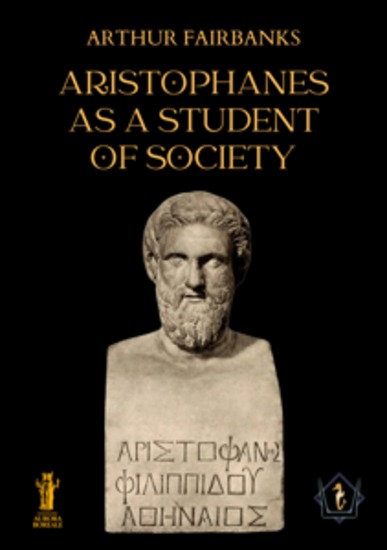
Aristophanes as a Student of Society - cover

Aristophanes as a Student of Society

Arthur Fairbanks

Verlag: Edizioni Aurora Boreale

  • 0
  • 0
  • 0

Beschreibung

Arthur Fairbanks (1864-1944) was an American art historian, archaeologist and a great scholar of classical literature and mythology. From 1908 to 1925, he was director of the Museum of Fine Arts in Boston.
Fairbanks was born November 13, 1864, in Hanover, New Hampshire. He graduated from Dartmouth College in 1886 and attended the Yale Divinity School and the Union Theological Seminary. He also studied in Germany, receiving a Ph.D. from the University of Freiburg in 1890. He was on the faculty of Dartmouth College and Yale and Cornell Universities until 1900, when he became professor of Greek literature and Archaeology at the University of Iowa. In 1906, he was appointed professor of Greek and Greek Archaeology in the University of Michigan. He was appointed curator of Classical Art at the Boston Museum of Fine Arts in 1907, and in 1908 became director there. He supervised the museum's move to its current Fenway location. He retired in 1925. He was a member of many classical and learned societies. He died January 13, 1944, in Cambridge, Massachusetts.
Fairbanks was the author of important essays, including Introduction to Sociology (1896), The Mythology of Greece and Rome (1907), Handbook of Greek Religion (1910), and Greek Gods and Heroes (1915).
The Fairbanks’ essay Aristophanes as a Student of Society, which today we propose to modern readers, was published in 1903 in The American Journal of Sociology. It is, undoubtedly, one of the best studies that have been written on the figure of Aristophanes, his personality and his works.
Verfügbar seit: 24.01.2025.

Weitere Bücher, die Sie mögen werden

  • Brainwashing - Forcibly Changing Someone's Beliefs or Attitudes - cover

    Brainwashing - Forcibly Changing...

    Cito Harder

    • 0
    • 0
    • 0
    Brainwashing is a process that manipulates an individual’s thoughts, beliefs, and perceptions, often without their conscious awareness. It is rooted in psychological principles that exploit the way the human mind processes information, reacts to stress, and seeks social belonging. By systematically breaking down existing thought patterns and replacing them with new ones, brainwashing can reshape an individual’s identity, morality, and loyalty. Understanding the psychology behind this phenomenon reveals why it is so effective and why some people are more susceptible than others. 
    At its core, brainwashing relies on cognitive dissonance, a psychological state that occurs when a person holds conflicting beliefs or values. When subjected to persistent pressure, individuals experience discomfort and seek to resolve the inconsistency. This vulnerability makes them more likely to accept new ideas, especially if rejecting them would lead to further psychological distress. Manipulators use this to their advantage, gradually shifting a person’s perception by presenting them with controlled information while isolating them from opposing viewpoints. Over time, the person internalizes the new ideology, often without realizing they have been influenced. 
    Another key psychological mechanism in brainwashing is the use of repetition. The more frequently an idea is presented, the more familiar and acceptable it becomes. Studies in cognitive psychology suggest that repeated exposure to a particular message strengthens neural pathways, making certain thoughts or beliefs more automatic. This is why propaganda, advertising, and even extremist ideologies rely heavily on repetition—constant reinforcement solidifies the desired mindset. The brain, overwhelmed by a lack of alternative perspectives, begins to default to the new beliefs as truth.
    Zum Buch
  • BULLSH!T - 50 Fibs That Made South Africa - cover

    BULLSH!T - 50 Fibs That Made...

    Jonathan Ancer

    • 0
    • 0
    • 0
    An outrageous miscellany of serious and light-hearted lies, myths, untruths, fibs and fabrications that tells the tall tale of South Africa.
    The fibs come thick and fast, like a burst sewerage pipe:
    • Why everything we've learnt about Shaka Zulu, 'Africa's Napoleon', is a pack of lies.
    • Back in the darkest of ages (the 1970s!), citizens were told that there were satanic messages if you played some of The Beatles songs backwards.
    • National icon Hansie Cronje was a paragon of virtue, and integrity … until he wasn't.
    • President Nelson Mandela told us that we, as a nation, were 'special'. Turns out we aren't.
    Whether a fabulous fib, an artful con, a doctor's spin, or simply a bald-faced lie, there's something for everyone.
    Zum Buch
  • Life's Too Short to Pretend You're Not Religious - Reframed and Expanded - cover

    Life's Too Short to Pretend...

    David Dark

    • 0
    • 0
    • 0
    We can't just be done with religion, argues David Dark. The fact of religion is the fact of us. Religion is the witness of everything we're up to—for better or worse. 


    David Dark is one of today's most respected thinkers, public intellectuals, and cultural critics at the intersection of faith and culture. Since its original release, Dark's Life's Too Short to Pretend You're Not Religious has become essential reading for those engaged in the conversation on religion in contemporary American society. Now, Dark returns to his classic text and offers us a revised, expanded, and reframed edition that reflects a more expansive understanding, employs inclusive language, and tackles the most pressing issues of the day. 


    With the same keen powers of cultural observation, candor, and wit audiences have come to know and love, Dark weaves in current themes around the pandemic and vaccine responses, Black Lives Matter, the #MeToo and #ChurchToo movements, critical race theory, and more. By looking intentionally at our weird religious background (we all have one), he helps us acknowledge the content of our everyday existence—the good, the bad, and the glaringly inconsistent. When we make peace with the idea of being religious, we can more practically envision an undivided life.
    Zum Buch
  • Liberalism - Individual Liberty and the Modern State - cover

    Liberalism - Individual Liberty...

    Hector Davidson

    • 0
    • 0
    • 0
    Liberalism is a political and philosophical ideology rooted in the principles of individual liberty, equality, and limited government. At its core, liberalism emphasizes the autonomy of the individual, arguing that each person has the right to pursue their own life and happiness, free from unnecessary interference by the state or society. Emerging in the Enlightenment period, liberalism challenged the traditional structures of monarchies and feudal systems, advocating for the rights of the individual and the importance of reason, tolerance, and democratic participation. 
    The roots of liberal thought can be traced back to the works of early modern philosophers such as John Locke, whose ideas on natural rights and government by consent laid the foundation for liberal political theory. Locke’s assertion that individuals possess inherent rights to life, liberty, and property formed the basis for much of liberal thought, influencing the development of constitutionalism and democratic governance. Over time, thinkers like Montesquieu, Rousseau, and later John Stuart Mill contributed to the evolution of liberalism, expanding its focus to issues of civil liberties, political freedoms, and social equality. 
    A defining characteristic of liberalism is its emphasis on individual freedom. This includes both personal liberty—the freedom to make choices about one’s own life—and political liberty—the right to participate in the democratic process and have a say in the laws and policies that govern society. Classical liberals advocated for minimal government interference in the economy and individual affairs, emphasizing free markets, private property, and limited state power. The role of the state, in this view, is to protect the rights of individuals and maintain social order, but not to intervene in the private lives or economic transactions of citizens.
    Zum Buch
  • Crécy and Agincourt: The History of the Hundred Years’ War’s Most Famous Battles - cover

    Crécy and Agincourt: The History...

    Editors Charles River

    • 0
    • 0
    • 0
    Although it ended over 550 years ago, the Hundred Years’ War still looms large in the historical consciousness of England and France, even if the name of the famous war is a misnomer. The war was more of a series of separate conflicts between the English and French monarchies, interspersed with periods of peace, and its reputation remains an odd one, in part because its origins were based on royal claims that dated back centuries. Furthermore, the English and French remained adversaries for nearly 400 years after it ended.  
    	That said, the war was transformative in many respects, and the impact it had on the geopolitical situation of Europe cannot be overstated. While some might think of the war as being a continuation of the feudal tradition of knights and peasants, the Hundred Years’ War revolutionized European warfare, and it truly helped to usher in the concept of nationalism on the continent. In England, it is remembered as a period of grandeur and success, even though the English lost the war and huge swathes of territory with it, while the French remember it as a strategic victory that ensured the continued independence of France and the denial of English hegemony. The legacy of the war has lived on ever since, helping determine how England became politically severed from the continent, how the knightly chivalric tradition slid into irrelevance, and how battlefield dominance can still leave a nation a loser in war.  
    Indeed, nothing characterized that dominance quite like the campaign that culminated with the Battle of Crécy, where the English used their diverse forces to maximum effect to defeat the French, a victory that allowed the English to eventually take and hold Calais. Agincourt was a hard-fought battle, and Henry V at one point ordered prisoners executed to avoid allowing them to be rescued. In the end the English won a decisive victory, taking 1,500 prisoners and marching on safely to Calais. 
    Zum Buch
  • War Is Not Just for Heroes - World War II Dispatches and Letters of US Marine Corps Combat Correspondent Claude R "Red" Canup - cover

    War Is Not Just for Heroes -...

    USMC (Ret.) Colonel Keith Oliver

    • 0
    • 0
    • 0
    Firsthand accounts of war in the Pacific theater from an intrepid reporter of World War II combat 


    War Is Not Just for Heroes rescues the incredible true stories of United States Marine Corps. Written by one marine, Claude R. "Red" Canup, a combat correspondent in the Pacific during World War II, these dispatches and private letters provide insight into the grind of war and ordinary men and women who carried out their duty. Thoughtfully edited and contextualized by a preface and prologue by his daughter, Linda M. Canup Keaton-Lima, War Is Not Just for Heroes combines documentary and biography to provide the human dimensions of those in combat and those who reported out.
    Zum Buch