Rejoignez-nous pour un voyage dans le monde des livres!
Ajouter ce livre à l'électronique
Grey
Ecrivez un nouveau commentaire Default profile 50px
Grey
Abonnez-vous pour lire le livre complet ou lisez les premières pages gratuitement!
All characters reduced
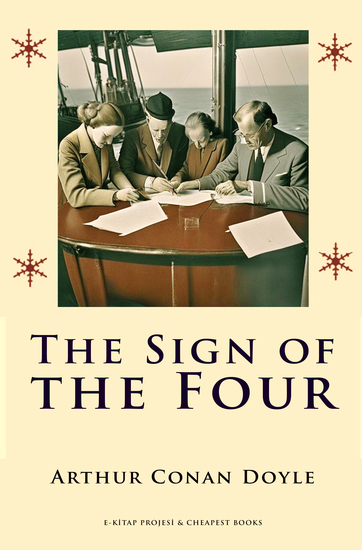
The Sign of the Four - cover

The Sign of the Four

Arthur Conan Doyle

Maison d'édition: E-Kitap Projesi & Cheapest Books

  • 0
  • 0
  • 0

Synopsis

In 1888 a client, Mary Morstan, comes with two puzzles for Holmes. The first is the disappearance of her father Captain Arthur Morstan in December 1878 and the second is that she has received 6 pearls in the mail from an anonymous benefactor once a year since 1882, since she answered an anonymous newspaper query inquiring for her. With the last pearl she has received a letter remarking that she has been a wronged woman and asks for meeting. Holmes takes the case and soon discovers that Major Sholto — Morstan's only friend who had denied seeing Morstan — had died in 1882 and that within a short span of time Mary began to receive the pearls, implying a connection. The only clue Mary can give Holmes is a map of a fortress with the names of Jonathan Small and three Sikhs, who are named Dost Akbar, Abdullah Khan, and Mahomet Singh.

Holmes, Watson, and Mary meet Thaddeus Sholto, the son of the late Major Sholto and Capt Morstan's Army friend who has sent her the pearls. Thaddeus remarks that his father had a paranoid fear of one-legged men and confirms that Mary's father had seen the Major the night he died. That night, in a quarrel about an Agra Treasure, Morstan — who was in weak health — suffered a heart attack. Not wanting to bring attention to the object of the quarrel to public notice, Sholto disposed of the body and hid the treasure. However his own health became worse when he received a letter from India. Dying, he called his two sons and confessed to Morstan's death and was about to divulge the location of the treasure when he suddenly cried "Keep him out!".

The puzzled sons glimpsed a face in the window but the only trace was a single footstep in the dirt. On their father's body is a note reading "The Sign of Four". Both brothers quarreled over whether a legacy should be left to Mary Morstan and Thaddeus left his brother Bartholomew, taking a chaplet and sending its pearls to Mary. The reason he sent the letter is that Bartholomew has found the treasure and possibly Thaddeus and Mary might confront him for a division of it.

Bartholomew is found dead in his home from a poison dart and the treasure is missing. While the police wrongly take Thaddeus in as a suspect Holmes deduces that there are two persons involved in the murder: a one-legged man, Jonathan Small, as well as another "small" accomplice. He traces them to a boat landing where Small has hired a launch named the Aurora. With the help of his Baker Street Irregulars and his own disguise Holmes traces the launch. In a Police launch Holmes and Watson chase the Aurora and capture it but in the process end up killing the "small" companion after he attempts to kill Holmes with a poisoned dart shot from a blow-pipe. Small tries to escape but is captured. However the iron treasure box is empty; Small claims to have dumped the treasure over the side during the chase.
Disponible depuis: 03/02/2024.
Longueur d'impression: 250 pages.

D'autres livres qui pourraient vous intéresser

  • The Classic Collection of Philip K Dick Science Fiction Short Stories - The Crystal Crypt The Eyes Have It Beyond the Door The Defenders The Gun and others - cover

    The Classic Collection of Philip...

    Philip K. Dick

    • 0
    • 0
    • 0
    Philip Kindred Dick (December 16, 1928 – March 2, 1982), often referred to by his initials PKD, was an American science fiction writer. He wrote 44 novels and about 121 short stories, most of which appeared in science fiction magazines during his lifetime. His fiction explored varied philosophical and social questions such as the nature of reality, perception, human nature, and identity, and commonly featured characters struggling against elements such as alternate realities, illusory environments, monopolistic corporations, drug abuse, authoritarian governments, and altered states of consciousness.  
     Born in Chicago, Dick moved to the San Francisco Bay Area with his family at a young age. He began publishing science fiction stories in 1952, at age 23. He found little commercial success until his alternative history novel The Man in the High Castle (1962) earned him acclaim, including a Hugo Award for Best Novel, when he was 33.[6] He followed with science fiction novels such as Do Androids Dream of Electric Sheep? (1968) and Ubik (1969). His 1974 novel Flow My Tears, the Policeman Said won the John W. Campbell Memorial Award for Best Science Fiction Novel. 
       
     The Crystal Crypt 
     The Eyes Have It 
     Beyond the Door 
     Beyond Lies the Wub 
     The Defenders 
     The Gun 
     Tony and the Beetles 
     The Hanging Stranger 
     Adjustment Team 
     Of Withered Apples 
     Survey Team 
     The Crawlers 
     Meddler 
     Souvenir 
     Human Is
    Voir livre
  • A Little Joke - From their pens to your ears genius in every story - cover

    A Little Joke - From their pens...

    Anthony Hope

    • 0
    • 0
    • 0
    Sir Anthony Hope Hawkins was born on 9th February 1863 in Clapton, London.  
    He was educated at St John's School, Leatherhead, Marlborough College and Balliol College, Oxford.  Hope trained as a lawyer and barrister and was called to the Bar by the Middle Temple in 1887. Despite what was thought to be a promising legal career he had literary ambitions and wrote in his spare time. 
    His early works appeared in various periodicals of the day but for his first book ‘A Man of Mark’ (1890), with no publisher interested, he published with his own resources.  
    More novels and short stories followed, including the mildly successful ‘Mr Witt's Widow’ in 1892. Hope even found time to run as the Liberal candidate for Wycombe in the election that same year but was unsuccessful. 
    His first major literary success came with ‘The Dolly Dialogues’, a collection of previously published magazine pieces followed very quickly by his instant classic, ‘The Prisoner of Zenda’. He now gave up the vestiges of his legal career to pursue writing full-time. 
    Despite never again reaching the same pinnacle of success he was popular and wrote prolifically across novels, plays and of course, short stories though his writing output rapidly diminished after the war. 
    In 1918 he was knighted for his contribution to propaganda efforts during World War I.  
    His short stories are delicate, mannered and often surprising with their wit, humour and interplay of characters who say one thing and usually mean another.  He was very definitely a writer of escapist rather than serious fare but they are no less enjoyable for that. 
    Anthony Hope died of throat cancer on 8th July 1933 at his country home, Heath Farm at Walton-on-the-Hill in Surrey. He was 70.
    Voir livre
  • Chivalry - From their pens to your ears genius in every story - cover

    Chivalry - From their pens to...

    Ricardo Fernandez Garcia

    • 0
    • 0
    • 0
    The bookshelves of World literature are incredible collections that have gathered together centuries of very talented authors.  From their countries and continents their fame spread and whilst among their number many are now forgotten or neglected their talents endure.  Among them is Ricardo Fernandez Garcia.
    Voir livre
  • Sansei and Sensibility - Stories - cover

    Sansei and Sensibility - Stories

    Karen Tei Yamashita

    • 0
    • 0
    • 0
    In these buoyant and inventive stories, Karen Tei Yamashita transfers classic tales across boundaries and questions what an inheritance—familial, cultural, emotional, artistic—really means. In a California of the sixties and seventies, characters examine the contents of deceased relatives' freezers, tape-record high school locker-room chatter, or collect a community's gossip while cleaning the teeth of its inhabitants. Mr. Darcy is the captain of the football team, Mansfield Park materializes in a suburb of LA, bake sales replace ballroom dances, and station wagons, not horse-drawn carriages, are the preferred mode of transit. The stories of traversing class, race, and gender leap into our modern world with humor.
    Voir livre
  • The Secret of the Fox Hunter - cover

    The Secret of the Fox Hunter

    William Le Queux

    • 0
    • 0
    • 0
    When two European spies join a hunting party at an English country house, William Drew of the Foreign Office goes undercover to pursue his own type of prey. Drew suspects a traitor may be working with the spies, and soon learns they are more than willing to kill to get what they want.
    Voir livre
  • Sansei and Sensibility - Stories - cover

    Sansei and Sensibility - Stories

    Karen Tei Yamashita

    • 0
    • 0
    • 0
    In these buoyant and inventive stories, Karen Tei Yamashita transfers classic tales across boundaries and questions what an inheritance—familial, cultural, emotional, artistic—really means. In a California of the sixties and seventies, characters examine the contents of deceased relatives' freezers, tape-record high school locker-room chatter, or collect a community's gossip while cleaning the teeth of its inhabitants. Mr. Darcy is the captain of the football team, Mansfield Park materializes in a suburb of LA, bake sales replace ballroom dances, and station wagons, not horse-drawn carriages, are the preferred mode of transit. The stories of traversing class, race, and gender leap into our modern world with humor.
    Voir livre