Join us on a literary world trip!
Add this book to bookshelf
Grey
Write a new comment Default profile 50px
Grey
Subscribe to read the full book or read the first pages for free!
All characters reduced
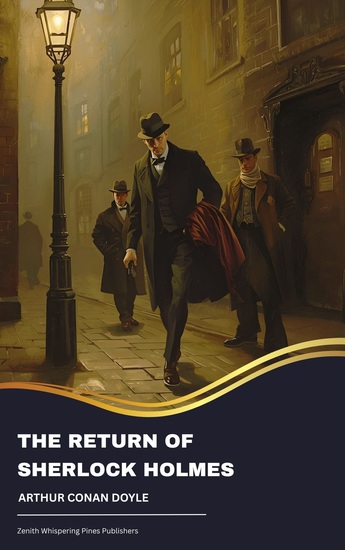
The Return of Sherlock Holmes - cover

The Return of Sherlock Holmes

Arthur Conan Doyle

Publisher: Zenith Whispering Pines Publishers

  • 0
  • 0
  • 0

Summary

A dead man returns. A legend rises again. And London's criminals have no idea what's coming.
After years of silence and presumed death, Sherlock Holmes steps back into Dr. Watson's life—and immediately plunges into a new series of baffling mysteries. From sinister blackmailers and masked attackers to coded messages and impossible alibis, Holmes proves that his razor-sharp mind has lost none of its power.

Readers hail this collection as "a triumphant rebirth of the world's greatest detective," filled with humor, suspense, and dazzling deduction. Each story reinforces why Holmes became a literary icon—and why his return shocked and thrilled the world.

If you love clever twists, atmospheric storytelling, and the thrill of Holmes reclaiming his place in the shadows, this collection is essential.

Rejoin the great detective—start reading now and witness Holmes at his brilliant best.
Available since: 12/03/2025.
Print length: 323 pages.

Other books that might interest you

  • Life's Little Ironies - cover

    Life's Little Ironies

    Thomas Hardy

    • 0
    • 0
    • 0
    Delve into the bittersweet intricacies of human existence with "Life's Little Ironies" by Thomas Hardy, a poignant collection of short stories that reveal the unexpected twists and turns of fate. Set against the backdrop of rural England, these tales explore themes of love, betrayal, ambition, and societal pressures. Through vivid characters and ironic circumstances, Hardy masterfully exposes the tragic and often ironic quirks of life, rendering this anthology a timeless exploration of human nature and its complexities.
    Show book
  • The Murders in the Rue Morgue - cover

    The Murders in the Rue Morgue

    Edgar Allan Poe

    • 0
    • 0
    • 0
    "The Murders in the Rue Morgue" is a short story by Edgar Allan Poe, first published in Graham's Magazine in 1841. It is often considered the first modern detective story and features the character C. Auguste Dupin, who later became a prototype for many fictional detectives to come. The story revolves around a brutal double murder in Paris that baffles the police. C. Auguste Dupin, a brilliant amateur detective, takes on the challenge of solving the seemingly inexplicable crime. Through deductive reasoning and keen observation, Dupin unravels the mystery in a dramatic and unexpected manner.
    Show book
  • Tono-Bungay (Unabridged) - cover

    Tono-Bungay (Unabridged)

    H. G. Wells

    • 0
    • 0
    • 0
    Presented as a miraculous cure-all, Tono-Bungay is in fact nothing other than a pleasant-tasting liquid with no positive effects. Nonetheless, when the young George Ponderevo is employed by his uncle Edward to help market this ineffective medicine, he finds his life overwhelmed by its sudden success. Soon the worthless substance is turned into a formidable fortune as society becomes convinced of the merits of Tono-Bungay through a combination of skilled advertising and public credulity.
    -Includes a newly established text, a full biographical essay on Wells, a list of further reading, and detailed notes
    -Edward Mendelson's introduction explores the many ways in which Tono-Bungay satirizes the fictions and delusions that shape modern life
    Show book
  • The Threat and Other Stories - cover

    The Threat and Other Stories

    Saki Saki

    • 0
    • 0
    • 0
    Sir Lulworth Quayne discusses with his nephew the threat posed by the suffragette movement in this satirical short story by Saki. This collection of stories also includes "Tea", "The Wolves of Cernogratz" and "The Penance", which were first published in 1919 in The Toys of Peace and Other Papers.
    Show book
  • Sherlock Holmes: The Adventure of the Blue Carbuncle - cover

    Sherlock Holmes: The Adventure...

    Sir Arthur Conan Doyle

    • 0
    • 0
    • 0
    The Adventure of The Blue Carbuncle, one of the 56 short Sherlock Holmes stories written by British author Sir Arthur Conan Doyale, is the seventh story of 12 in The Adventure of Sherlock Holmes. The story was first published in Strand Magazine in January 1892. 
    A "Blue Carbuncle" is stolen from a hotel suite, and a former felon is soon arrested. However, an acquaintance of Holmes discovers the carbuncle in the throat of a Christmas goose. 
    Holmes traces the owner of the goose, but soon determines that he was not the thief by offering him a replacement goose. The detective continues his search, first to an inn and then to a dealer in Covent Garden. The dealer refuses to provide Holmes with information about the source of the goose, but Holmes observes another man trying to find the same information, and confronts him. The man, the head attendant at the hotel, confesses to his crime. Holmes allows him to remain free, arguing that prison could make him a hardened criminal later. 
    ©2016 Rick Sheridan (P)2016 Rick Sheridan
    Show book
  • A Fight with a Cannon - From their pens to your ears genius in every story - cover

    A Fight with a Cannon - From...

    Victor Hugo

    • 0
    • 0
    • 0
    Victor Marie Hugo was born on 26th February 1802 in Besançon, France.   
    There can be no doubt that Hugo is ranked as the greatest of French authors and poets. In addition to this he fought against social injustice throughout his life and from his frequent elections to the French Assembly. 
    Hugo published his first novel, Han d’Islande (1823), the year after his marriage and so began an immense canon of fiction and poetry not only for France but to World literature.  
    He was elected to the Académie Française in 1841 and the same year came a peerage and entrance to the Higher Chamber as a pair de France, where he spoke against the death penalty, social injustice and in favour of press freedom.  
    In the years leading up to the Revolution of 1848 Hugo began to lean towards Republicanism and greater freedoms.  With the formation of the Second Republic, he was again elected to the Assembly. 
    When Napoleon III seized power in 1851, and established an anti-parliamentary constitution, Hugo openly declared him a traitor to France. This, of course, meant exile where he remained until 1870.  In exile he published his greatest work ‘Les Misérables’, and further widely honoured collections of poetry. 
    Returning home he was again elected to the National Assembly and the Senate.  It was the time of the Franco-Prussian war and with Paris under siege and food ever more scarce, he wrote in his diary that he was now "eating the unknown". 
    Later he was instrumental in strengthening the rights of artists and copyright, steps which led to the international protections of the Berne Convention.  
    Victor Hugo died on 22nd May 1885, aged 83.
    Show book