Join us on a literary world trip!
Add this book to bookshelf
Grey
Write a new comment Default profile 50px
Grey
Subscribe to read the full book or read the first pages for free!
All characters reduced
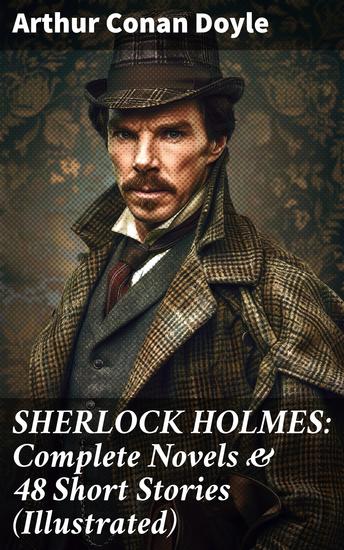
SHERLOCK HOLMES: Complete Novels & 48 Short Stories (Illustrated) - The Mysterious World of Victorian Crime-Solving - cover

SHERLOCK HOLMES: Complete Novels & 48 Short Stories (Illustrated) - The Mysterious World of Victorian Crime-Solving

Arthur Conan Doyle

Publisher: Good Press

  • 0
  • 0
  • 0

Summary

In "SHERLOCK HOLMES: Complete Novels & 48 Short Stories (Illustrated)", Arthur Conan Doyle masterfully presents the iconic tales of his renowned detective, Sherlock Holmes, and his loyal companion, Dr. John Watson. This comprehensive collection showcases Doyle's distinctive literary style, characterized by meticulous detail and astute psychological insight. Set against the backdrop of Victorian England, these narratives explore themes of rationality, morality, and the complexities of human nature, all while employing a captivating blend of mystery and deductive reasoning that has enthralled readers for generations. Doyle, a trained physician, drew inspiration from the meticulous logical processes he encountered in his medical practice. Furthermore, his fascination with criminology and the burgeoning field of forensic science allowed him to create a character as ingenious and vivid as Holmes. The author's keen observations of society and human behavior run through his work, making these stories not only thrilling but also a reflection of the tensions and transformations of his time. This illustrated collection is a must-read for both devoted fans and newcomers to the world of Sherlock Holmes. Each story invites readers to engage with the celebrated sleuth's cerebral adventures, while the accompanying illustrations enhance the reading experience. Dive into this timeless anthology and experience the genius of Sherlock Holmes through Doyle's unparalleled storytelling.
Available since: 01/16/2024.
Print length: 1520 pages.
Other books that might interest you

  • The Masque of the Red Death - cover

    The Masque of the Red Death

    Edgar Allan Poe

    • 0
    • 0
    • 0
    "The Masque of the Red Death" (originally published as "The Mask of the Red Death: A Fantasy") is a short story by American writer Edgar Allan Poe, first published in 1842. The story follows Prince Prospero's attempts to avoid a dangerous plague, known as the Red Death, by hiding in his abbey. He, along with many other wealthy nobles, hosts a masquerade ball in seven rooms of the abbey, each decorated with a different color. In the midst of their revelry, a mysterious figure disguised as a Red Death victim enters and makes his way through each of the rooms. Prospero dies after confronting this stranger, whose "costume" proves to contain nothing tangible inside it; the guests also die in turn.
    
    Poe's story follows many traditions of Gothic fiction and is often analyzed as an allegory about the inevitability of death, though some critics advise against an allegorical reading. Many different interpretations have been presented, as well as attempts to identify the true nature of the eponymous disease. The story was first published in May 1842 in Graham's Magazine and has since been adapted in many different forms, including a 1964 film starring Vincent Price. Poe's short story has also been alluded to by other works in many types of media.
    Show book
  • The Maltese Cat - Celebrated author of The Jungle Book Kipling brings another marvellous story from the perspective of an animal this time about a game of polo set in India during British rule - cover

    The Maltese Cat - Celebrated...

    Rudyard Kipling

    • 0
    • 0
    • 0
    Joseph Rudyard Kipling was born in Mumbai, India on 30th December 1865.   
     
    As was the custom in those days, he and his sister were sent back to England when he was 5.  The ill-treatment and cruelty by the Portsmouth couple they boarded with Kipling said contributed to the onset of his literary life.  
     
    At 16 he returned to India to work on a local paper where he was soon contributing and writing.  It also exposed him to the issues of identity and national allegiance which pervade much of his work.  
     
    In 1886, his ‘Departmental Ditties’, collection of verse appeared in print followed by 39 short stories for his newspaper over only 8 months.  These were then published as ‘Plain Tales from the Hills’, shortly after his 22nd birthday.  
     
    He continued his prolific pace of writing before being dismissed in a dispute and, taking his pay-off and the profits from the sale of some publishing rights, decided to return to London, travelling via Rangoon, Hong Kong, Japan and the United States, all the while writing articles, and arriving at Liverpool in October 1889. 
     
    Over the next two years he saw further works published as books and in magazines, as well as a nervous breakdown for which he was prescribed a sea voyage, to South Africa, Australia, New Zealand and India.  
     
    Happier times came with marriage to Caroline Starr Balestier in January 1892.  The honeymoon began in Vermont and ended in Yokahama where they heard their bank had failed.  They returned to Vermont and settled.  Caroline was now pregnant and he was planning the ‘Jungle Books’.  
     
    A failed arbitration between the US and England resulted in an argument between Caroline’s brother and Kipling, and then his arrest.  At the hearing he was mortified by the exposure of his private life and after settling the matter they returned to England and life in Torquay.  ‘Kim’ was published in 1902, and ‘Just So Stories for Little Children’, a year later.  
     
    In 1907 he was awarded the Nobel Prize for Literature with the citation “in consideration of the power of observation, originality of imagination, virility of ideas and remarkable talent for narration which characterise the creations of this world-famous author”.   
     
    When the Great War erupted, he scorned those who refused conscription.  His son enlisted and was killed at the Battle of Loos in September 1915, at 18, an exploding shell had ripped his face apart.  This death inspired Kipling’s writing thereafter, but the tragedy broke his life and by 1930 his prolific pen had almost ceased. 
     
    Rudyard Kipling died on 18th January 1936 from a perforated duodenal ulcer.  He was 70.  His ashes are buried at Poets’ Corner in Westminster Abbey. 
     
    In the Maltese Cat Kipling returns once more to India and the British Empire.  A polo match is being played.  The fierce competitive instincts of two social classes are fighting for dominance.  All told through the voice of the Maltese Cat, the most cunning of the horses.
    Show book
  • The Canterville Ghost - cover

    The Canterville Ghost

    Oscar Wilde

    • 0
    • 0
    • 0
    The Canterville Ghost is a humorous short story by Oscar Wilde. It was the first of Wilde's stories to be published, appearing in two parts in The Court and Society Review, 23 February and 2 March 1887. The story is about an American family who moved to a castle haunted by the ghost of a dead English nobleman, who killed his wife and was then walled in and starved to death by his wife's brothers. It has been adapted for the stage and screen several times.
    Show book
  • Death in the Woods - From their pens to your ears genius in every story - cover

    Death in the Woods - From their...

    Sherwood Anderson

    • 0
    • 0
    • 0
    Sherwood Anderson was born on 13th September 1876 in Camden, Ohio. 
    When his father’s business failed the family was forced to move on a regular basis before finally settling in Clyde, Ohio.   
    Anderson, one of 7 children, left school at 14 to take a number of jobs to help with the family finances. These were difficult years. 
    He moved to Chicago in search of opportunities before joining the Army for the US-Spanish War of 1898.  He then entered Wittenberg Academy in Springfield, Ohio to complete his education before moving back to Chicago to take up a writing job. 
    In 1904 he married Cornelia Lane, her family had resources and Anderson was keen, with this family backing, to run a business. 
    The early years of their marriage produced 3 children but a nervous breakdown in 1907 and another in 1912, despite his success as a business entrepreneur, resulted in him abandoning his family and deciding that a literary career would be best for him.   
    A move back to Chicago resulted in a job in advertising, a divorce from Cornelia and marriage to Tennessee Mitchell.  
    That same year his first book ‘Windy McPherson’s Son’ was released and in 1919, his most famous book, ‘Winesburg, Ohio’, a collection of short stories about life in an Ohio town was released. 
    Anderson continued to write short stories, novels and non-fiction but his only true bestseller came with ‘Dark Laughter’.  His influence on writers that followed, from Faulkner to Hemingway, was immense. He also married a further two times.   
    Sherwood Anderson died in in Colón, Panama, on the 8th March, 1941. He was 64. An autopsy revealed that a swallowed toothpick had resulted in peritonitis. 
    His headstone epitaph reads ‘Life, Not Death is the Great Adventure.’
    Show book
  • Sherlock Holmes: The Boscombe Valley Mystery - cover

    Sherlock Holmes: The Boscombe...

    Sir Arthur Conan Doyle

    • 0
    • 0
    • 0
    The Boscombe Valley Mystery is the fourth of the 12 stories in The Adventures of Sherlock Holmes. It was first published in Strand Magazine in 1891. 
    Holmes is summoned to a community in Herefordshire where a local landowner has been murdered outdoors. The deceased's estranged son is strongly implicated. Holmes quickly determines that a mysterious third man may be responsible for the crime, unraveling a thread involving a secret criminal past, thwarted love, and blackmail. 
    Public Domain (P)2016 Listen & Live Audio
    Show book
  • Mankind in the Making (Unabridged) - cover

    Mankind in the Making (Unabridged)

    H. G. Wells

    • 0
    • 0
    • 0
    Mankind in the Making (1903) is H.G. Wells's sequel to Anticipations (1901). Mankind in the Making analyzes the "process" of "man's making," i.e. "the great complex of circumstances which mould the vague possibilities of the average child into the reality of the citizen of the modern state." Taking an aggressive tone in criticizing many aspects of contemporary institutions, Wells proposed a doctrine he called "New Republicanism," which "tests all things by their effect upon the evolution of man.
    Show book