Join us on a literary world trip!
Add this book to bookshelf
Grey
Write a new comment Default profile 50px
Grey
Subscribe to read the full book or read the first pages for free!
All characters reduced
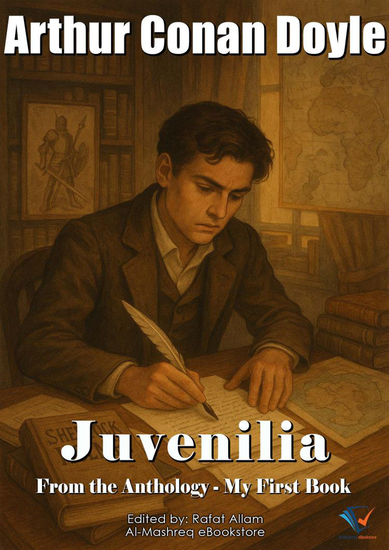
Juvenilia - From the Anthology "My First Book" - cover

Juvenilia - From the Anthology "My First Book"

Arthur Conan Doyle

Publisher: Al-Mashreq eBookstore

  • 0
  • 0
  • 0

Summary

Step back into the formative years of a literary giant with Juvenilia, an autobiographical glimpse into the early writings of Arthur Conan Doyle. Before Sherlock Holmes was ever conceived, Doyle was a young, imaginative schoolboy scribbling out tales that reveal both the promise of his genius and the raw energy of youthful creativity. This collection of his earliest prose and poetic efforts showcases his burgeoning voice, his love for storytelling, and the moral and adventurous themes that would later define his most iconic works. Engaging, often humorous, and deeply personal, Juvenilia is more than a literary curiosity—it's a time machine into the mind of a writer in the making. A must-read for Doyle aficionados and aspiring authors alike, this is where it all began.
Available since: 08/01/2025.
Print length: 32 pages.
Other books that might interest you

  • World Citizen Journeys of a Humanitarian - cover

    World Citizen Journeys of a...

    Jane Olson

    • 0
    • 0
    • 0
    These stories are about light and hope in the midst of unimaginable human suffering in war zones and places of extreme poverty around the world. Important lessons from a childhood in rural western Iowa are woven throughout, as are examples of human strength and resiliency. Each chapter can be read as a complete experience. Intimate details recorded by the author in journals and on film take the reader on memorable journeys with international human rights and humanitarian organizations. Despite being plunged into war zones, crowded refugee camps, and some of the poorest and most disease-affected places on the planet, we learn the life-saving impact of humanitarian intervention, the healing power of community, the importance of justice, and the truth that one caring person can indeed make a difference. To be a World Citizen is to embrace and champion the Universal Declaration of Human Rights, knowing that all lives are valuable and equally deserving of protection and support.
    Show book
  • A Rare Recording of Dan Smoot Explaining Why America Is A Constitutional Republic - cover

    A Rare Recording of Dan Smoot...

    Dan Smoot

    • 0
    • 0
    • 0
    Dan Smoot (October 5, 1913 - July 24, 2003), born in East Prairie, MO, was an FBI agent turned conservative political commentator. From 1956 to 1971, he published The Dan Smoot Report, which was a weekly newsletter and radio program. Smoot wrote four books, including The Invisible Government (1962), concerning early members of the Council on Foreign Relations. In the following recording, Smoot explains the importance of America as a Constitutional Republic.
    Show book
  • The Swift Conquest - Unraveling Hitler's Rapid Domination of Europe - cover

    The Swift Conquest - Unraveling...

    John Harpoon

    • 0
    • 0
    • 0
    The rise of Adolf Hitler and the Nazi Party did not occur in isolation but was the culmination of a confluence of societal, economic, and political factors. Post-World War I Germany was a nation in turmoil, grappling with humiliation, economic devastation, and political instability. The Treaty of Versailles, signed in 1919, placed the blame for the war squarely on Germany's shoulders, imposing severe reparations that crippled its economy. The German people, burdened by hyperinflation, unemployment, and poverty, became disillusioned with the democratic Weimar Republic, which they perceived as weak and ineffectual. 
    Amid this chaos, Hitler emerged as a figure of radical change. A decorated veteran of the First World War, Hitler initially joined the German Workers’ Party, a small and obscure nationalist group. With his fiery oratory skills and an unrelenting focus on propaganda, he quickly rose to prominence, transforming the group into the National Socialist German Workers' Party (NSDAP), or the Nazi Party. Hitler’s message was simple yet potent: he promised to restore Germany to greatness, overturn the Treaty of Versailles, and provide a scapegoat for the nation’s suffering—the Jewish people and other minorities. 
    By the early 1920s, Hitler had crafted a political doctrine that combined virulent nationalism, anti-Semitism, and a disdain for democracy. He also sought to exploit the populace’s fears of communism, which was gaining traction in Europe following the Bolshevik Revolution in Russia. The failed Beer Hall Putsch in 1923, an attempted coup in Munich, briefly landed Hitler in prison. However, this setback proved instrumental to his ideological development, as he used the time to dictate Mein Kampf, a manifesto outlining his vision for Germany’s future and the expansion of Lebensraum, or "living space," for the German people.
    Show book
  • Ecce Homo - cover

    Ecce Homo

    Friedrich Nietzsche

    • 0
    • 0
    • 0
    “Without music, life would be a mistake.”“It is not a lack of love, but a lack of friendship that makes unhappy marriages.” ...“That which does not kill us makes us stronger.”“I'm not upset that you lied to me, I'm upset that from now on I can't believe you.” 
    Nietzsche 
     
    The philosopher Friedrich Nietzsche's autobiography, Ecce Homo, was the last prose work that he wrote before his illness in 1889. Coming at the end of an extraordinarily productive year in which he had produced The Twilight of the Idols and The Antichrist, Nietzsche shuns any pretense at modesty with chapter titles include “Why I am so Wise”, “Why I am so Clever” and “Why I Write Such Excellent Books”. His translator Anthony M. Ludovici states, Ecce Homo “is not only a coping-stone worthy of the wonderful creations of that year, but also a fitting conclusion to his whole life, in the form of a grand summing up of his character as a man, his purpose as a reformer, and his achievement as a thinker. 
     
    Friedrich Wilhelm Nietzsche was a German philosopher, cultural critic and philologist whose work has exerted a profound influence on modern intellectual history. He began his career as a classical philologist before turning to philosophy.
    Show book
  • Holding Fire - A Reckoning with the American West - cover

    Holding Fire - A Reckoning with...

    Bryce Andrews

    • 0
    • 0
    • 0
    From the award-winning author of Down from the Mountain, a memoir of inheritance, history, and one gun’s role in the violence that shaped the American West—and an impassioned call to forge a new way forward 
    Bryce Andrews was raised to do no harm. The son of a pacifist and conscientious objector, he moved from Seattle to Montana to tend livestock and the land as a cowboy. For a decade, he was happy. Yet, when Andrews inherited his grandfather’s Smith & Wesson revolver, he felt the weight of the violence braided into his chosen life. Other white men who’d come before him had turned firearms like this one against wildlife, wilderness, and the Indigenous peoples who had lived in these landscapes for millennia. This was how the West was “won.” Now, the losses were all around him and a weapon was in his hand. 
    In precise, elegiac prose, Andrews chronicles his journey to forge a new path for himself, and to reshape one handgun into a tool for good work. As waves of gun violence swept the country and wildfires burned across his beloved valley, he began asking questions—of ranchers, his Native neighbors, his family, and a blacksmith who taught him to shape steel—in search of a new way to live with the land and with one another. In laying down his arms, he transformed an inherited weapon, his ranch, and the arc of his life. 
    Holding Fire is a deeply felt memoir of one Western heart’s wild growth, and a personal testament to how things that seem permanent—inheritance, legacies of violence, forged steel—can change. 
    Supplemental enhancement PDF accompanies the audiobook.
    Show book
  • Haunted West Virginia - Ghosts and Strange Phenomena of the Mountain State - cover

    Haunted West Virginia - Ghosts...

    Patty A Wilson

    • 0
    • 0
    • 0
    Eerie tales from the Mountain State, including the restless spirits of Harpers Ferry, the legendary Mothman, the ghosts of Twistabout Ridge, and more.  Things that go bump in the night, disembodied voices, footsteps in an empty stairwell, an icy hand on your shoulder . . . let your imagination run wild as you read about West Virginia’s most extraordinary apparitions, sinister spooks, and bizarre beasts. You may know of the haunted Blennerhassett Hotel or the headless ghost of George Van Meter, but perhaps you haven’t you heard about:  The strangled bride whose ghostly visits led a jury to convict her husband of murder  Point Pleasant’s long history of tragedies, mysterious events, and natural disasters that have plagued the area ever since Scioto Shawnee Chief Cornstalk cursed the ground  A pretty blonde hitchhiker who died crossing a washed-out bridge and continues to guide drivers to avoid the same fate  Moundsville’s old state penitentiary, which is considered to be one of the most haunted places in West Virginia
    Show book