Rejoignez-nous pour un voyage dans le monde des livres!
Ajouter ce livre à l'électronique
Grey
Ecrivez un nouveau commentaire Default profile 50px
Grey
Abonnez-vous pour lire le livre complet ou lisez les premières pages gratuitement!
All characters reduced
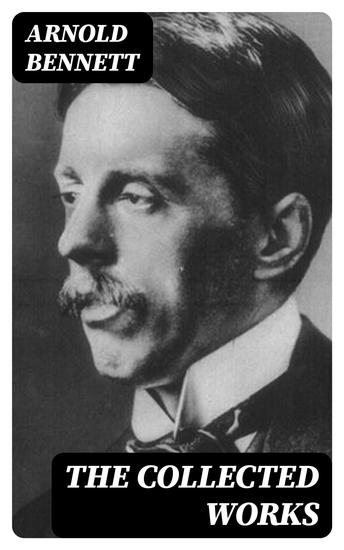
The Collected Works - Enriched edition - cover

The Collected Works - Enriched edition

Arnold Bennett

Maison d'édition: DigiCat

  • 0
  • 0
  • 0

Synopsis

Arnold Bennett's "The Collected Works" serves as a profound exploration of early 20th-century English society through a rich tapestry of character-driven narratives and incisive social commentary. The anthology includes key works that reflect Bennett's deftness in the realist style, utilizing meticulous detail and psychological depth to offer an authentic portrait of life in the potteries of Staffordshire. As an embodiment of Edwardian literature, these works engage with themes of aspiration, industrial transformation, and the complexities of modernity, capturing the zeitgeist of an era on the brink of monumental change. Arnold Bennett (1867-1931) rose from humble beginnings in the industrial heart of England, experiences that deeply influenced his understanding of social structures and human character. His background as a journalist and playwright equipped him with keen observational skills and a unique narrative voice, allowing him to vividly articulate the struggles and triumphs of ordinary individuals. Bennett's commitment to portraying the intricacies of provincial life resonates throughout his oeuvre, drawing the reader into a world both familiar and profoundly revealing. "The Collected Works" is highly recommended for readers seeking an immersive literary experience that both entertains and enlightens. Students of social history, fans of classic literature, and those interested in the evolution of the modern novel will find Bennett's insights particularly rewarding, as they resonate within today's ongoing dialogues about identity and place.

In this enriched edition, we have carefully created added value for your reading experience:
- A comprehensive Introduction outlines these selected works' unifying features, themes, or stylistic evolutions.
- A Historical Context section situates the works in their broader era—social currents, cultural trends, and key events that underpin their creation.
- A concise Synopsis (Selection) offers an accessible overview of the included texts, helping readers navigate plotlines and main ideas without revealing critical twists.
- A unified Analysis examines recurring motifs and stylistic hallmarks across the collection, tying the stories together while spotlighting the different work's strengths.
- Reflection questions inspire deeper contemplation of the author's overarching message, inviting readers to draw connections among different texts and relate them to modern contexts.
- Lastly, our hand‐picked Memorable Quotes distill pivotal lines and turning points, serving as touchstones for the collection's central themes.
Disponible depuis: 11/10/2022.
Longueur d'impression: 8902 pages.

D'autres livres qui pourraient vous intéresser

  • War - From their pens to your ears genius in every story - cover

    War - From their pens to your...

    Sherwood Anderson

    • 0
    • 0
    • 0
    Sherwood Anderson was born on 13th September 1876 in Camden, Ohio. 
    When his father’s business failed the family was forced to move on a regular basis before finally settling in Clyde, Ohio.   
    Anderson, one of 7 children, left school at 14 to take a number of jobs to help with the family finances. These were difficult years. 
    He moved to Chicago in search of opportunities before joining the Army for the US-Spanish War of 1898.  He then entered Wittenberg Academy in Springfield, Ohio to complete his education before moving back to Chicago to take up a writing job. 
    In 1904 he married Cornelia Lane, her family had resources and Anderson was keen, with this family backing, to run a business. 
    The early years of their marriage produced 3 children but a nervous breakdown in 1907 and another in 1912, despite his success as a business entrepreneur, resulted in him abandoning his family and deciding that a literary career would be best for him.   
    A move back to Chicago resulted in a job in advertising, a divorce from Cornelia and marriage to Tennessee Mitchell.  
    That same year his first book ‘Windy McPherson’s Son’ was released and in 1919, his most famous book, ‘Winesburg, Ohio’, a collection of short stories about life in an Ohio town was released. 
    Anderson continued to write short stories, novels and non-fiction but his only true bestseller came with ‘Dark Laughter’.  His influence on writers that followed, from Faulkner to Hemingway, was immense. He also married a further two times.   
    Sherwood Anderson died in in Colón, Panama, on the 8th March, 1941. He was 64. An autopsy revealed that a swallowed toothpick had resulted in peritonitis. 
    His headstone epitaph reads ‘Life, Not Death is the Great Adventure.’
    Voir livre
  • Anthem - cover

    Anthem

    Ayn Rand

    • 0
    • 0
    • 0
    Though written in the 1930s, Anthem addresses controversial subjects in society that are still relevant today: equality, environment, sexism, mental health, the role of government. In revisiting this book and its many subjects, one keeps catching glimpses of understandings, and connections with our society today. The use of “we”—could it have a connection to the way we now declare our pronouns? The light he creates—could it have a connection to how man exploits the planet and is paying the price for it now? The Mating Hall—could it have a connection to the Me Too movement? The assumption that all must be happy, for there is no reason not to be—could it have a connection to our dawning understanding of mental health? Then, as you hear the struggles of the main character to grasp something just beyond his fingertips, you too may struggle to find your own understanding of what all this means in today’s world. Listen. And see what questions it brings to mind for you.
    Voir livre
  • The Emancipated - cover

    The Emancipated

    George Gissing

    • 0
    • 0
    • 0
    The Emancipated explores the complexities of marriage, personal freedom, and societal expectations in late Victorian England. The story centers on Everard Domby, a disillusioned barrister trapped in a loveless marriage to a woman whose conventional mindset stifles his intellectual and emotional growth. As he grows closer to Dora Mead, a divorced and independent-minded woman considered scandalous by society, Everard is forced to confront his own ideals versus social reality. Gissing critiques the institution of marriage and the rigid moral codes of the time, portraying the inner turmoil of individuals torn between duty and desire. With psychological depth and sharp social observation, the novel questions what it truly means to be free—especially for those who challenge the norms of family, gender, and class.
    Voir livre
  • Without the Option - cover

    Without the Option

    P. G. Wodehouse

    • 0
    • 0
    • 0
    Some men are born to lead. Others are born to follow. Bertie Wooster, however, was born to regard the legal system as something that happens to other people—preferably at a safe distance.
    In Without the Option, P. G. Wodehouse sends Bertie hurtling from harmless celebration into the dignified horror of British justice, where a misplaced moment of enthusiasm for a policeman's helmet has entirely proper consequences. When his friend Sippy finds himself threatened by an aunt of truly formidable proportions, Bertie agrees—without fully consulting reality—to a bold and highly experimental solution involving impersonation, relocation, and the general suspension of sensible decision-making.
    The countryside, it turns out, is not a refuge so much as a different stage on which to commit the same errors in slightly better lighting. Very quickly, Bertie discovers that "being someone else" is an occupation with no pension plan and a shocking amount of paperwork. Between suspicious relatives, social expectations, and objects of questionable legal ownership, he is soon operating at the very limits of polite endurance.
    Effortlessly comic and structurally disastrous in the most reassuring way, this is Wodehouse at full tilt: where plans behave like unruly pets, authority arrives without warning, and every attempt at improvement quietly accelerates chaos.
    Perfect for listeners who appreciate British humour at its most refined, where catastrophe is inevitable, but always impeccably dressed.
    Voir livre
  • Unwritten Novel An - cover

    Unwritten Novel An

    Virginia Woolf

    • 0
    • 0
    • 0
    The story starts on a train, when the narrator looks up from her newspaper
    Voir livre
  • In Bayswater - One family is home to many secrets in this classic modernist short story - cover

    In Bayswater - One family is...

    Mary Butts

    • 0
    • 0
    • 0
    Mary Frances Butts was born on 13th December 1890 in Poole, Dorset. 
     
    Her early years were spent at Salterns, an 18th-century house overlooking Poole Harbour.  Sadly in 1905 her father died, and she was sent for boarding at St Leonard's school for girls in St Andrews. 
     
    Her mother remarried and, from 1909, Mary studied at Westfield College in London, and here, first became aware of her bisexual feelings.  She was sent down for organising a trip to Epsom races and only completed her degree in 1914 when she graduated from the London School of Economics.  By then Mary had become an admirer of the occultist Aleister Crowley and she was given a co-authorship credit on his ‘Magick (Book 4)’. 
     
    In 1916, she began the diary which would now detail her future life and be a constant reference point for her observations and her absorbing experiences. 
     
    During World War I, she was doing social work for the London County Council in Hackney Wick, and involved in a lesbian relationship.  Life changed after meeting the modernist poet, John Rodker and they married in 1918. 
     
    In 1921 she spent 3 months at Aleister Crowley's Abbey of Thelema in Sicily; she found the practices dreadful and also acquired a drug habit.  Mary now spent time writing in Dorset, including her celebrated book of short stories ‘Speed the Plough’ which saw fully develop her unique Modernist prose style. 
     
    Europe now beckoned and several years were spent in Paris befriending many artists and writing further extraordinary stories.   
     
    She was continually sought after by literary magazines and also published several short story collections as books. Although a Modernist writer she worked in other genres but is essentially only known for her short stories.  Mary was deeply committed to nature conservation and wrote several pamphlets attacking the growing pollution of the countryside. 
     
    In 1927, she divorced and the following year her novel ‘Armed with Madness’ was published.  A further marriage followed in 1930 and time was spent attempting to settle in London and Newcastle before setting up home on the western tip of Cornwall.  By 1934 the marriage had failed. 
     
    Mary Butts died on 5th March 1937, at the West Cornwall Hospital, Penzance, after an operation for a perforated gastric ulcer. She was 46. 
     
    Her story ‘In Bayswater’ grippingly describes a man’s friendship with a dysfunctional family he rents a room from.  As each facet reveals itself his opinion and decisions change, back and forth, this way and that….
    Voir livre