Join us on a literary world trip!
Add this book to bookshelf
Grey
Write a new comment Default profile 50px
Grey
Subscribe to read the full book or read the first pages for free!
All characters reduced
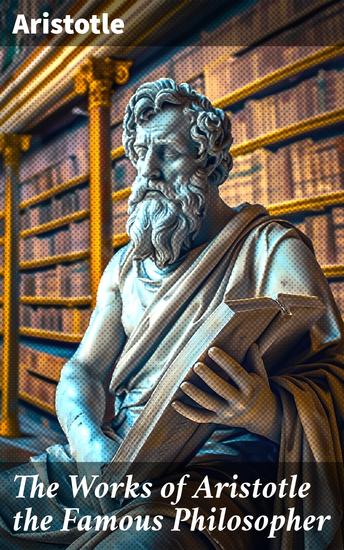
The Works of Aristotle the Famous Philosopher - Exploring the Timeless Wisdom of Ancient Greek Philosophy - cover

The Works of Aristotle the Famous Philosopher - Exploring the Timeless Wisdom of Ancient Greek Philosophy

Aristotle

Publisher: Good Press

  • 0
  • 0
  • 0

Summary

The Works of Aristotle the Famous Philosopher is a monumental compilation that encompasses the vast spectrum of Aristotle's thoughts across various domains such as metaphysics, ethics, politics, and natural sciences. Written in a clear yet profound prose style, Aristotle employed dialectical reasoning to dissect complex concepts, delivering insights that continue to influence modern thought. The structure of his works often incorporates dialogues and treatises, showcasing his commitment to empirical observation and logical analysis, which delineates his contributions within the context of ancient Greek philosophy and beyond. Aristotle (384-322 BCE), a student of Plato and teacher of Alexander the Great, was driven by an insatiable curiosity about the world around him. His systematic approach to inquiry was profoundly informed by his experiences in different arenas of life, from his tutelage under Plato to his extensive studies in biology and ethics. This rich tapestry of knowledge shaped his philosophical pursuits and instilled an enduring legacy, solidifying his role as a cornerstone of Western intellectual tradition. For readers eager to explore the foundational principles of Western philosophy, this compilation offers an unparalleled journey into Aristotle'Äôs expansive mind. Whether you're a seasoned scholar or a curious novice, engaging with his works provides invaluable insights into the nature of reality, the art of living, and the intricacies of human behavior, making it essential reading for anyone committed to deepening their understanding of philosophical thought.
Available since: 08/12/2023.
Print length: 273 pages.


Other books that might interest you

  • Hollywood’s Favorite Screwball Actresses: The Lives and Legacies of the Women Who Popularized the Comedy Genre - cover

    Hollywood’s Favorite Screwball...

    Editors Charles River

    • 0
    • 0
    • 0
    “If I couldn't laugh, I'd rather die.” – Claudette Colbert 
    The 1930s were the height of the classical Hollywood era, known for lavish studio productions by heavyweights like MGM, RKO, Warner Brothers, Paramount, and 20th Century Fox, which were operating at the height of their powers. Every major studio possessed a long roster of contract players, and films were released at such a rapid pace that it made for an especially competitive environment within the industry. Even while America remained in the throes of the Great Depression, the film industry continued to flourish, and movies easily supplanted the theater as the main attraction for American entertainment. Indeed, it would be no exaggeration to claim that the film industry reached its zenith during the decade precisely because it offered an affordable (if very temporary) escape from the anxieties of the economic woes of the era. 
    When the American Film Institute ranked its top 50 screen legends of the 20th century, many of the people named had careers spanning several decades, but one of them managed the feat despite living less than three decades. Ranked as the 22nd greatest actress of the 20th century, Jean Harlow was on the screen for less than 10 years, but in that time the “Blonde Bombshell” became the most popular actress of the 1930s, eclipsing superstars like Joan Crawford and Norma Shearer along the way. In fact, the platinum blonde accomplished that feat as a leading lady for just five years before her premature death of renal failure at the age of 26. 
    Carole Lombard has been memorialized in many fitting ways as an actress, and one of her biggest contributions to Hollywood was the blond archetype that the film industry used successfully for decades in screwball comedies, paving the way for the success of women like Marilyn Monroe. Perhaps the most remarkable aspect of that fact is that it was actually based on Carole’s gushing personality. 
    Show book
  • Pardon Power - How The Pardon System Works And Why - cover

    Pardon Power - How The Pardon...

    Kim Wehle

    • 0
    • 0
    • 0
    If you've ever wondered about the constitutional basis for presidential pardons, this book explains it, offering examples from the recent and distant past. Follow constitutional law professor and popular newsroom commentator Kim Wehle through a fascinating rundown of how this executive power has been—and might be—used by American presidents.
    Show book
  • Walking the Appalachian Trail - cover

    Walking the Appalachian Trail

    Larry Luxenberg

    • 0
    • 0
    • 0
    A fascinating portrait of the community of people—and one cat—who’ve traveled the trail end to end, by the founder of the Appalachian Trail Museum.   Countless hikers have walked stretches of the two-thousand-plus-mile Appalachian Trail, but only a small, deeply dedicated group has completed the trek all the way through from Georgia to Maine. This book explores the history of the trail through colorful profiles of those who are a part of this unique community and reveals the customs and culture that have evolved around them over the years.   From the sore muscles to the moments of solitude in nature, from the retired postmaster who parachuted onto the top of Springer Mountain to begin his journey to the woman who set out in tennis shoes because she couldn’t find women’s hiking boots in her size, Walking the Appalachian Trail explores questions of who these end-to-enders are, what drives them, what risks they face, and what rewards to body and soul they gain from this extraordinary walk.   Includes color photographs
    Show book
  • Why Did That Happen? - Aristotle Has Four Answers and None of Them Are Helpful - cover

    Why Did That Happen? - Aristotle...

    Sophia Blackwell

    • 0
    • 0
    • 0
    Why Did That Happen? Aristotle Has Four Answers and None of Them Are Helpful is your brutally sarcastic, surprisingly educational crash course in Aristotelian philosophy—specifically his theory of causality, aka why things happen according to a man who thought everything, including acorns and chairs, had a spiritual destiny. 
    In this delightfully vicious breakdown of Aristotle’s metaphysics, Sophia Blackwell (author of Kant You Not) drags you through the Four Causes—material, formal, efficient, and final—with all the reverence of a philosopher who’s had enough. Whether it’s trees yearning to be trees, tables having identity crises, or humans trying to find meaning while simultaneously sabotaging themselves, this book dissects Aristotle’s ancient framework with modern sarcasm and a side of existential dread. 
    Inside, you’ll get: 
    A roast of Aristotle’s greatest hits: substance, essence, and metaphysical overkill 
    Why your coffee mug apparently has purpose and moral character 
    How causality shows up in nature, ethics, AI, and your inability to commit 
    A final cause that dares to ask if you have one (spoiler: Aristotle thinks you should) 
    And a walk through the philosophical ruins of teleology, where purpose and pretension meet 
    Perfect for philosophy students, intellectual masochists, or anyone who’s ever asked “Why did that happen?” and gotten four wildly overcomplicated answers in response. 
    This is not your professor’s Aristotle. This is Aristotle, but make it bearable
    Show book
  • Dubheasa and Fiadh Breaking Up is Hard To Do - Merlin Fairy Series Book 4 - cover

    Dubheasa and Fiadh Breaking Up...

    Martha Begley Schade

    • 0
    • 0
    • 0
    What happens when a family constellation changes? In this story, the elder fairies Bridget and Fiona decide it is best they live in different trees. Small fairies Dubheasa and Fiadh feel like their whole world is changing for the worse. Through love, honesty and careful respect of everyone's feelings, they earn how life can be like a river. It goes through rocky phases but always moves forward to better places. Dubheasa and Fiadh is a story about developing an understanding about family break-ups, friendships, living through changes and honesty. Galway Fairytales are a range of books that aim to nurture children's wellbeing through Irish storytelling. These books enable discussions on topics such as bullying, friendships, kindness, teamwork, finding your source of good guidance in life, persevering as a friend, the importance of saying sorry and owning up to wrongdoing, the limits to pranking others, social inclusion, family breakup and coping with anxiety. Each story comes complete with a discussion list and sets of interesting facts about some character or aspect in the story. Dubheasa and Fiadh is the fourth book of the Merlin Fairy Series and comes complete with a discussion list as well as interesting or fun facts about Irish Gods and Goddesses. Social-emotional learning through enjoyable Irish stories. "If you want your children to be intelligent, read them fairy tales. If you want them to be more intelligent, read them more fairy tales." Albert Einstein
    Show book
  • Wingless Victory - The Story of Sir Basil Embry's Escape From Occupied France in the Summer of 1940 - cover

    Wingless Victory - The Story of...

    Anthony Richardson

    • 0
    • 0
    • 0
    The true story of an airman's audacious escape from occupied France in World War Two. 


    Perfect for fans of The Great Escape, The 21 Escapes of Lt Alastair Cram, and The Wooden Horse. 


    Sir Basil Embry's Blenheim bomber was shot down in the summer of 1940. 


    During the course of his time in enemy territory he broke out from a column of prisoners while having a Nazi machine gun aimed at him, fought against his captors with stolen weapons, hid in stinking manure, and even posed as a member of the Irish Republican Army in order to throw his captors off the scent of his true identity. 


    In total he was captured three times and three times he refused to submit. Only through sheer courage and wit did he make his way back to Britain to fight and fly again. This is his remarkable story. 


    Anthony Richardson served as Adjutant in the same squadron as Embry later in the war and was told about these astounding exploits first-hand. This book will undoubtedly amaze all interested in moments of amazing fortitude in the face of overwhelming odds.
    Show book