Join us on a literary world trip!
Add this book to bookshelf
Grey
Write a new comment Default profile 50px
Grey
Subscribe to read the full book or read the first pages for free!
All characters reduced
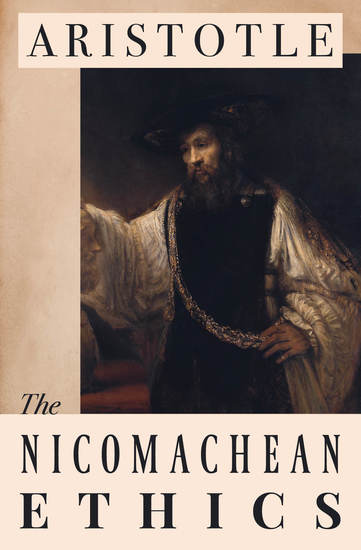
The Nicomachean Ethics - cover

The Nicomachean Ethics

Aristotle

Publisher: Open Road Media

  • 0
  • 0
  • 0

Summary

This landmark work from the ancient Greek philosopher takes an in-depth look at the goal of life: happiness. One of Aristotle’s most widely read and influential works, The Nicomachean Ethics examines how to live well and be a good person. Aristotle explores the nature of happiness and how we achieve it. He discusses numerous moral virtues, such as courage, temperance, liberality, and magnanimity, as well as their corresponding vices. He also elucidates the concepts of pleasure, love, and friendship. The Nicomachean Ethics is considered one of the most important philosophical works in history. It influenced the Middle Ages as well as modern philosophy and European law and theology.
Available since: 11/29/2022.
Print length: 368 pages.

Other books that might interest you

  • Redefining Moments - A Collection of Events Which Changed One Life - cover

    Redefining Moments - A...

    Anonymous

    • 0
    • 0
    • 0
    Michael Baer's life mirrors his own passion for learning. He delights in the thrill of a search, the celebration of a find, and the gift of bringing to light a discovery to share with others.  
    This collection of stories and accounts from Michael's life illustrates the power of "redefining moments" - experiences which profoundly shape our character and map out pathways through life. In this book,  Michael shares some of his most treasured "redefining moments" with us.
    Show book
  • Medieval Bosnia: The Turbulent History of Bosnia and the Region during the Middle Ages - cover

    Medieval Bosnia: The Turbulent...

    Editors Charles River

    • 0
    • 0
    • 0
    Much has been written about Western intervention during the breakup of Yugoslavia, and whether it made matters worse, prevented worse atrocities, or was simply ineffective. In early 1992, however, what was clear was that Europe was hopelessly divided over the best course of action to take towards Yugoslavia, and after several years of fighting, the Bosnian War was one of the most violent conflagrations in Europe since the end of World War II.  
    That war had been the byproduct of centuries of tensions in the Balkans, and an attempt in the wake of World War I to redraw the political boundaries of Europe and the Middle East. That included forming the Kingdom of Yugoslavia, initially known as the Kingdom of Serbs, Croats and Slovenes, a particularly fragile enterprise, and there was almost constant tension between the majority Serbs and the other Yugoslav nationalities, especially the Croats.  
    Depending on the source, many authors have focused on different catalysts for Yugoslavia’s demise, but Vesna Drapac may have succinctly summed the situation up when he wrote that by the end, the state “lacked a reason to exist.” There is certainly something in this sentiment, but the disintegration came at an enormous cost. 
    Given what happened in Yugoslavia, it should be little surprise that Bosnia did not have its fully-established borders until the 19th century, and even in modern times, in many respects the people distinguished and defined Bosnia as a polity more than its shifting borders, and regardless of whether Bosnia operated as an independent state or kingdom. It was during the Middle Ages that Bosnia’s culture and ethnic makeup truly began to coalesce, despite the politically rocky nature of the era in the Balkans. 
    Show book
  • Abbreviated Life An - A Memoir - cover

    Abbreviated Life An - A Memoir

    Anonymous

    • 0
    • 0
    • 0
    A beautiful, startling, and candid memoir about growing up without boundaries, in which Ariel Leve recalls with candor and sensitivity the turbulent time she endured as the only child of an unstable poet for a mother and a beloved but largely absent father, and explores the consequences of a psychologically harrowing childhood as she seeks refuge from the past and recovers what was lost. 
    Ariel Leve grew up in Manhattan with an eccentric mother she describes as “a poet, an artist, a self-appointed troublemaker and attention seeker.” Leve learned to become her own parent, taking care of herself and her mother’s needs. There would be uncontrolled, impulsive rages followed with denial, disavowed responsibility, and then extreme outpourings of affection. How does a child learn to feel safe in this topsy-turvy world of conditional love? 
    Leve captures the chaos and lasting impact of a child’s life under siege and explores how the coping mechanisms she developed to survive later incapacitated her as an adult. There were material comforts, but no emotional safety, except for summer visits to her father’s home in South East Asia—an escape that was terminated after he attempted to gain custody. Following the death of a loving caretaker, a succession of replacements raised Leve—relationships which resulted in intense attachment and loss. It was not until decades later, when Leve moved to other side of the world, that she could begin to emancipate herself from the past. In a relationship with a man who has children, caring for them yields clarity of what was missing. 
    In telling her haunting story, Leve seeks to understand the effects of chronic psychological maltreatment on a child’s developing brain, and to discover how to build a life for herself that she never dreamed possible: An unabbreviated life.
    Show book
  • Reimagining Government - Achieving the Promise of AI - cover

    Reimagining Government -...

    Thomas H. Davenport, Faisal...

    • 0
    • 0
    • 0
    How AI can help the government lead with speed, trust, and impact.Artificial Intelligence is reshaping what is possible across every sector—and public service is no exception. Reimagining Government is a bold, practical playbook for harnessing AI to deliver smarter, faster, and more effective outcomes. Inside, you'll find: 
    · Clear breakdowns of AI opportunities and challenges in the government space 
    · Proven frameworks and maturity models for responsible, scalable adoption 
    · Insights and examples from real-world government innovators 
    · Strategies to transform leadership, culture, and public impactWritten for policymakers, technologists, and civic leaders, this book is a guide to making AI work—for people as well as for systems.
    Show book
  • Wounds into Wisdom - Healing Intergenerational Jewish Trauma - cover

    Wounds into Wisdom - Healing...

    PhD Rabbi Tirzah Firestone, MD...

    • 0
    • 0
    • 0
    Our past does not simply disappear. The painful history of our ancestors and their rich cultural wisdom intertwine within us to create the patterns of our future. Even when past trauma remains unspoken or has long been forgotten, it becomes part of us and our children—a legacy of both strength and woundedness that shapes our lives. 


    In this book, Tirzah Firestone brings to life the profound impact of protracted historical trauma through the compelling narratives of Israeli terror victims, Holocaust survivors, and those whose lives were marred by racial persecution and displacement. The tragic story of Firestone's own family lays the groundwork for these revealing testimonies of recovery, forgiveness, and moral leadership. 


    Throughout, Firestone interweaves their voices with neuroscientific and psychological findings, as well as relevant and inspiring Jewish teachings. Seven principles emerge from these wise narratives—powerful prescriptive tools that speak to anyone dealing with the effects of past injury. At the broadest level, these principles are directives for staying morally awake in a world rife with terror.
    Show book
  • The Forbidden Knowledge of the Book of Enoch - The Watchers Nephilim Fallen Angels and the End of the World - cover

    The Forbidden Knowledge of the...

    Harold Roth

    • 0
    • 0
    • 0
    “Lore of the Watcher angels is an important and often overlooked part of Jewish and Christian traditions that exerts a strong influence on Western magic and occultism. Harold Roth tackles complicated texts like the books of Enoch and Jubilees alongside traditions like Merkavah mysticism and Christian demonology and, in plain language, gives the clearest and best examination of the Watchers and the Nephilim that I have come across yet.” —Jason Miller, author of Consorting with Spirits and other books   The Book of Enoch has captured and commanded interest for the past two thousand years. Sometimes part of religious canon and doctrine, and sometimes outright banned, the Book of Enoch is more popular today than ever. Still many questions remain. Who was Enoch? Who—or what—were the Watchers, and what knowledge did they bring? What became of their wives and their children, the rapacious half-man, half-angel giants, the Nephilim?   From Renaissance magic of Dr. John Dee and early Christian apocalyptic texts, to contemporary conspiracy theories and modern magical angelology, the Book of Enoch has been influential in many spiritual and religious traditions. What has been missing from the various approaches to the Book of Enoch are any real attempts to find not only what is at the center of these stories but also their connections to magic. The Forbidden Knowledge of the Book of Enoch identifies and elucidates those connections.
    Show book