Join us on a literary world trip!
Add this book to bookshelf
Grey
Write a new comment Default profile 50px
Grey
Subscribe to read the full book or read the first pages for free!
All characters reduced
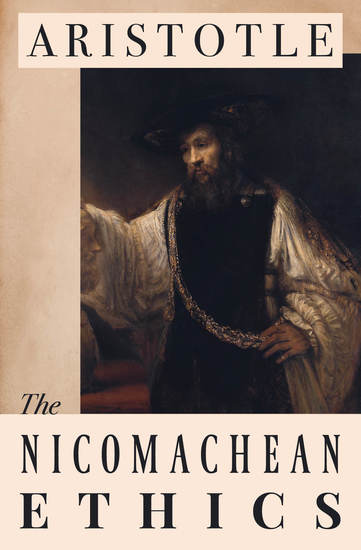
The Nicomachean Ethics - cover

The Nicomachean Ethics

Aristotle

Publisher: Open Road Media

  • 0
  • 0
  • 0

Summary

This landmark work from the ancient Greek philosopher takes an in-depth look at the goal of life: happiness. One of Aristotle’s most widely read and influential works, The Nicomachean Ethics examines how to live well and be a good person. Aristotle explores the nature of happiness and how we achieve it. He discusses numerous moral virtues, such as courage, temperance, liberality, and magnanimity, as well as their corresponding vices. He also elucidates the concepts of pleasure, love, and friendship. The Nicomachean Ethics is considered one of the most important philosophical works in history. It influenced the Middle Ages as well as modern philosophy and European law and theology.
Available since: 11/29/2022.
Print length: 368 pages.

Other books that might interest you

  • How to Be Caring - An Ancient Guide to a Compassionate Life - cover

    How to Be Caring - An Ancient...

    Shantideva

    • 0
    • 0
    • 0
    Written by the medieval Indian Buddhist monk Shantideva, The Bodhicaryavatara is one of the most beloved and frequently taught works in Buddhism and a favorite of the Dalai Lama. An inspiring and powerful poem that uses a gripping, first-person, confessional voice, it is the most systematic work of ethical thought in the Indo-Tibetan Buddhist tradition. And its invaluable insights, exhortations, and encouragements about how we can relieve suffering by becoming more caring and compassionate are universal. In How to Be Caring, philosopher and Buddhist scholar Jay Garfield presents a lively new translation of selected verses from Shantideva’s text that capture its powerful lessons for all of us. The result is the clearest, most concise, and most accessible introduction to this masterful Buddhist guidebook about how we can change the world by changing ourselves.Focusing on the life of a bodhisattva, a person committed to attaining awakening for the benefit of all beings, Shantideva argues that the first step to reducing suffering and making the world better is to conquer our own psychopathologies. Urging us to remember that we won’t live forever and therefore need to think about what is most important, the work seeks to inspire us and teach us how to be more generous, thoughtful, polite, patient, committed, and self-aware.
    Show book
  • Grief's Second Mile - Beyond the First Year - cover

    Grief's Second Mile - Beyond the...

    Doug Manning

    • 0
    • 0
    • 0
    Most bereavement materials are focused on the first year of the grieving experience. We have often been asked, "What do you have for after the first anniversary?" In response to this need, Doug Manning has written this book, Grief's Second Mile: Life Beyond the First Year. 
    Grief's Second Mile addresses some of the specific losses such as the death after extended illness, death of a child, suicide, violent or unresolved deaths, and why those may lengthen or stall the person's ability to approach the necessary transitions of grief in a healthy or complete manner. He provides insights and suggestions for developing ways to express feelings and cope with the loss and how to seek the help that is vital. Doug focuses on allowing the reader to feel "normal" in their search and to discover the answers that are right for them. 
    A valuable resource for those families who are struggling or would appreciate something that speaks to their grieving beyond the first year. 
    Show book
  • Hillbilly Elegy - A Memoir of a Family and Culture in Crisis - cover

    Hillbilly Elegy - A Memoir of a...

    Anonymous

    • 0
    • 0
    • 0
    Hillbilly Elegy recounts J.D. Vance's powerful origin story... 
    From a former marine and Yale Law School graduate now serving as a U.S. Senator from Ohio and the Republican Vice Presidential candidate for the 2024 election, an incisive account of growing up in a poor Rust Belt town that offers a broader, probing look at the struggles of America's white working class. 
    THE #1 NEW YORK TIMES BESTSELLER 
    ""You will not read a more important book about America this year.""—The Economist 
    ""A riveting book.""—The Wall Street Journal 
    ""Essential reading.""—David Brooks, New York Times 
    Hillbilly Elegy is a passionate and personal analysis of a culture in crisis—that of white working-class Americans. The disintegration of this group, a process that has been slowly occurring now for more than forty years, has been reported with growing frequency and alarm, but has never before been written about as searingly from the inside. J. D. Vance tells the true story of what a social, regional, and class decline feels like when you were born with it hung around your neck. 
    The Vance family story begins hopefully in postwar America. J. D.'s grandparents were ""dirt poor and in love,"" and moved north from Kentucky's Appalachia region to Ohio in the hopes of escaping the dreadful poverty around them. They raised a middle-class family, and eventually one of their grandchildren would graduate from Yale Law School, a conventional marker of success in achieving generational upward mobility. But as the family saga of Hillbilly Elegy plays out, we learn that J.D.'s grandparents, aunt, uncle, and, most of all, his mother struggled profoundly with the demands of their new middle-class life, never fully escaping the legacy of abuse, alcoholism, poverty, and trauma so characteristic of their part of America. With piercing honesty, Vance shows how he himself still carries around the demons of his chaotic family history. 
    A deeply moving memoir, with its share of humor and vividly colorful figures, Hillbilly Elegy is the story of how upward mobility really feels. And it is an urgent and troubling meditation on the loss of the American dream for a large segment of this country.
    Show book
  • Representative Democracy - A Justification - cover

    Representative Democracy - A...

    Dimitri Landa, Ryan Pevnick

    • 0
    • 0
    • 0
    Despite the not-so-distant invocations of the "end of history," representative democracy is, today, under siege even from corners where one once might have expected strong sympathy and support. Indeed, confidence in representative democracy has, in recent years, been shaken by the economic and political performance of many such regimes. 
     
    Representative Democracy explains why the definitive institutional features of representative democracy—the electoral selection of policymaking officials who are independent in the interim between elections—are attractive relative to salient alternatives (including direct democracy, lottery-based systems, and meritocratic alternatives) and, relatedly, why it is a distinctively attractive institutional arrangement, rather than—as it is often perceived to be—a pale stand-in for more robust and genuine forms of democratic government. Building on novel arguments that connect the distinctive institutional features of representative democracy to important epistemic and stability-based benefits, the book provides a normative account of a well-functioning system of representative democracy against which proposed reforms can be evaluated.
    Show book
  • The Last Island - Discovery Defiance and the Most Elusive Tribe on Earth - cover

    The Last Island - Discovery...

    Adam Goodheart

    • 0
    • 0
    • 0
    In November 2018, a zealous American missionary was killed while attempting to visit an island he called "Satan's last stronghold," a small patch of land known as North Sentinel in the Andaman Islands, a remote archipelago in the Indian Ocean. News of the tragedy fascinated people around the world. Most were unaware such a place still existed in our time: an island unmolested by the advances of modern technology. 


    Twenty years before the American missionary's ill-fated visit, a young American historian and journalist named Adam Goodheart also traveled to the waters off North Sentinel. During his time in the Andaman Islands, he witnessed another isolated tribe emerge into modernity for the first time. 


    Now, Goodheart—a bestselling historian—has returned to the Andamans. The Last Island is a work of history as well as travel, a journey in time as well as place. It tells the stories of others drawn to North Sentinel's mystery through the centuries, from imperial adventurers to an eccentric Victorian photographer to modern-day anthropologists. It narrates the tragic stories of other Andaman tribes' encounters with the outside world. And it shows how the web of modernity is drawing ever closer to the island's shores.
    Show book
  • Phoenician Language and Writing: The History and Legacy of the Ancient World’s Most Influential Script - cover

    Phoenician Language and Writing:...

    Editors Charles River

    • 0
    • 0
    • 0
    There is no doubt that the alphabets and forms of writing employed by most European languages comes directly from the Phoenicians, but the process by which that took place is still a mystery. Some of the ancient historians provided theories concerning how the Phoenicians gave their alphabet and system of writing to the Greeks, and Herodotus offered an account that is probably more accurate than most. He claimed, “The Phoenicians who came with Cadmus – amongst whom were the Gephyraei – introduced into Greece, after their settlement in the country, a number of accomplishments, of which the most important was writing, an art till then, I think, unknown to the Greeks. At first, they used the same characters as all the other Phoenicians, but as time went on, and they changed their language, they also changed the shape of their letters. At that period most of the Greeks in the neighborhood were Ionians; they were also taught these letters by the Phoenicians and adopted them, with a few alterations, for their own use, continuing to refer to them as Phoenician characters – as was only right, as the Phoenicians had introduced them.”  
    Like many of Herodotus’ other passages in Histories, there is truth wrapped with some errors. The Greeks certainly knew of the concept of writing before the Phoenicians, as the Mycenaeans used the Linear B script, but that knowledge had vanished at the end of the Bronze Age (Morkot 1996, 18). Perhaps what makes Herodotus’ account accurate and most interesting is his description of how the writing evolved. He mentions how the Greeks “changed the shape of their letters”, which is the normal course when any group of people adopts a script to write their native language. For example, there are slight variations in the Latin script employed by most modern Western European languages, such as the umlauts in German or the various accents in French and Spanish.
    Show book