Join us on a literary world trip!
Add this book to bookshelf
Grey
Write a new comment Default profile 50px
Grey
Subscribe to read the full book or read the first pages for free!
All characters reduced
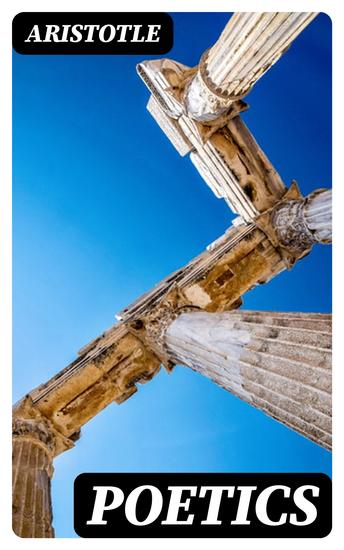
Poetics - cover

Poetics

Aristotle

Translator S. H. Butcher

Publisher: DigiCat

  • 0
  • 0
  • 0

Summary

Aristotle's "Poetics" stands as a seminal text in the foundation of literary theory, wherein he meticulously analyzes the principles of dramatic and epic poetry. Written in the 4th century BCE, this work deftly bridges philosophical inquiry with the art of storytelling, presenting concepts such as mimesis, catharsis, and the unities of time, place, and action. Aristotle's analytical style combines empirical observation with deductive reasoning, offering a systematic inquiry into the nature of poetry and its emotive effects on audiences. His exploration of tragedy, in particular, delineates the characteristics of heroic narratives and serves as a cornerstone for the future development of dramatic literature in the Western canon. As a towering figure in ancient philosophy, Aristotle's extensive educational and intellectual background informed his literary critiques. A student of Plato and a teacher of Alexander the Great, he cultivated a profound understanding of human nature and the societal roles that literature plays within it. His holistic approach to knowledge also encompassed natural sciences and ethics, allowing him to draw interdisciplinary connections that enrich his examination of poetic form and function. "Poetics" is essential for anyone keen on understanding the intricate mechanics of storytelling and dramatic art. Whether you are a scholar, a writer, or simply an avid reader, Aristotle's insights will deepen your appreciation for literature's ability to reflect and influence human experience. Engage with this timeless work to unlock the enduring principles that continue to shape narrative art.
Available since: 11/13/2022.
Print length: 38 pages.
Other books that might interest you

  • The Poetry of Lewis Carroll - The writer of Alice In Wonderland was an equally talented poet this anthology shows why he's regarded as one of the masters of word play - cover

    The Poetry of Lewis Carroll -...

    Lewis Carroll

    • 0
    • 0
    • 0
    Lewis Carroll was born Charles Lutwidge Dodgson on the 27th January 1832 at Daresbury, Cheshire, the eldest boy and the third child.  Another eight followed.   
     
    When Dodgson was 11, his cleric father moved his family to Croft-on-Tees in the North Riding of Yorkshire.  Although his father was active and highly conservative his son was ambivalent with those values and with the Church as a whole. 
     
    In his early years Dodgson was educated at home and by age 7 he was reading the likes of ‘The Pilgrim's Progress’.  He also spoke with a stammer which he called his ‘hesitation’. 
     
    At 12 he was dispatched to Richmond Grammar School in North Yorkshire and then on to Rugby.  He sailed through the curriculum.  He was accepted at Christ Church, Oxford but two days after arriving he was summoned home: his mother had died of ‘inflammation of the brain’ at only 47. 
     
    Dodgson was exceptionally gifted and, when not distracted, achievement came easily to him.  He remained at Christ Church studying and teaching in various capacities until his death. 
     
    In March 1856, he published the romantic poem ‘Solitude’ as by ‘Lewis Carroll’.  
     
    That same year he took up the new art of photography.  He soon excelled and became a well-known gentleman-photographer, and even toyed with the idea of making a living out of it.  When he ceased photography in 1880, he had his own studio and had created around 3,000 images. 
     
    He enjoyed moderate success with his early poems and short stories but had an array of other interests in the pre-Raphaelite circle, Psychical Research and even ordained in the Church of England in 1861.  
     
    In July 1862 he told a young Alice Liddell the story that would become his first and greatest success.  Alice begged him to write it down, and eventually he did and later presented her with a handwritten and illustrated ‘Alice's Adventures Under Ground’.  The publisher Macmillan agreed to publish it as ‘Alice's Adventures in Wonderland’ by Lewis Carroll.  
     
    It was a huge and sensational life-changing success.  Royalties quickly accumulated as did fan mail.  
     
    In 1871, the darker themed sequel ‘Through the Looking-Glass, and What Alice Found There’ was published.  A half decade later came ‘The Hunting of the Snark’, a fantastical nonsense poem, as nine tradesmen and a beaver set off to find the snark.  It was another enormous success. 
     
    He also loved to invent such delights as a writing tablet ‘the nyctograph’ that allowed note-taking in the dark as well as many word games, such as the precursor to ‘Scrabble’, and alternative systems of parliamentary voting.  Within the discipline of mathematics, he worked in geometry, linear and matrix algebra, mathematical logic, recreational mathematics and wrote nearly a dozen books on the subject.   
     
    Lewis Carroll died of pneumonia following influenza on 14th January 1898 in Guildford, Surrey.  He was 65.  
     
    1 - The Poetry of Lewis Carroll - An Introduction 
    2 - The Walrus & the Carpenter by Lewis Carroll 
    3 - A Lobster Quadrille by Lewis Carroll 
    4 - Turtle Soup by Lewis Carroll 
    5 - How Doth the Little Crocodile by Lewis Carroll 
    6 - Jabberwocky by Lewis Carroll 
    7 - A Valentine by Lewis Carroll 
    8 - The Mad Gardener's Song by Lewis Carroll 
    9 - The Knight's Song by Lewis Carroll 
    10 - The Deserted Parks by Lewis Carroll 
    11 - Humpty Dumpty's Recitation by Lewis Carroll 
    12 - A Boat Beneath a Sunny Sky (Life Is But a Dream) by Lewis Carroll 
    13 - You Are Old Father William (from Alice's Adventures in Wonderland) by Lewis Carroll 
    14 - Lays of Sorrow by Lewis Carroll 
    15 - A Sea Dirge by Lewis Carroll 
    16 - Melancholetta by Lewis Carroll 
    17 - Phantasmagoria.
    Show book
  • A Young Boy Named David Book 22 - cover

    A Young Boy Named David Book 22

    David M. Smith

    • 0
    • 0
    • 0
    The “Young Boy Named David” series is designed to help young people deal with difficult situations that are hard to talk about and adults reconnect to their disconnected childhood helping heal broken pasts. In Book 22, the very real and pressing issue of guns enters David's life. He learns a lesson about this that will definitely help our young ones growing up in this crazy world.
    Show book
  • Ballad of Old Joe Booth The (A Song For Eighth Block) - cover

    Ballad of Old Joe Booth The (A...

    William Pauley III

    • 0
    • 0
    • 0
    Some monsters are impossible to see.This is The Ballad of Old Joe Booth.An epic poem in four parts.A song for Eighth Block.
    Show book
  • The Treasure of the Sierra Madre - Adapted from the screenplay & performed for radio by the original film stars - cover

    The Treasure of the Sierra Madre...

    Mr Punch

    • 0
    • 0
    • 0
    Mr Punch Presents: THE TREASURE OF THE SIERRA MADRE, we follow the fortunes of three ill-matched gold diggers, who are searching for treasure in Mexico. As they hunt for their elusive prize, the three prospectors become progressively more corrupt and greedy and fall foul of each other’s all-consuming greed, in this exciting adventure story. With Humphrey Bogart recapturing his role as the wicked Fred C. Dobbs and Walter Huston as the grizzled old timer Howard, the role for which he received the Oscar as best supporting actor. 
     
    This high-quality audiobook has been re-mastered and re-edited from the original radio broadcast. 
      
    Also available as part of the Hollywood Playhouse BOX SET, a collection of 14 Oscar winning ear-movies, adapted from the original screenplays & performed for the radio by many of the original film stars in front of a live studio audience. 
      
    These radio dramas were….to become as popular as the movies themselves. Hollywood Movie Memories 
      
    This is an excellent audio product that will appeal to the majority of audiobook listeners. Talking Business 
      
    A lovely series to add to any film, audio or crime lovers’ collection. Audio World
    Show book
  • Talisman for the Soul - cover

    Talisman for the Soul

    Andrew Bell

    • 0
    • 0
    • 0
    ‘Talisman for the Soul’ is an immersive and illuminating collection that expresses a powerful intensity of emotion, exploring overarching themes of human interaction, as well as the human need to transform and adapt as individuals. Written by a poet of rare descriptive power, the poems speak to a world of increasing disconnection, one that is careering towards climate breakdown and ecological destruction. The poems seek to reconnect with the mystery and sacredness of human life by exploring the foundations of human identity through themes that touch us all: love and loss, humour, beauty, joy, relationships, and the natural world.
    Show book
  • Waley's Chinese Poetry - Including: The Poet Li Po A Hundred and Seventy Chinese Poems More Translations from the Chinese and Arthur Waley (Poems from the Chinese) - cover

    Waley's Chinese Poetry -...

    Arthur Waley

    • 0
    • 0
    • 0
    There have been many translators of Chinese literature and poetry over time, but Arthur Waley stands out as one of the best known and most loved. This is perhaps because he had an attribute that most others lacked, which is his poetic abilities. Waley was as much a poet himself as a translator, and while his scholarly erudition was matched by a few others at his time, none ever managed to bring out the true character of Chinese poetry quite so well. 
    Contained in this collection:The Poet Li Po A.D. 701-762, 1918A Hundred and Seventy Chinese Poems, 1918, Arthur WaleyMore Translations from the Chinese (Alfred A. Knopf, New York, 1919)Arthur Waley (Poems from the Chinese) 1920
    Show book