Join us on a literary world trip!
Add this book to bookshelf
Grey
Write a new comment Default profile 50px
Grey
Subscribe to read the full book or read the first pages for free!
All characters reduced
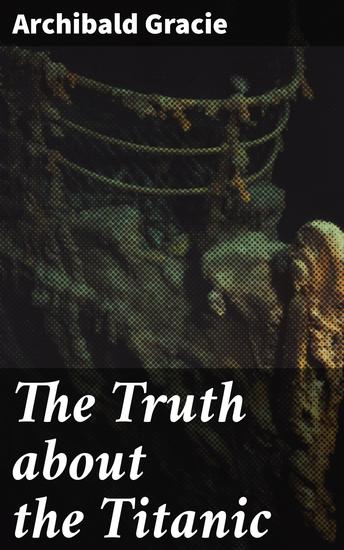
The Truth about the Titanic - Unveiling the Tragic Titanic Disaster: A Survivor's Account and Historical Investigation - cover

The Truth about the Titanic - Unveiling the Tragic Titanic Disaster: A Survivor's Account and Historical Investigation

Archibald Gracie

Publisher: Good Press

  • 0
  • 0
  • 0

Summary

Archibald Gracie's "The Truth about the Titanic" offers a unique and poignant perspective on one of history's most catastrophic maritime disasters. Written in the immediate aftermath of the Titanic's sinking in 1912, Gracie employs a first-person narrative style that weaves personal experience with factual recounting. His poignant prose balances the harrowing details of the tragedy with reflections on human bravery and folly, creating a powerful literary tapestry that captures the chaos and despair of that fateful night while also exploring themes of loss and survival in the face of overwhelming odds. Gracie's account is distinctively anchored in the zeitgeist of early 20th-century maritime culture, offering readers insight into the societal attitudes and technological advancements of the era. As a prominent New York businessman and survivor of the Titanic, Gracie'Äôs unique position lends credibility to his narrative. His lived experience as a cabin occupant aboard the ill-fated ship'Äîwhere he witnessed both the luxury and the peril of life aboard'Äîshapes his perspective. Gracie'Äôs efforts to document the events not only serve to enlighten future generations but also function as a cathartic process for his own trauma, reflecting the relentless human quest for understanding amidst tragedy. "The Truth about the Titanic" is an essential read for history enthusiasts and literary scholars alike. Gracie'Äôs vivid recollections provide an unparalleled glimpse into the complexities of human emotion and morality during one of history'Äôs most infamous disasters. This book is both a historical document and a profound personal narrative, recommended for anyone seeking to comprehend the full impact of the Titanic sinking and the indomitable spirit of its survivors.
Available since: 08/21/2022.
Print length: 184 pages.

Other books that might interest you

  • Discourses on Livy - cover

    Discourses on Livy

    Niccolò Machiavelli

    • 0
    • 0
    • 0
    Discourses on Livy is the founding document of modern republicanism, and Harvey C. Mansfield and Nathan Tarcov have provided the definitive English translation of this classic work. Faithful to the original Italian text, properly attentive to Machiavelli’s idiom and subtlety of thought, it is eminently readable. With a substantial introduction, extensive explanatory notes, a glossary of key words, and an annotated index, the Discourses reveals Machiavelli’s radical vision of a new science of politics, a vision of “new modes and orders” that continue to shape the modern ethos. 
     
    “[Machiavelli] found in Livy the means to inspire scholars for five centuries. Within the Discourses, often hidden and sometimes unintended by their author, lie the seeds of modern political thought. . . . [Mansfield and Tarcov’s] translation is careful and idiomatic.”—Peter Stothard, The Times 
     
    ”Translated with painstaking accuracy—but also great readability.”—Weekly Standard 
     
    ”A model of contemporary scholarship and a brave effort at Machiavelli translation that allows the great Florentine to speak in his own voice.”—Choice
    Show book
  • The City of The Sun - cover

    The City of The Sun

    Tommaso Campanella

    • 0
    • 0
    • 0
    The City of the Sun is a philosophical work by the Italian Dominican philosopher Tommaso Campanella. It is an important early utopian work. The work was written in Italian in 1602, shortly after Campanella's imprisonment for heresy and sedition. A Latin version was written in 1613–1614 and published in Frankfurt in 1623. 
    The book is presented as a dialogue between "a Grandmaster of the Knights Hospitaller and a Genoese Sea-Captain". Inspired by Plato's Republic and the description of Atlantis in Timaeus, it describes a theocratic society where goods, women and children are held in common. It also resembles the City of Adocentyn in the Picatrix, an Arabic grimoire of astrological magic. In the final part of the work, Campanella prophesies—in the veiled language of astrology—that the Spanish kings, in alliance with the Pope, are destined to be the instruments of a Divine Plan: the final victory of the True Faith and its diffusion in the whole world. While one could argue that Campanella was simply thinking of the conquest of the New World, it seems that this prophecy should be interpreted in the light of a work written shortly before The City of the Sun, The Monarchy in Spain, in which Campanella exposes his vision of a unified, peaceful world governed by a theocratic monarchy.
    Show book
  • Fate: Part V - Dive (Yaoi MM Monster Romance) - cover

    Fate: Part V - Dive (Yaoi MM...

    Kai Aubrey

    • 0
    • 0
    • 0
    The message is penned upon thick, ornate parchment. Gold and silver threads woven into the paper glimmer as Cecil holds the strange letter aloft. 
    By invitation of Lord Valdan VI, you are invited to a social banquet at the imperial palace. 
    Please bring a guest. 
    Males only. 
    --- 
    CONTAINS EXPLICIT GAY SEXUAL CONTENT. 
    For more stories, visit www.KaiAubrey.com.
    Show book
  • Kiran Mazumdar-Shaw - cover

    Kiran Mazumdar-Shaw

    Press Trust Of India

    • 0
    • 0
    • 0
    Kiran Mazumdar-Shaw recognized among world's top 20 inspirational leaders in Biopharma
    Show book
  • Gladiators - History and Background of Roman Slave Fighters - cover

    Gladiators - History and...

    Kelly Mass

    • 0
    • 0
    • 0
    Gladiators were highly trained warriors who fought to the death for the entertainment of the Roman public. These brutal battles took place in large arenas throughout the Roman Republic and Empire, where gladiators would engage in combat with other fighters, wild animals, or even condemned criminals. The fights were often bloody and merciless, designed to showcase the might and martial prowess of the Roman world. While some gladiators volunteered, seeking fame and fortune in the arena, many were slaves or prisoners of war who were forced to fight. 
    The life of a gladiator was harsh and dangerous. Those who entered the arena did so at great personal risk, as their fights often meant risking their lives for the entertainment of the masses. Even voluntary gladiators, known as "auctorati," gambled with their personal safety and social standing. They had little to no rights and were subject to the whims of their owners or sponsors. Gladiators who survived and fought well could gain fame and admiration, but their lives were fraught with physical injury and emotional isolation. The training they underwent was grueling, often conducted in harsh conditions at special training schools known as "ludi," where they were forced to endure relentless drills and punishments. 
    Gladiators were not only fighters but also symbols of Roman martial virtues. Through their valor and resilience in the arena, they represented Rome's ideals of strength, honor, and discipline. Their performances were often immortalized in Roman art and artifacts, with their images appearing on coins, pottery, and sculptures. Despite the grim nature of their lives, gladiators could gain popular admiration for their ability to fight bravely or die with honor. Some even became beloved figures in Roman culture, celebrated in both elite and everyday art.
    Show book
  • Decolonizing Language and Other Revolutionary Ideas - cover

    Decolonizing Language and Other...

    Ngũgĩ wa Thiong’o

    • 0
    • 0
    • 0
    Ngũgĩ wa Thiong'o was a towering figure in African literature, and his novels A Grain of Wheat; Weep Not, Child; and Petals of Blood are modern classics. Emerging from a literary scene that flourished in the 1950s and '60s during the last years of colonialism in Africa, he became known not just as a novelist—one who, in the late '70s, famously stopped writing novels in English and turned to the language he grew up speaking, Gĩkũyũ—but as a major postcolonial theorist. 


    In Decolonizing Language and Other Revolutionary Ideas, Ngũgĩ gives us a series of essays that build on the revolutionary ideas about language and its constructive role in national culture, history, and identity that he set out in his earlier work. 


    Intricate and deeply nuanced, this collection examines the enduring power of African languages in resisting both the psychic and material impacts of colonialism, past and present. 


    A brave call for discourse and immensely relevant to our present moment, Decolonizing Language and Other Revolutionary Ideas works both as a wonderful introduction to the enduring themes of Ngũgĩ's work as well as a vital addition to the library of the world's greatest and most provocative writers.
    Show book