Junte-se a nós em uma viagem ao mundo dos livros!
Adicionar este livro à prateleira
Grey
Deixe um novo comentário Default profile 50px
Grey
Assine para ler o livro completo ou leia as primeiras páginas de graça!
All characters reduced
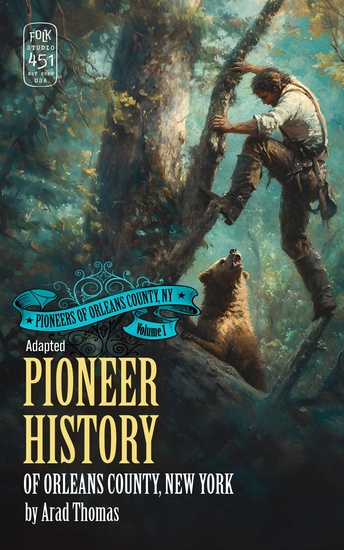
Pioneer History of Orleans County New York - cover
LER

Pioneer History of Orleans County New York

Arad Thomas

Editora: FOLK STUDIO 451

  • 0
  • 0
  • 0

Sinopse

Follow the journeys of pioneer families as they leave the relative comfort of New England, joined by immigrants from diverse backgrounds, to carve out a new life in the untamed wilderness of Western New York.
 
Spanning the years 1790 to 1824, this era unfolds in the wake of the Revolutionary War, through the trials of the War of 1812, and touches upon stories that echo even into the Great Rebellion. Their courage and determination shaped a rugged frontier into thriving communities, laying the foundation for generations to come.
 
Marvel at their fortitude as they fight bears, withstand debilitating sickness, and struggle to survive starvation during the “year without a summer.”
 
Explore the founding of villages, the formation of towns, and the personal tales of the early settlers richly detailed in their own words, all meticulously detailed in this significant historical work by Arad Thomas (1871).
 
This annotated version includes updated language for modern readers, a comprehensive glossary, and an extended name and subject index.
Disponível desde: 10/02/2025.
Comprimento de impressão: 590 páginas.

Outros livros que poderiam interessá-lo

  • Healing Grounds - Climate Justice and the Deep Roots of Regenerative Farming - cover

    Healing Grounds - Climate...

    Liz Carlisle

    • 0
    • 0
    • 0
    A powerful movement is happening in farming—farmers are reconnecting with their roots to fight climate change. 


    In Healing Grounds, Liz Carlisle tells the stories of Indigenous, Black, Latinx, and Asian American farmers who are reviving their ancestors' methods of growing food—techniques long suppressed by the industrial food system. These farmers are restoring native prairies, nurturing beneficial fungi, and enriching soil health. While feeding their communities and revitalizing cultural ties to land, they are steadily stitching ecosystems back together and repairing the natural carbon cycle. This is the true regenerative agriculture—not merely a set of technical tricks for storing CO2 in the ground, but a holistic approach that values diversity in both plants and people. 


    Cultivating this kind of regenerative farming will require reckoning with our nation's agricultural history—a history marked by discrimination and displacement. And it will ultimately require dismantling power structures that have blocked many farmers of color from owning land or building wealth. 


    By coming together to restore these farmlands, we can not only heal our planet, we can heal our communities.
    Ver livro
  • Mind-Lines Lines for Changing Minds - The Magic of Conversational Reframing - cover

    Mind-Lines Lines for Changing...

    L. Michael Hall, Bob Bodenhamer

    • 0
    • 0
    • 0
    This book will teach you how to recognize and use the magic of language. Mind-Lines reworks Sleight-of-Mouth patterns using the logical level system of Meta-States. In doing so the authors bring order, understanding, and magic to the use of language in influencing, persuading, selling, negotiating, and many other human interactions.
    Ver livro
  • Monkey to Man - The Evolution of the March of Progress Image - cover

    Monkey to Man - The Evolution of...

    Gowan Dawson

    • 0
    • 0
    • 0
    The first book to examine the iconic depiction of evolution, the "march of progress," and its role in shaping our understanding of how humans evolved 


    We are all familiar with the "march of progress," the representation of evolution that depicts a series of apelike creatures becoming progressively taller and more erect before finally reaching the upright human form. Its emphasis on linear progress has had a decisive impact on public understanding of evolution, yet the image contradicts modern scientific conceptions of evolution as complex and branching. 


    This book is the first to examine the origins and history of this ubiquitous and hugely consequential illustration. In a story spanning more than a century, from Victorian Britain to America in the Space Age, Gowan Dawson traces the interconnected histories of the two most important versions of the image: the frontispiece to Thomas Henry Huxley's Evidence as to Man's Place in Nature (1863) and "The Road to Homo Sapiens," a fold-out illustration in the bestselling book Early Man (1965). Dawson explores how the recurring appearances of this image pointed to shifting scientific and public perspectives on human evolution, as well as indicated novel artistic approaches, and advancements in technology.
    Ver livro
  • Bringing Mindfulness Into the Classroom - Easy Ideas You Can Try Tomorrow - cover

    Bringing Mindfulness Into the...

    Tara Segree

    • 0
    • 0
    • 0
    How can we help our students navigate challenges with confidence, mental well-being, and presence? While many schools implement social emotional learning or guidance programs, this book shows an easy, effective, and sustainable way to incorporate mindfulness into your classroom no matter what grade or subject you teach. 


    Tara Segree, recipient of the 2021 Innovative Educator Award and a collaborator of the Mini Meditations for Kids podcast, shows how mindful practices can help students build confidence, overcome anxiety, focus, engage in learning, find their strengths, and more. 


    Chapters provide tools and activities for incorporating mindfulness into your day-to-day teaching, as well as ideas for partnering with families so students can continue their practice at home. Special features include The 30-Day Mindfulness Challenge to give you an accessible way to try mindfulness with your students, and journal prompts to help you on your own mindfulness journey.
    Ver livro
  • World War 3: How Close Are We Really? - cover

    World War 3: How Close Are We...

    Marcus Reed

    • 0
    • 0
    • 0
    The world of 2025 feels more fragile than ever. From the war in Ukraine and rising tensions in the Taiwan Strait, to proxy battles in the Middle East and the militarization of the Arctic, global flashpoints are multiplying. Technology, cyberattacks, nuclear weapons, and fragile alliances create a dangerous mix where one mistake could ignite World War 3. 
    This audiobook explores the reality behind the headlines and asks the urgent question: how close are we, really, to a global conflict? 
    You will discover: 
     
    The regions most likely to spark escalation — Ukraine, Taiwan, the Middle East, and beyond.How cyber warfare, AI, and hypersonic missiles are changing the rules of conflict.Why nuclear deterrence, once a safeguard, may now be the greatest risk of all.How alliances like NATO can both protect and endanger global stability.The psychology of leaders under pressure, and why miscalculation could be catastrophic. 
    Neutral, clear, and unsettling, World War 3: How Close Are We Really? is not about panic — it’s about awareness. It shows the fragile silence holding our world together, and reminds us that the future is not written. 
    The storm hasn’t started yet. But the silence is breaking.
    Ver livro
  • How to Cope - An Ancient Guide to Enduring Hardship - cover

    How to Cope - An Ancient Guide...

    Boethius

    • 0
    • 0
    • 0
    A vivid and accessible new translation of essential selections from Boethius's Consolation of PhilosophyWhat do you do when your life has fallen apart? Fifteen hundred years ago, a Roman nobleman named Boethius asked this question as he was sitting in a prison cell waiting to die, accused—probably unjustly—of treason. Boethius had been a rich and powerful man with all a person could want in life, but now he had lost everything. Shaken, he wondered how such terrible misfortune could have happened to him and why life was so unfair. When Philosophy herself appears in his cell and confronts Boethius, the conversation that follows between the two on the nature of evil and why humans suffer is as powerful and inspiring today as it was to its first readers. In How to Cope, Philip Freeman presents a lively modern translation of essential selections from Boethius's classic.This translation vividly captures Boethius's journey from bitterness and anger to reconciliation and peace, showing how ancient philosophy, especially Stoicism, can help listeners deal with adversity in their own lives. The book reveals the qualities that have made The Consolation of Philosophy one of the most popular and influential works of classical and world literature, and an inspiration to countless writers, including Thomas Aquinas, Dante, and Chaucer.
    Ver livro