Join us on a literary world trip!
Add this book to bookshelf
Grey
Write a new comment Default profile 50px
Grey
Subscribe to read the full book or read the first pages for free!
All characters reduced
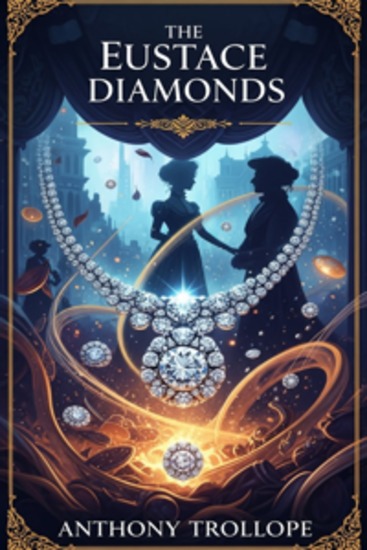
The Eustace Diamonds - cover

The Eustace Diamonds

Anthony Trollope

Publisher: Bu Classics Books

  • 0
  • 0
  • 0

Summary

Lizzie Eustace, a beautiful and cunning widow, finds herself at the center of a scandalous legal battle over a valuable diamond necklace she claims as a heirloom. Her web of lies and manipulations entraps suitors, lawyers, and family members, exposing the greed and hypocrisy lurking beneath the surface of polite society. The narrative combines elements of a mystery with biting social satire, as the diamonds become a symbol of the hollow values of the upper class. Lizzie’s relentless pursuit of wealth and status creates a chaotic yet mesmerizing spectacle of deception.
Available since: 01/29/2026.
Print length: 1068 pages.

Other books that might interest you

  • Vanka - From their pens to your ears genius in every story - cover

    Vanka - From their pens to your...

    Anton Chekhov

    • 0
    • 0
    • 0
    Anton Pavlovich Chekhov was born on 29th January 1860 in Taganrog, on the south coast of Russia.  
    His family life was difficult; his father was strict and over-bearing but his mother was a passionate story-teller, a subject Chekhov warmed to. As he later said; ‘our talents we got from our father, but our soul from our mother’.  
    At school Chekhov was distinctly average. At 16 his father mis-managed his finances and was declared bankrupt. His family fled to Moscow. Chekhov remained and eked out a living by various means, including writing and selling short sketches to newspapers, to finish his schooling. That completed and with a scholarship to Moscow University obtained he rejoined his family. 
    He was able to help support them by selling satirical sketches and vignettes of Russian lifestyles and gradually obtained further commissions. In 1884, he qualified as a physician and, although it earned him little, he often treated the poor for free, he was fond of saying ‘Medicine is my lawful wife, and literature is my mistress.’ 
    His own health was now an issue as he began to cough up blood, a symptom of tuberculosis.  Despite this his writing success enabled him to move the family into more comfortable accommodation.  
    Chekhov wrote over 500 short stories which included many, many classics including ‘The Kiss’ and ‘The Lady with a Dog’.  His collection ‘At Dusk’ won him the coveted Pushkin Prize when was only 26.  
    He was also a major playwright beginning with the huge success of ‘Ivanov’ in 1887.   
    In 1892 Chekhov bought a country estate north of Moscow. Here his medical skills and money helped the peasants tackle outbreaks of cholera and bouts of famine. He also built three schools, a fire station and a clinic.  It left him with less time for writing but the interactions with real people gained him detailed knowledge about the peasantry and their living conditions for his stories.  
    His most famous work, ‘The Seagull’ was received disastrously at its premiere in St Petersburg. It was later restaged in Moscow to highlight its psychological aspects and was a huge success. It led to ‘Uncle Vanya’, ‘The Three Sisters’ and ‘The Cherry Orchard’.  
    Chekhov suffered a major lung hemorrhage in 1897 while visiting Moscow. A formal diagnosis confirmed tuberculosis and the doctors ordered changes to his lifestyle.  
    Despite a dread of weddings the elusive literary bachelor quietly married the actress Olga Knipper, whom he had met at rehearsals for ‘The Seagull’, on 25th May 1901. 
    By May 1904 with his tuberculosis worsening and death imminent he set off for the German town of Badenweiler writing cheerful, witty letters to his family and assuring them his health was improving.  
    On 15th July 1904 Anton Chekhov died at Badenweiler.  He was 44.
    Show book
  • Notes from Underground - cover

    Notes from Underground

    Fyodor Dostoyevsky

    • 0
    • 0
    • 0
    Notes from Underground also translated as Notes from the Underground or Letters from the Underworld) is a novella by Fyodor Dostoevsky, first published in the journal Epoch in 1864. It is a first-person narrative in the form of a "confession": the work was originally announced by Dostoevsky in Epoch under the title "A Confession".The novella presents itself as an excerpt from the memoirs of a bitter, isolated, unnamed narrator (generally referred to by critics as the Underground Man), who is a retired civil servant living in St. Petersburg. Although the first part of the novella has the form of a monologue, the narrator's form of address to his reader is acutely dialogized. According to Mikhail Bakhtin, in the Underground Man's confession "there is literally not a single monologically firm, undissociated word". The Underground Man's every word anticipates the words of an other, with whom he enters into an obsessive internal polemic.
    Show book
  • The Lost World - An Uncharted Amazonian Plateau A Prehistoric Secret The Greatest Adventure in the History of Science - cover

    The Lost World - An Uncharted...

    Yvonne Schaefer

    • 0
    • 0
    • 0
    Is there any room left in the world for true romance and daring heroics? 
    Young journalist Edward Malone is desperate to prove his worth to the woman he loves. When he begs his editor for the most dangerous assignment available, he is sent to interview the notorious, irascible, and fiercely imposing Professor George Edward Challenger. The Professor has just returned from an isolated plateau deep in the uncharted Amazon basin with claims that defy all modern science: prehistoric life still walks the earth. 
    Met with mockery and outrage by the scientific establishment of London, Challenger dares his detractors to see the truth for themselves. Joined by a cynical rival professor, a fearless big-game hunter, and the eager young Malone, the expedition sets sail for the treacherous jungles of South America. 
    Will they uncover the greatest biological miracle of the twentieth century, or vanish forever into the jaws of a primordial nightmare? Step into a world where time stands still, dinosaurs rule, and every shadow conceals a heart-pounding threat in this masterful tale of exploration and survival.
    Show book
  • A Dreamer - From their pens to your ears genius in every story - cover

    A Dreamer - From their pens to...

    Barbara Baynton

    • 0
    • 0
    • 0
    The bookshelves of World literature are incredible collections that have gathered together centuries of very talented authors.  From their countries and continents their fame spread and whilst among their number many are now forgotten or neglected their talents endure.  Among them is Barbara Baynton.
    Show book
  • A Farewell to Arms - cover

    A Farewell to Arms

    Ernest Hemingway

    • 0
    • 0
    • 0
    This new audiobook edition of Hemingway's classic is narrated by Audie Award nominee and AudioFile Golden Voice Kevin R. Free.  
    It is a moving and beautiful book. —Percy Hutchison in the The New York Times Book Review, 1929  
    Hemingway’s rhythmic, stripped-down, often-mimicked style lulls readers into a sort of trance that allows his final line to explode like a tossed grenade, devastating in its simplicity. —Valerie Trapp in The Atlantic, in their list of The Great American Novels  
    Frederic Henry is an American lieutenant of an ambulance corps serving in the Italian front of World War I. During his service he meets Catherine Barkley, an English nurse who goes on to work closely with him.  
    As the relationship between Frederic and Catherine develops, the novel follows the effects the war has on them and those around them. But the war is not the centerpiece of the book; rather, it serves more as a background and plot device for the growth of the characters’ interpersonal relationships.  
    A Farewell to Arms went on to become his first bestseller, with contemporary critics calling it “the premier American war novel from World War I.” It cemented his reputation as a powerful voice of the Lost Generation, and modern critics consider it among his best works.
    Show book
  • The Trail Of The Serpent - cover

    The Trail Of The Serpent

    M. E. Braddon

    • 0
    • 0
    • 0
    On a cold and stormy night in Slopperton-on-the-Sloshy, Richard Marwood returns after a mysterious and long disappearance. While his rich uncle aids him in starting a new life, his reappearance is quickly upended after he is apparently framed for murder. Meanwhile, Jabez North—prodigal son of Slopperton-on-the-Sloshy—schemes to make his fortunes by any means possible. The Trail of the Serpent is M. E. Braddon's first book. Although it initially met with poor sales under its original title of Three Times Dead , it was later revised and re-issued under its current title to much wider recognition, and is now considered to be one of the first British detective novels. M. E. Braddon (died 1915) was a prominent voice of the late 19th and early 20th century. Their work has endured across generations and continues to be read and studied worldwide. As a work of classic literary fiction, The Trail Of The Serpent exemplifies the narrative craft and social insight that defined great storytelling of its era. Literary fiction of this period was characterized by careful attention to character psychology, social milieu, and the moral questions that animated public discourse.
    Show book