Join us on a literary world trip!
Add this book to bookshelf
Grey
Write a new comment Default profile 50px
Grey
Subscribe to read the full book or read the first pages for free!
All characters reduced
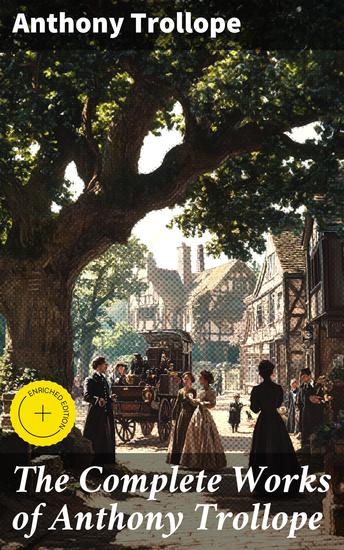
The Complete Works of Anthony Trollope - Enriched edition Exploring Victorian Society Through Masterpiece Novels - cover

The Complete Works of Anthony Trollope - Enriched edition Exploring Victorian Society Through Masterpiece Novels

Anthony Trollope

Publisher: Good Press

  • 0
  • 0
  • 0

Summary

Anthony Trollope's "The Complete Works of Anthony Trollope" presents a comprehensive collection of the author's extensive literary oeuvre, showcasing his mastery in chronicling Victorian society's complexities through a blend of realism and keen observation. This anthology encapsulates his signature narrative style, characterized by meticulous character development and intricate social dynamics. Spanning themes of politics, love, and morality, his prose offers a window into the societal norms and values of 19th-century Britain, making it an indispensable resource for understanding the era's literary landscape. Born in 1815, Trollope's background in the postal service and his extensive travels across England and Ireland profoundly influenced his literary perspective. His experiences with class structures, rural life, and urban dynamics enriched his storytelling, allowing him to portray both the grand and the mundane aspects of human life with equal eloquence. Trollope's prolific output was driven by a passionate commitment to reflect societal truths, making his work a vital part of the Victorian literary canon. This anthology is highly recommended for both literary scholars and casual readers alike. It serves not only as a treasure trove of engaging narratives but also as an essential study of the intricacies of human nature and societal structures. Trollope's penetrating insights and wit invite readers to explore the enduring themes that resonate throughout time.

In this enriched edition, we have carefully created added value for your reading experience:
- A comprehensive Introduction outlines these selected works' unifying features, themes, or stylistic evolutions.
- The Author Biography highlights personal milestones and literary influences that shape the entire body of writing.
- A Historical Context section situates the works in their broader era—social currents, cultural trends, and key events that underpin their creation.
- A concise Synopsis (Selection) offers an accessible overview of the included texts, helping readers navigate plotlines and main ideas without revealing critical twists.
- A unified Analysis examines recurring motifs and stylistic hallmarks across the collection, tying the stories together while spotlighting the different work's strengths.
- Reflection questions inspire deeper contemplation of the author's overarching message, inviting readers to draw connections among different texts and relate them to modern contexts.
- Lastly, our hand‐picked Memorable Quotes distill pivotal lines and turning points, serving as touchstones for the collection's central themes.
Available since: 12/28/2023.
Print length: 20640 pages.

Other books that might interest you

  • The Adventure of the Sussex Vampire - cover

    The Adventure of the Sussex Vampire

    Arthur Conan Doyle

    • 0
    • 0
    • 0
    The Adventure of the Sussex Vampire by Arthur Conan Doyle is a classic Sherlock Holmes mystery that blends gothic atmosphere, domestic intrigue, and Holmes’s signature deductive brilliance. When a distraught husband seeks Holmes’s help after witnessing his wife appearing to bite their infant son, rumors of vampirism spread through the quiet Sussex countryside. Holmes and Watson investigate the troubling case, uncovering layers of jealousy, childhood resentment, and cultural misunderstandings beneath the eerie accusations.
    Show book
  • After the Funeral - From their pens to your ears genius in every story - cover

    After the Funeral - From their...

    Mary Butts

    • 0
    • 0
    • 0
    Mary Frances Butts was born on 13th December 1890 in Poole, Dorset. 
    Her early years were spent at Salterns, an 18th-century house overlooking Poole Harbour.  Sadly in 1905 her father died, and she was sent for boarding at St Leonard's school for girls in St Andrews. 
    Her mother remarried and, from 1909, Mary studied at Westfield College in London, and here, first became aware of her bisexual feelings.  She was sent down for organising a trip to Epsom races and only completed her degree in 1914 when she graduated from the London School of Economics.  By then Mary had become an admirer of the occultist Aleister Crowley and she was given a co-authorship credit on his ‘Magick (Book 4)’. 
    In 1916, she began the diary which would now detail her future life and be a constant reference point for her observations and her absorbing experiences. 
    During World War I, she was doing social work for the London County Council in Hackney Wick, and involved in a lesbian relationship.  Life changed after meeting the modernist poet, John Rodker and they married in 1918. 
    In 1921 she spent 3 months at Aleister Crowley's Abbey of Thelema in Sicily; she found the practices dreadful and also acquired a drug habit.  Mary now spent time writing in Dorset, including her celebrated book of short stories ‘Speed the Plough’ which saw fully develop her unique Modernist prose style. 
    Europe now beckoned and several years were spent in Paris befriending many artists and writing further extraordinary stories.   
    She was continually sought after by literary magazines and also published several short story collections as books. Although a Modernist writer she worked in other genres but is essentially only known for her short stories.  Mary was deeply committed to nature conservation and wrote several pamphlets attacking the growing pollution of the countryside. 
    In 1927, she divorced and the following year her novel ‘Armed with Madness’ was published.  A further marriage followed in 1930 and time was spent attempting to settle in London and Newcastle before setting up home on the western tip of Cornwall.  By 1934 the marriage had failed. 
    Mary Butts died on 5th March 1937, at the West Cornwall Hospital, Penzance, after an operation for a perforated gastric ulcer. She was 46.
    Show book
  • The Reversible Santa Claus - cover

    The Reversible Santa Claus

    Meredith Nicholson

    • 0
    • 0
    • 0
    Celebrate the holiday season with The Reversible Santa Claus by Meredith Nicholson, a charming and whimsical tale brought to life by the narration of Brian Mark Mitchell. This delightful story follows a mischievous twist on the classic Santa Claus legend, blending humor, adventure, and holiday spirit. Whether sneaking into or out of a cozy, snow-covered home or facing comedic mix-ups, this Santa’s escapades will leave listeners of all ages grinning from ear to ear. 
    Filled with festive charm and warm humor, this audiobook offers a fresh and entertaining take on holiday storytelling. Perfect for families, holiday enthusiasts, or anyone who enjoys a lighthearted Christmas tale, The Reversible Santa Claus is sure to become a seasonal favorite. 
    Brian Mark Mitchell’s lively narration enhances the humor and heart of this story, making it a must-listen for fans of holiday classics. Step into a snow-filled world of laughter, surprises, and festive cheer with this unforgettable holiday audiobook.
    Show book
  • Soldiers' Pay - cover

    Soldiers' Pay

    William Faulkner

    • 0
    • 0
    • 0
    A wounded aviator returns home after his time in World War One. Escorted to his small hometown in Georgia by another wounded veteran of the war and a widow, he faces the many realities that come with his return: his anything-but-loyal fiancée, the silence he lives in because of his head injury, and the widow who plans to marry him herself.
    Show book
  • Frau Brechenmacher Attends a Wedding - cover

    Frau Brechenmacher Attends a...

    Mansfield Katherine

    • 0
    • 0
    • 0
    In Frau Brechenmacher Attends a Wedding by Katherine Mansfield we have the theme of gender roles, domination, submission, control, struggle, identity and tradition. Taken from her In a German Pension collection the story is narrated in the third person by an unnamed narrator and after reading the story the reader realises that Mansfield may be exploring the theme of control. Throughout the story Frau Brechenmacher is at the beck and call of her husband.
    Show book
  • A Wagner Matinee - From their pens to your ears genius in every story - cover

    A Wagner Matinee - From their...

    Willa Cather

    • 0
    • 0
    • 0
    Willa Sibert Cather had Welsh ancestry but like her parents Charles and Mary, was born in Virginia, on 7th December 1873.  Despite strong roots in the community, Willa was 9, when the family moved to Nebraska, to work the rich soil and avoid TB of which there were numerous outbreaks in Virginia.   
    The vastness and drama of the Nebraska prairie and its’ extreme weather conditions as well as the many diverse cultures of the local families proved to be a major influence on her and can be evidenced in much of her later writing.   
    Her first writing was for the local journal when she was at the University of Nebraska and later became the managing editor of the student newspaper.    
    In 1896 she obtained work for a woman’s magazine in Pittsburgh and soon after became a regular contributor to the Pittsburgh Leader and wrote poetry and short stories for the Library, another local publication.   
    Her first collection of short stories, ‘The Troll Garden’, was published in 1905 and contains several of her most famous including ‘A Wagner Matinee’ and ‘Paul's Case.’ As a writer Cather was now taking immense strides forward.   
    Between 1913 and 1918 Cather wrote her Prairie Trilogy: ‘O Pioneers!’, ‘The Song of the Lark’, and ‘My Ántonia’ and in 1922 the Pulitizer Prize was hers for her novel ‘One of Ours’ set during WWI.  
    Acknowledged as one of America's greatest writers’ further honours flowed. In 1943 she was elected a Fellow of the American Academy of Arts and Sciences. The following year Cather received the gold medal for fiction from the National Institute of Arts and Letters.  
    A determinedly private person, Cather destroyed many old drafts, personal papers, and letters. Her will would also restrict the ability of scholars to quote from personal papers that remained. 
    On 24th April 1947, Willa Siebert Cather died of a cerebral haemorrhage at her Manhattan home. She was 73.
    Show book