Join us on a literary world trip!
Add this book to bookshelf
Grey
Write a new comment Default profile 50px
Grey
Subscribe to read the full book or read the first pages for free!
All characters reduced
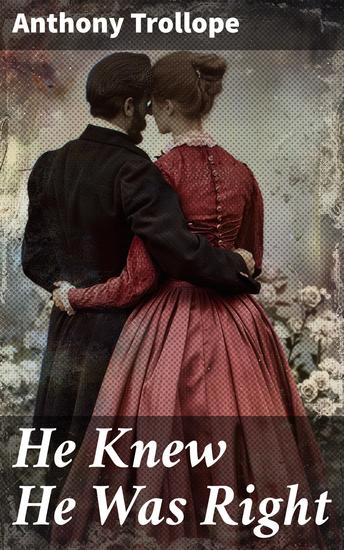
He Knew He Was Right - Victorian Romance Novel - cover

He Knew He Was Right - Victorian Romance Novel

Anthony Trollope

Publisher: Good Press

  • 0
  • 0
  • 0

Summary

Anthony Trollope's "He Knew He Was Right" is a compelling exploration of marriage, jealousy, and societal norms within Victorian England. The novel intricately weaves together the lives of its characters, primarily focusing on the obsessive relationship between the protagonist, Louis Trevelyan, and his wife, Emily. Trollope's writing style is characterized by its psychological depth and keen social insight, employing a narrative technique that oscillates between omniscient commentary and intimate character perspectives. The novel's rich, descriptive prose not only captures the moral dilemmas faced by the characters but also critiques the rigid social conventions of the time. Trollope, a prominent figure in the Victorian literary scene, had firsthand experience of the complexities of marriage and relationships, having navigated multiple personal challenges in his own life. His relentless dedication to his writing and his keen observation of human behavior shine through in this work. Drawing upon his own experiences and keen social awareness, Trollope delves into the darker facets of love and possession, elevating the narrative to a profound commentary on the nature of trust and autonomy in marriage. This thought-provoking novel is highly recommended for readers interested in Victorian literature, psychological drama, and social commentary. Trollope's nuanced character studies and rich narrative will resonate with anyone looking to understand the intricacies of human relationships. "He Knew He Was Right" remains a timeless lesson on love, trust, and the perils of obsession that continues to captivate audiences today.
Available since: 12/12/2023.
Print length: 836 pages.

Other books that might interest you

  • The Picture of Dorian Gray - Abridged for Intermediate English-Language Students (B1 B2) - cover

    The Picture of Dorian Gray -...

    Oscar Wilde, Gerhard Symons

    • 0
    • 0
    • 0
    This is an abridged audiobook of The Picture of Dorian Gray in English. It is intended for intermediate English-language students (CEFR: level B1/B2). 
    This audiobook is a simplified version of the classic story by nineteenth-century playwright and novelist Oscar Wilde (1854-1900). 
    It is abridged and narrated by Gerhard Symons, a native English speaker with a neutral English accent. 
    The audiobook run time is five hours and fifty minutes (350 minutes). The audiobook is enhanced with appropriate sound effects throughout. 
    -- 
    WHAT WOULD YOU DO FOR ETERNAL YOUTH? 
    Victorian London. One afternoon, a beautiful young man is sitting in an artist’s studio. His name is Dorian Gray. He is discussing life in the company of friends. 
    One of his friends convinces him that youth and beauty are the most important things in life. Dorian Gray fears growing old and ugly. He accepts this idea without question, and decides to make a terrible deal with the devil… 
    Every sin that Dorian commits has a cost. Every picture must be seen. Every pleasure that Dorian enjoys has a price. And Dorian will pay a terrible price for eternal youth… 
    © 2023 Three Thrushes
    Show book
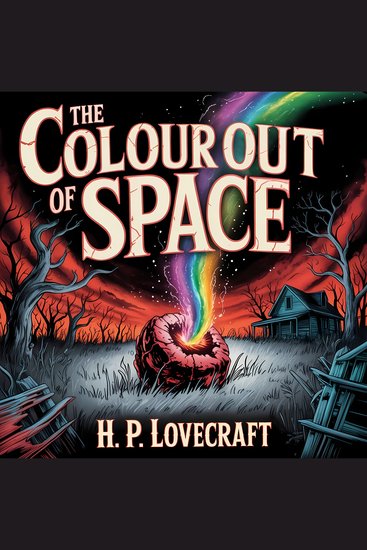
  • The Colour Out Of Space - A Classic Cosmic Horror Story of an Unknowable Force and Supernatural Terror - cover

    The Colour Out Of Space - A...

    H. P. Lovecraft

    • 0
    • 0
    • 0
    What if horror didn’t crawl, speak, or breathe - but fell from the sky? The Colour Out of Space is not just a story; it’s a chilling descent into a nightmare beyond human understanding. When a strange meteorite crashes onto a quiet New England farm, it leaves behind something impossible to describe - an unnatural presence that seeps into the land, the animals, and the people who live there. Crops rot, livestock change, and the air itself feels wrong as an invisible force spreads with silent, relentless intent. As you listen, dread builds slowly, twisting curiosity into fear while the familiar world decays into something alien and terrifying. This audiobook draws you deep into classic cosmic horror, where science fails and humanity stands powerless before the unknown. By the final moments, you won’t just understand the horror - you’ll feel it lingering, glowing faintly in the darkness long after the story ends. Press play, and discover a terror that cannot be named… only endured.
    Show book
  • Sparks from the Fire - And Other Strange Tales (Unabridged) - cover

    Sparks from the Fire - And Other...

    Rosalie Parker

    • 0
    • 0
    • 0
    "There are many ways to tell a story . . . It is a question of choosing the right one." - "Sparks from the Fire" The stories in Sparks from the Fire explore a wide variety of familiar characters and settings, yet there is always something else a shadow world that haunts, disturbs, and threatens. Sons and daughters, mothers and fathers, recluses and lovers all find themselves shifting between realities: the prosaic and the mystical, even between life and death. The horrors and wonders of these parallel existences are often glimpsed, sometimes revealed, and occasionally overwhelm. These nineteen tales inhabit a terrain in which the uncanny may at any time intrude into everyday life.
    Contents: Breath of Life / Entitlement / Holiday Reading / House Party / Jetsam / Job Start / Messages / Productivity / Sparks from the Fire / The Attempt / The Birdcage / The Bronze Statuette / The Fell Race / Tour Guide / View from a Window / Voluntary Work / War Games / Wing Man / Writers' Retreat.
    Show book
  • A Society - From their pens to your ears genius in every story - cover

    A Society - From their pens to...

    Virginia Woolf

    • 0
    • 0
    • 0
    Adeline Virginia Woolf was born on the 25th January 1882 in South Kensington in London. 
    Although lauded as a founder of modernist writing with such classics as ‘Orlando’, ‘Mrs Dalloway’ and ‘To the Lighthouse’ and, of course, many classic short stories, her background is filled with elements of tragedy that she somehow overcame to become such a revered writer.   Her mother died when she was 13, her half-sister Stella two years later and with it her first of several nervous breakdowns.  Appallingly it was later found that three of her half-brothers had sexually abused her so darkness must have seemed ever present.   
    She began writing professionally at age 20 but her father’s death two years later brought a complete mental collapse and she was briefly institutionalised.  Somehow she found within herself a literary career and with it great innovations in writing; she was a pioneer of “stream of consciousness”.    
    Her tight circle of friends were the founders of the Bloomsbury Group, a movement whose legacy still influences across the arts and society in many way to this day.   
    Whilst the dark periods continued to interrupt her emotional state her rate of work never ceased.  Until, on 28th March 1941, Woolf put on her overcoat, filled up its pockets with stones, and walked into the River Ouse, in Lewes, East Sussex and drowned herself.  Her body was not recovered until the 18th April.  She was 59. 
    She left behind a note which read in part “Dearest, I feel certain that I am going mad again.  I feel we can't go through another of those terrible times.  And I shan't recover this time.  I begin to hear voices, and I can't concentrate.  So I am doing what seems the best thing to do”.
    Show book
  • A Diagnosis of Death - From their pens to your ears genius in every story - cover

    A Diagnosis of Death - From...

    Ambrose Bierce

    • 0
    • 0
    • 0
    Ambrose Gwinnett Bierce was born on 24th June 1842 at Horse Cave Creek in Meigs County, Ohio. His parents were poor but they introduced him to literature at an early age, instilling in him a deep appreciation of books, the written word and the elegance of language.  
    Growing up in Koscuisko County, Indiana poverty and religion were defining features of his childhood, and he would later describe his parents as “unwashed savages” and fanatically religious, showing him little affection but always quick to punish. He came to resent religion, and his introduction to literature appears to be their only positive effect. 
    At age 15 Bierce left home to become a printer’s devil, mixing ink and fetching type at The Northern Indian, a small Ohio paper. Falsely accused of theft he returned to his farm and spent time sending out work in the hopes of being published. 
    His Uncle Lucius advised he be sent to the Kentucky Military Institute. A year later he was commissioned as an Officer.  As the Civil War started Bierce enlisted in the 9th Indiana Infantry Regiment.  
    In April 1862 Bierce fought at the Battle of Shiloh, an experience which, though terrifying, became the source of several short stories. Two years later he sustained a serious head wound and was off duty for several months. He was discharged in early 1865.  
    A later expedition to inspect military outposts across the Great Plains took him all the way to San Francisco. He remained there to become involved with publishing and editing and to marry, Mary Ellen on Christmas Day 1871.  They had a child, Day, the following year.  
    In 1872 the family moved to England for 3 years where he wrote for Fun magazine. His son, Leigh, was born, and first book, ‘The Fiend’s Delight’, was published.  
    They returned to San Francisco and to work for a number of papers where he gained admiration for his crime reporting. In 1887 he began a column at the William Randolph Hearst’s San Francisco Examiner.  
    Bierce’s marriage fell apart when he discovered compromising letters to his wife from a secret admirer. The following year, 1889 his son Day committed suicide, depressed by romantic rejection. 
    In 1891 Bierce wrote and published the collection of 26 short stories which included ‘An Occurrence at Owl Creek Bridge’.  Success and further works including poetry followed.  
    Bierce with Hearst’s resources helped uncover a financial plot by a railroad to turn 130 million dollars of loans into a handout. Confronted by the railroad and asked to name his price Bierce answered “my price is $130 million dollars. If, when you are ready to pay, I happen to be out of town, you may hand it over to my friend, the Treasurer of the United States”.  
    He now began his first foray as a fabulist, publishing ‘Fantastic Fables’ in 1899.  But tragedy again struck two years later when his second son Leigh died of pneumonia relating to his alcoholism.  
    He continued to write short stories and poetry and also published ‘The Devil’s Dictionary’.  
    At the age of 71, in 1913 Bierce departed from Washington, D.C., for a tour of the battlefields where he had fought during the civil war. At the city of Chihuahua he wrote his last known communication, a letter to a friend. It’s closing words were “as to me, I leave here tomorrow for an unknown destination,” Ambrose Bierce then vanished without trace.
    Show book
  • Dark Dignum - From their pens to your ears genius in every story - cover

    Dark Dignum - From their pens to...

    Bernard Capes

    • 0
    • 0
    • 0
    Bernard Edward Joseph Capes was born on the 30th August 1854 in London.  He was one of 11 children. 
    His early work was as a journalist and this developed into writing many short stories for the periodicals of the time including Blackwood's, Cassell's, Cornhill Magazine, Illustrated London News, Macmillan's Magazine, Mall Magazine, Pearson's Magazine, The Idler, and The Queen. 
    It took him many years to decide that writing full-time could be a sustainable career path.  His initial success came with ‘The Mill of Silence’.  As well as being published it garnered second prize at a competition sponsored by the Chicago Record.  He exceeded that by winning it the following year with ‘The Lake of Wine’.   
    Capes quickly became both prolific and popular.  As well as his stories and articles for the periodicals he wrote around 40 volumes across novels, poetry, history as well as romance and mystery novels. 
    Bernard Capes died on 2nd November 1918 in the flu epidemic.
    Show book