Junte-se a nós em uma viagem ao mundo dos livros!
Adicionar este livro à prateleira
Grey
Deixe um novo comentário Default profile 50px
Grey
Assine para ler o livro completo ou leia as primeiras páginas de graça!
All characters reduced
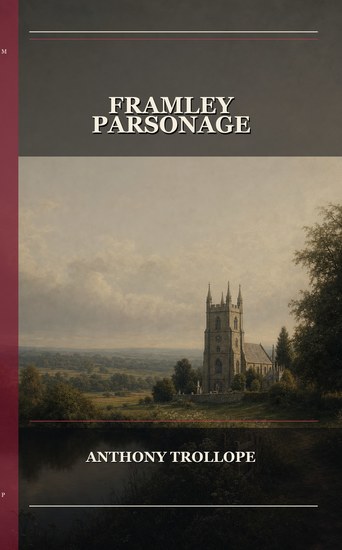
Framley Parsonage - cover
LER

Framley Parsonage

Anthony Trollope

Editora: Morlune Press

  • 0
  • 0
  • 0

Sinopse

Framley Parsonage is the fourth novel in Trollope's Chronicles of Barsetshire series. Originally a serial, it was first published as a book in 1861, and it has since been praised for its unsentimental depiction of the lives of middle-class people in the mid-Victorian era. As with the other books in the series, Framley Parsonage is set in the fictious English county of Barsetshire, and deals with the doings of a variety of families and characters who live in the region, several of whom have appeared in the previous books; but it primarily concerns the young Reverend Mark Robarts. Robarts has been appointed as vicar of the parish of Framley through the patronage of Lady Lufton of Framley Court, the mother of his long-time friend Ludovic, now Lord Lufton. After he and his wife Fanny take up residence in Framley Parsonage, Robarts is led into the society of some loose-living aristocrats through his friendship with Ludovic. Robarts eventually finds himself weakly consenting to his name being included on a bill for a loan to one of his new connections, Sowerby. By so doing, he becomes liable for debts he cannot possibly satisfy. An important secondary thread involves Mark Robarts' sister Lucy, who after their father's death comes to live with her brother's family at the parsonage. Through them, she becomes acquainted with Lady Lufton and her son Ludovic, and romantic complications ensue. Framley Parsonage was originally published anonymously in serial form in Cornhill Magazine , and such was its popularity that during its publication a hysterical young woman apparently tried to gain notoriety in her country town by claiming to be its author. "The real writer," we are told, "dealt very gently with the pretender."
Disponível desde: 19/05/2026.
Comprimento de impressão: 701 páginas.
Outros livros que poderiam interessá-lo

  • So Big - cover

    So Big

    Edna Ferber

    • 0
    • 0
    • 0
    Selina Peake moves from Chicago to a rural Dutch farming area just outside the city to teach in a one room school. As she attempts to fit into the community, she learns about her own strength in adapting to rural life. She marries an uneducated but sweet Dutch farmer named Pervus DeJong and has a son, Dirk, nicknamed "So Big." She wishes her son to have the same appreciation for the arts and education she has, and although he becomes an architect, his disillusionment with the architectural apprentice system leads him to a career as a successful bond salesman. He later regrets eschewing his architecture career when he meets a beautiful and eccentric artist. Ferber was not confident in the book's prospects when it was first published. Nevertheless, it became very popular, won her the Pulitzer Prize for Fiction in 1925, and was later made into three different motion pictures. Edna Ferber (died 1968) was a significant literary figure of the 20th century. Their work has endured across generations and continues to be read and studied worldwide. As a work of classic literary fiction, So Big exemplifies the narrative craft and social insight that defined great storytelling of its era. Literary fiction of this period was characterized by careful attention to character psychology, social milieu, and the moral questions that animated public discourse.
    Ver livro
  • The Black Moth - cover

    The Black Moth

    Georgette Heyer

    • 0
    • 0
    • 0
    We rely on your support to help us keep producing beautiful, free, and unrestricted editions of literature for the digital age. Will you support our efforts with a donation ? The Black Moth focuses on Lord Jack Carstares, an 18th-century earl who has retreated from society and become a highwayman after taking the blame for cheating at cards years ago. He meets our heroine, Diana Beauleigh, when he rescues her from an attempted abduction by the Duke of Andover, and the three of them proceed to have grand adventures. Published in 1921, The Black Moth is Georgette Heyer's first novel, and marks her debut as one of the originators of the modern historical romance. Set in the Georgian period, the novel features many of the elements that are characteristic of Heyer's work: action, romance, and aristocratic characters in a historical setting, all focusing on themes of love and honor. Georgette Heyer (died 1974) was a significant literary figure of the 20th century. Their work has endured across generations and continues to be read and studied worldwide. As a work of classic literary fiction, The Black Moth exemplifies the narrative craft and social insight that defined great storytelling of its era. Literary fiction of this period was characterized by careful attention to character psychology, social milieu, and the moral questions that animated public discourse.
    Ver livro
  • The Game of Life and How to Play It - cover

    The Game of Life and How to Play It

    Florence Scovel Shinn

    • 0
    • 0
    • 0
    The Game of Life and How to Play It by Florence Scovel Shinn is offered here in a clean English digital edition prepared for fluent ebook reading. The work stands within shakespeare and gives modern readers direct access to a public-domain classic with navigable structure and a restrained typographic presentation. The opening pages establish the book's atmosphere with this first movement: Most people consider life a battle, but it is not a battle, it is a game. It is a game, however, which cannot be played successfully without the knowledge of spiritual law, and the Old and the New Testaments give the rules of the game with wonderful clearness. Jesus Christ taught that it was a great This edition is suited to readers who want a reliable, uncluttered version of the text for study, rediscovery, and sustained reading.
    Ver livro
  • The Case-Book of Sherlock Holmes - cover

    The Case-Book of Sherlock Holmes

    Arthur Conan Doyle

    • 0
    • 0
    • 0
    A deadly secret in a quiet room. A vanished bride. A killer who leaves no trace—except the one clue Holmes refuses to miss.
    In these twelve gripping final stories, Sherlock Holmes confronts some of the most mysterious, unsettling, and emotionally charged cases of his career. From twisted revenge plots to chilling disappearances and impossible crimes, Holmes and Watson push deeper into the shadows than ever before.
    
    Celebrated as "a haunting and masterful conclusion to the Holmes canon," this collection showcases a more seasoned detective—sharper, darker, and remarkably human. Readers love the intense atmosphere, surprising twists, and unforgettable deductions.
    
    If you crave moody mysteries, psychological tension, and Holmes at his most complex, this essential volume will keep you turning pages long into the night.
    
    Enter Holmes's final casebook—start reading now and experience deduction at its most brilliant.
    Ver livro
  • Tales from Edgar Allan Poe - Volume 3 - cover

    Tales from Edgar Allan Poe -...

    Edgar Allan Poe

    • 0
    • 0
    • 0
    Edgar Allan Poe was an American writer, poet, editor and literary critic, considered part of the American Romantic Movement.  
    Best known for his tales of mystery and the macabre, Poe was one of the earliest American practitioners of the short story and is considered the inventor of the detective-fiction genre.  He is further credited with contributing to the emerging genre of science fiction. Here is a third collection of some of his best stories:  "The Oblong Box", "M.S. Found In A Bottle", and "Loss of Breath".
    Don't miss the other volumes in the Tales from Edgar Allan Poe collection.
    Public Domain (P)2012 Listen & Live Audio, Inc.
    Ver livro
  • God Sees the Truth But Waits - From their pens to your ears genius in every story - cover

    God Sees the Truth But Waits -...

    Leo Tolstoy

    • 0
    • 0
    • 0
    Leo Tolstoy was born in 1828 in the Russian province of Tula to a wealthy noble family. As a child, he had private tutors but he showed little interest in any formal education. When he went to the University of Kazan in 1843 to study oriental languages and law, he left without completing his courses.  Life now was relaxed and idle but with some writing also taking place.  Gambling debts forced an abrupt change of path and he joined the army to fight in the Crimean War.  He was commended for his bravery and promoted but was appalled at the brutality and loss of life.  He recorded these and other earlier experiences in his diaries which formed the basis of several of his works. 
    In 1852 ‘Childhood’ was published to immediate success and was followed by ‘Boyhood’ and ‘Youth’. 
    His experience in the army and the horrors he witnessed resulted in ‘The Cossacks’ in 1862 and the trilogy ‘Sevastopol Tales’. After the war he travelled around Europe, visiting London and Paris and meeting such luminaries as Victor Hugo and Charles Darwin.  
    It was now that Tolstoy began his masterpiece, ‘War and Peace’. Published in 1869 it was an epic work that changed literature. He quickly followed this with ‘Anna Karenina’.  
    These successes made Tolstoy rich and helped him accomplish many of his dreams but also brought problems as he grappled with his faith and the lot of the oppressed poor. These revolutionary views became so popular that the authorities now kept him under surveillance.  
    He led a life of asceticism and vegetarianism and put his socialist ideals into practice by establishing numerous schools for the poor and food programmes. He also believed in giving away his wealth, which caused much discord with his wife.  
    His writing continued to bring forth classics such as ‘The Death of Ivan Ilyich’ and many brilliant and incisive short stories such as ‘How Much Land Does A Man Need’.  
    In 1901 Tolstoy was excommunicated from the Church and controversially deselected for the Nobel Prize for Literature. 
    Whilst undertaking a pilgrimage by train in October 1910 with his daughter Aleksandra he caught pneumonia in the nearby town of Astapovo.  Leo Tolstoy died on November 9th, 1910, he was 82.
    Ver livro