Join us on a literary world trip!
Add this book to bookshelf
Grey
Write a new comment Default profile 50px
Grey
Subscribe to read the full book or read the first pages for free!
All characters reduced
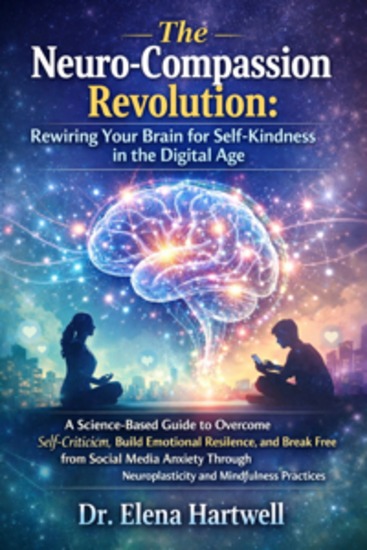
The Neuro-Compassion Revolution: Rewiring Your Brain for Self-Kindness in the Digital Age - A Science-Based Guide to Overcome Self-Criticism Build Emotional Resilience and Break Free from Social Media Anxiety Through Neuroplasticity and Mindfulness Practices - cover

The Neuro-Compassion Revolution: Rewiring Your Brain for Self-Kindness in the Digital Age - A Science-Based Guide to Overcome Self-Criticism Build Emotional Resilience and Break Free from Social Media Anxiety Through Neuroplasticity and Mindfulness Practices

Anonymous

Publisher: Da'pathfinder Publishing

  • 0
  • 0
  • 0

Summary

Transform Your Relationship with Yourself Through the Power of Brain ScienceAre you trapped in an endless cycle of self-criticism and digital comparison? Do you scroll through social media feeling like everyone else has it figured out while you're falling behind? Does your inner critic seem louder than ever in our hyperconnected world?You're not alone—and there's a scientifically proven way out.Discover the Neuro-Compassion RevolutionIn The Neuro-Compassion Revolution, Dr. Elena Hartwell reveals groundbreaking insights from neuroscience research that will change how you think about self-compassion forever. This isn't just another self-help book filled with empty platitudes—it's a science-based roadmap to literally rewire your brain for lasting change.What You'll Learn:✓ The Neuroscience of Self-Criticism – Discover why your brain is wired to be hard on yourself and how neuroplasticity gives you the power to change✓ Break Free from Digital Anxiety – Understand how social media hijacks your brain's reward system and learn practical strategies to reclaim your mental peace✓ The Three Pillars of Self-Compassion – Master the scientifically-validated framework that activates your brain's caregiving system and reduces stress✓ Escape Comparison Culture – Stop the exhausting cycle of measuring yourself against others' highlight reels and build authentic self-worth✓ Rewire Your Inner Dialogue – Transform harsh self-talk into supportive internal conversations that strengthen emotional resilience✓ Build Unshakeable Resilience – Develop the neural foundations that help you bounce back from setbacks faster and stronger✓ Digital Detox Strategies – Create healthy boundaries with technology that support your mental health without disconnecting from the world✓ Practical Daily Practices – Implement evidence-based exercises that create measurable brain changes in just weeksWhy This Book is Different:Unlike traditional self-help approaches, The Neuro-Compassion Revolution is grounded in cutting-edge brain research. Dr. Hartwell bridges the gap between ancient wisdom and modern neuroscience, showing you exactly how and why self-compassion practices work at the neurological level.Each chapter includes:Real neuroscience explained in accessible languageActionable practices you can start using immediatelyClear explanations of what's happening in your brainProven techniques backed by research studiesPerfect For:📱 Anyone struggling with social media anxiety and comparison 🧠 People interested in neuroplasticity and brain-based change 💭 Those battling chronic self-criticism and negative self-talk 🌱 Anyone seeking emotional resilience and mental well-being 🔬 Readers who want science-backed personal development 🧘 Mindfulness practitioners looking to deepen their practice 💪 Anyone ready to break free from perfectionism and self-judgmentThe Crisis is Real—But So is the SolutionWe're living through a mental health crisis fueled by digital overwhelm. Rates of anxiety, depression, and burnout are at all-time highs. But you have the power to rewire your brain's response to this challenging environment.Self-compassion isn't self-indulgence. Research shows that people who practice self-compassion are:More motivated to improve after failuresBetter at maintaining healthy relationshipsMore resilient in the face of stressLess prone to anxiety and depressionMore willing to take on meaningful challengesInside This Transformative Guide:PART 1: Understanding Your Brain Learn the neuroscience behind self-criticism and why the digital age makes it worse than everPART 2: The Three PillarsMaster self-kindness, common humanity, and mindful awareness—the scientifically-proven components of self-compassionPART 3: Rewiring Strategies Implement practical techniques for breaking comparison habits, transforming self-talk, and building lasting resiliencePART 4: Long-Term Transformation Create a sustainable practice that continues evolving throughout your life—and discover how your self-compassion ripples out to change the worldWhat Readers Are Saying:"Finally, a book that explains the neuroscience of self-compassion in a way that actually makes sense. Dr. Hartwell bridges the gap between brain science and real-life application perfectly.""I've read dozens of self-help books, but this is the first one that explained WHY the practices work. Understanding the neuroplasticity behind it made all the difference.""This book gave me hope that I can actually change my relationship with myself. The digital detox chapter alone was worth the price."Your Brain is Ready to Change—Are You?You weren't born with harsh self-criticism—you learned it. And what was learned can be unlearned through the remarkable power of neuroplasticity. Your brain is capable of profound transformation at any age.Every moment you choose self-kindness over self-attack, every recognition of common humanity, every practice of mindful awareness—these are literally changing your brain's structure and function.The question isn't whether you can develop self-compassion. The science proves you can.The question is: Will you?🎁 BONUS: Practical Exercises ThroughoutThis isn't just theory—you'll get step-by-step practices including:Self-compassion breaks for difficult momentsBody scan meditations for nervous system regulationJournaling prompts for transforming self-talkDigital boundaries that actually workQuick practices for busy schedulesDon't Wait Another Day Living at War with YourselfJoin the neuro-compassion movement and discover how treating yourself with kindness isn't just good psychology—it's good neuroscience.Scroll up and click "Buy Now" to start rewiring your brain for self-compassion today.
Available since: 01/06/2026.


Other books that might interest you

  • Patagonia: The History of the Southernmost Region in South America - cover

    Patagonia: The History of the...

    Editors Charles River

    • 0
    • 0
    • 0
    The name, "Patagonia" comes from an observation made by Ferdinand Magellan, who visited the region during his historic expedition around the world. Marveled by the height of the indigenous people, he referred to the region as a “land of giants.” Those giants were the Tehuelches, named by Magellan’s expedition as Patagones, and the chronicles of that trip, written by Antonio Pigafetta, popularized the term “Patagones,” a term that refers to their big feet (in Spanish, “patones” means "of big feet"). This description would later derive in the name Patagonia. 
    	From its discovery until the 20th century, the borders of Patagonia as well as those elements that define it as such have gone through several changes and names. The main thing for understanding its limits during the Spanish conquest is that Patagonia referred to the land south of the European area of influence. Back then, Patagonia was under control of indigenous inhabitants and, as such, outside European control or only partly influenced. It is no wonder, then, that the earliest limit was the Río de la Plata itself, where in 1536 (and again in 1580) the city of Buenos Aires was founded. Later on, the conquest of the territory, along with the work of cartographers from around the world, gave shape to the region.
    Show book
  • Feeding Washington's Army - Surviving the Valley Forge Winter of 1778 - cover

    Feeding Washington's Army -...

    Ricardo A. Herrera

    • 0
    • 0
    • 0
    In this major new history of the Continental Army's Grand Forage of 1778, award-winning military historian Ricardo A. Herrera uncovers what daily life was like for soldiers during the darkest and coldest days of the American Revolution: the Valley Forge winter. Here, the army launched its largest and riskiest operation—not a bloody battle against British forces but a campaign to feed itself and prevent starvation or dispersal during the long encampment. Herrera brings to light the army's herculean efforts to feed itself, support local and Continental governments, and challenge the British Army. 


    Highlighting the missteps and triumphs of both General George Washington and his officers as well as ordinary soldiers, sailors, and militiamen, Feeding Washington's Army moves far beyond oft-told, heroic, and mythical tales of Valley Forge and digs deeply into its daily reality, revealing how close the Continental Army came to succumbing to starvation and how strong and resourceful its soldiers and leaders actually were.
    Show book
  • Glossy - The inside story of Vogue - cover

    Glossy - The inside story of Vogue

    Nina-Sophia Miralles

    • 0
    • 0
    • 0
    Vogue magazine started, like so many great things do, in the spare room of someone's house. But unlike other such makeshift projects that flare up then fizzle away, Vogue burnt itself onto our cultural consciousness. 


    Today, 128 years later, Vogue spans twenty-two countries, has an international print readership upwards of twelve million, and nets over sixty-seven million monthly online users. Uncontested market leader for a century, it is one of the most recognizable brands in the world and a multi-million dollar money-making machine. It is not just a fashion magazine, it is the establishment. But what—and more importantly who—made Vogue such an enduring success? 


    Glossy will answer this question and more by tracing the previously untold history of the magazine, from its inception as a New York gossip rag, to the sleek, corporate behemoth we know now. This will be a biography of Vogue in every sense of the word, taking the listener through three centuries, two world wars, plunging failures, and blinding successes, as it charts the story of the magazine and those who ran it.
    Show book
  • Jesus Takes a Side - Embracing the Political Demands of the Gospel - cover

    Jesus Takes a Side - Embracing...

    Jonny Rashid

    • 0
    • 0
    • 0
    Jesus sides with the oppressed. Will you?In a world divided by left and right, red and blue, many Christians have upheld a “third way” approach in pursuit of moderation, harmony, and unity. But if Christians are more concerned with divisiveness than with faithfulness, we have failed to grasp the gospel’s political demands. We do not see Jesus taking a “third way” between oppressor and oppressed. And as followers of Jesus, neither should we.For the sake of our faith, for the sake of the least of these among us, and for Christ’s sake, Christians need to stand firmly for truth, peace, and justice. In Jesus Takes a Side, author Jonny Rashid lays out the political demands of following Jesus and offers strategies for how to engage politics practically and prophetically—even if it means taking a side. 
    Show book
  • The Erich Fromm Reader - Readings Selected and Edited by Rainer Funk - cover

    The Erich Fromm Reader -...

    Erich Fromm

    • 0
    • 0
    • 0
    “Fromm crossed the boundaries of traditional disciplines to expound his view on the alienation of man in an increasingly technological world.” —Newsweek Erich Fromm’s basic idea was to look at the individual as a social being, and to look at society as an ensemble of many individuals who have not only mutual ideas and convictions based on a common practice of life, but also a shared psychic structure. With his concept of “social character,” Fromm created a new interdisciplinary thinking presented in this compendium.The Erich Fromm Reader exhibits the true genius of an original thinker in seeing the connections between overlapping knowledge from many different fields. Here, interdisciplinarity is not only a lip service but the impact of Erich Fromm’s unique social psychological notion.  
    Show book
  • The Narcissist’s Maze - A Guide to Recognizing and Dealing with Narcissism - cover

    The Narcissist’s Maze - A Guide...

    Jordan Malik

    • 0
    • 0
    • 0
    Welcome to "The Narcissist's Maze: A Guide to Recognizing and Dealing with Narcissism." In the intricate web of human relationships, navigating the complexities of narcissism can be a challenging journey. This book serves as a compass, offering insights and practical guidance to help you recognize the subtle signs, understand the intricate dynamics, and empower yourself to break free from the grip of narcissistic relationships.  
    Narcissistic Personality Disorder (NPD) affects individuals across a spectrum, and its manifestations can vary widely. The first chapter, "Unveiling Narcissism," delves into the core of this disorder, providing a comprehensive understanding of its defining characteristics and shedding light on the diverse behaviors that fall within its spectrum. With this knowledge, readers will be better equipped to identify narcissistic traits in themselves or those around them.  
    Chapter two, "Early Signs and Red Flags," acts as a beacon, illuminating the warning signs that often go unnoticed. By exploring manipulative tactics and unraveling the layers of gaslighting, this chapter aims to empower readers to recognize these tactics early on, creating a shield against emotional manipulation.
    Show book