Join us on a literary world trip!
Add this book to bookshelf
Grey
Write a new comment Default profile 50px
Grey
Subscribe to read the full book or read the first pages for free!
All characters reduced
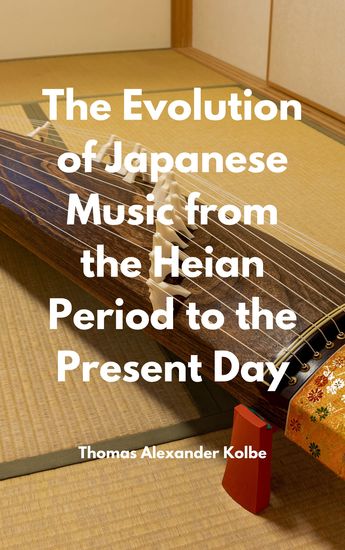
The Evolution of Japanese Music from the Heian Period to the Present Day - cover

The Evolution of Japanese Music from the Heian Period to the Present Day

Anonymous

Publisher: ah15 Publishing

  • 0
  • 0
  • 0

Summary

The ebook "The Evolution of Japanese Music from the Heian Period to the Present Day" covers the rich history and transformation of Japanese music across multiple periods. It explores key eras such as the Heian, Muromachi, Edo, and modern periods, focusing on how historical, political, and cultural shifts shaped musical forms.

During the Heian period (794–1185), Gagaku (court music) and Bugaku (dance) dominated the scene, representing the pinnacle of classical Japanese music tied to the imperial court. Instruments like the biwa and koto became central to these traditions. As Japan entered the Muromachi period (1336–1573), new musical influences from Zen Buddhism emerged, particularly through the use of the shakuhachi, a bamboo flute used by monks for meditation. Popular and folk music such as *dengaku* and *sarugaku* also evolved, becoming the foundation for future theatrical traditions like Noh.

The Azuchi-Momoyama period (1573–1603) saw continued development in Noh theater and the rise of Kabuki, a dynamic theatrical form combining music, dance, and drama. The introduction of Western music through European contact during this time brought new instruments like the guitar and harpsichord to Japan, although traditional instruments such as the shamisen became key to the emerging Bunraku puppet theater.

By the Edo period (1603–1868), Japan's isolationist policies preserved and refined its musical traditions. Kabuki and Bunraku became major cultural forces, heavily integrating music into their performances. The shamisen played a central role in both forms. Gagaku and other courtly traditions persisted but gradually became more ceremonial.

In the modern era, Western influences grew stronger, leading to a blending of traditional and contemporary styles, from classical Japanese music to the introduction of genres like J-pop and Enka, while maintaining the distinctiveness of traditional Japanese sound.

This historical journey shows how Japanese music continuously adapted to external influences while preserving its ancient roots.
Available since: 01/09/2025.
Print length: 20 pages.

Other books that might interest you

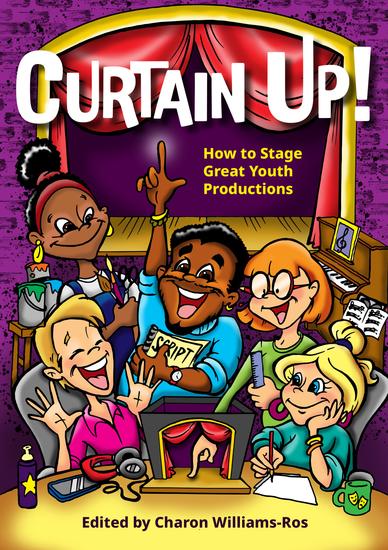
  • Curtain Up! - How to Stage Great Youth Productions - cover

    Curtain Up! - How to Stage Great...

    Charon Williams-Ros

    • 0
    • 0
    • 0
    This comprehensive, hands-on guide to making theatre – perfect for any school, college, youth group or amateur-theatre company – gives you the knowledge you need to take your productions to the next level.
    Curtain Up! is packed with invaluable advice and practical tips on every aspect of putting on your show, including:
    
    - Direction: from choosing your project to casting, rehearsals and opening night
    - Vocal Direction: give your singers and actors the confidence to deliver great performances
    - Choreography: step-by-step advice on bringing your choreography to life
    - Production Design: use set, costumes and more to realise your vision innovatively (and come in on budget)
    - Puppets & Props: inject some practical magic into your production – and how to make your own puppets
    - Scriptwriting: beat the blank page and pen your own original show
    - Lighting Design: maximise your resources to create a whole world on stage
    - Publicity: identify your audience, reach them and get those bums on seats
    Each section is written by an experienced theatre professional, laying out the essentials of every role and offering creative, practical ideas to breathe new life into your own theatre projects.
    Also included is a section on planning, with tips and worksheets to assist with everything from budgeting to selecting your production team.
    Wherever and however you make theatre, this inspiring, empowering and highly accessible manual will help make your next production your best yet!
    Show book
  • GLOBO ARTE JANUARY 2023 ISSUE - AN art magazine for helping artist in their art career - cover

    GLOBO ARTE JANUARY 2023 ISSUE -...

    Globo Arte team

    • 0
    • 0
    • 0
    Hi guys this is the January 2023 Magazine issue, s contains artists interviews to inspire artists, and so much more to help the artist in their art career,it contains artist interviews, art-related topics articles and question of the month, step of the month and social media updates
    Show book
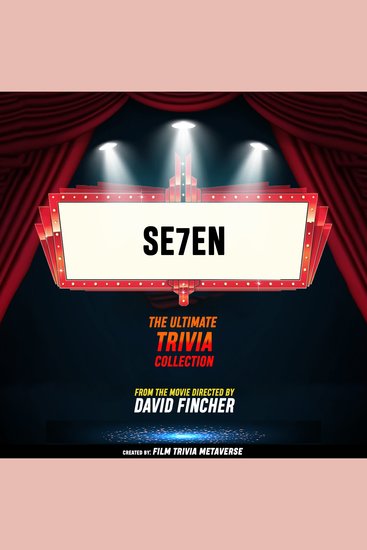
  • Se7en - The Ultimate Trivia Collection - From The Movie Directed By David Fincher - cover

    Se7en - The Ultimate Trivia...

    Film Trivia Metaverse

    • 0
    • 0
    • 0
    SE7EN 
    THE ULTIMATE TRIVIA COLLECTION 
      
    FROM THE MOVIE DIRECTED BY DAVID FINCHER 
      
    CREATED BY FILM TRIVIA METAVERSE 
      
    ABOUT THE FILM 
    Se7en is a psychological crime thriller directed by David Fincher. The film follows two detectives, the seasoned William Somerset and the impulsive David Mills, as they investigate a series of gruesome murders based on the seven deadly sins. The killer, known as John Doe, orchestrates his crimes as a twisted form of social commentary, leading the detectives into a dark and disturbing world. With its grim atmosphere, Se7en explores themes of morality, justice, and the human condition, using tension, suspense, and psychological horror to delve deep into the minds of both the detectives and the killer. 
      
    TRIVIA SAMPLES: 
      
    “Leland Orser prepared for his intense interrogation scene by rapidly breathing in and out to saturate his body with oxygen, enabling him to hyperventilate. Additionally, he stayed awake for several days to achieve a disoriented look for his character.” 
      
    “Initially, New Line executives were opposed to the film's ending, but Brad Pitt insisted on keeping it as is, refusing to participate if any changes were made.” 
      
    “Director David Fincher told both Kevin Spacey and Brad Pitt that while the film might not be the movie they'd be remembered for, it would be one they'd take immense pride in.” 
      
    “During the filming of the chase scene where Mills follows John Doe in the rain, Brad Pitt fell and injured his arm by smashing it through a car windshield. The injury was later incorporated into the script.”
    Show book
  • You Are Looking Live! - How The NFL Today Revolutionized Sports Broadcasting - cover

    You Are Looking Live! - How The...

    Rich Podolsky, Jim Nantz

    • 0
    • 0
    • 0
    You Are Looking Live! is about the genesis, success, and magic of a live television show that in 1975 captured the excitement of the country, and launched four magnetic personalities to stardom: Brent Musburger, Phyllis George, Irv Cross, and Jimmy The Greek Snyder. It was the first NFL studio show to go live and the first to have both a Black and female cohost. Those four personalities battled each other and the competition, and America loved them for it. 


    This is the story of how Brent, Phyllis, Irv, and Jimmy got there, their drama and front-page headlines, and what happened to them after the magic ended. Those headlines included Brent and The Greek's famous fight at Peartrees, Phyllis first marrying the man who produced The Godfather, then dropping him after two months for the next governor of Kentucky, and the shocking firing of Musburger on April Fool's Day, 1990. 


    America had never seen a show like this before. The NFL Today became so popular that it not only dominated the ratings, but also won its timeslot eighteen straight years, from 1975 to 1993, until CBS lost its NFL package to Fox. And today, looking back, these four personalities, like any family, had their own battles, and became even more famous for them.
    Show book
  • The Mysterious Romance of Murder - Crime Detection and the Spirit of Noir - cover

    The Mysterious Romance of Murder...

    David Lehman

    • 0
    • 0
    • 0
    Why do we keep returning to Agatha Christie's ingenious puzzles and Raymond Chandler's hard-boiled murder mysteries? What do spy thrillers teach us, and what accounts for the renewed popularity of morally ambiguous noirs? In The Mysterious Romance of Murder, the poet and critic David Lehman explores a wide variety of outstanding books and movies—some famous (The Maltese Falcon, Double Indemnity), some known mainly to aficionados—with style, wit, and passion. 


    Lehman revisits the smoke-filled jazz clubs from the classic noir films of the 1940s, the iconic set pieces that defined Hitchcock's America, the interwar intrigue of Eric Ambler's best fictions, and the intensity of attraction between Humphrey Bogart and Lauren Bacall, Robert Mitchum and Jane Greer, Cary Grant and Ingrid Bergman. He also considers the evocative elements of noir—cigarettes, cocktails, wisecracks, and jazz standards—and offers five original noir poems (including a pantoum inspired by the 1944 film Laura) and ironic astrological profiles of Barbara Stanwyck, Marlene Dietrich, and Graham Greene. Written by a connoisseur with an uncanny feel for the language and mood of mystery, espionage, and noir, The Mysterious Romance of Murder will delight fans of the genre and newcomers alike.
    Show book
  • Urban Economics - Understanding City Growth and Economic Development - cover

    Urban Economics - Understanding...

    Lyric Vale

    • 0
    • 0
    • 0
    Urban economics is the study of how economic forces shape the development, growth, and functioning of cities. In today’s rapidly urbanizing world, understanding the dynamics of urban areas is crucial for policymakers, businesses, and residents alike. Cities are the engines of economic activity, often driving national economies through industrialization, technological advancement, and labor market opportunities. The field of urban economics provides a framework for analyzing the complex interactions between land use, housing markets, transportation, and labor, all of which influence the growth and prosperity of cities. 
    One of the core ideas of urban economics is the concept of agglomeration, which refers to the concentration of people and businesses in a specific area to take advantage of economies of scale, reduced transportation costs, and access to a skilled workforce. This concentration leads to the formation of cities as hubs of economic activity, where services, manufacturing, and innovation thrive. However, agglomeration also brings challenges, such as congestion, pollution, and rising living costs. Urban economists seek to understand these trade-offs and develop policies that can foster economic growth while addressing the negative externalities associated with urbanization. 
    Another fundamental aspect of urban economics is the relationship between urban form and economic performance. Cities are not static entities; they evolve over time as they expand, change in function, and adapt to shifting economic realities. The spatial structure of a city—how land is used, where different activities are located, and the connectivity between various areas—can significantly impact its economic performance. Urban economics explores how factors like zoning laws, infrastructure, and transportation systems influence a city’s efficiency, livability, and overall success.
    Show book