Join us on a literary world trip!
Add this book to bookshelf
Grey
Write a new comment Default profile 50px
Grey
Subscribe to read the full book or read the first pages for free!
All characters reduced
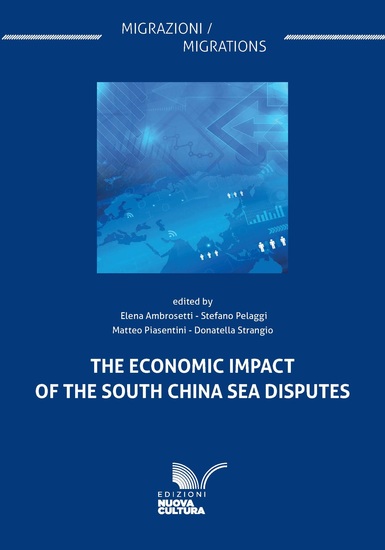
The Economic Impact of the South China Sea Disputes - cover

The Economic Impact of the South China Sea Disputes

Anonymous

Publisher: Edizioni Nuova Cultura

  • 0
  • 0
  • 0

Summary

The South China Sea stands today as one of the most sensitive crossroads of the international system – a vital artery for global trade, a strategic reservoir of energy resources, and a pivotal space where economic interests, military power, and international law intersect and collide.
Through the insights of diplomats, scholars, and experts from Italy and the Philippines, this volume examines the economic, political, and strategic dimensions of the maritime disputes in the Indo-Pacific, revealing how the stakes reach far beyond regional boundaries. From China's military modernisation to the risks facing energy security, from the central role of UNCLOS to the growing engagement of European actors such as Italy, the book offers a multidisciplinary exploration of one of the most critical theatres of the twenty-first century.
A central truth emerges: the future of the South China Sea will serve as a litmus test for the international order. Upholding freedom of navigation, supporting international law, and fostering cooperation and stability are not merely regional interests, but shared global responsibilities. An essential resource for scholars, diplomats, analysts, and readers seeking to understand how economics, geopolitics, and law converge at the heart of the Indo-Pacific – and how maritime tensions may shape the prosperity of the world.
Available since: 12/02/2025.
Print length: 134 pages.

Other books that might interest you

  • Ancient River Explorers of North America - cover

    Ancient River Explorers of North...

    George Mitrovic

    • 0
    • 0
    • 0
    The common consensus is that maybe a few lone or stray Vikings visited North America before Columbus sailed over the ocean blue, and we know the rest of it. This does not explain the amazing amounts of Roman, Jewish, early Christian, North African, Celtic, Phoenician and other cultures that left artifacts all over North America. Come with me on amazing river voyages across this vast continent as we actually find out how far early cultures travelled across the lakes, rivers and plains of North America.
    Show book
  • The Decline and Fall of the Human Empire - Why Our Species Is on the Edge of Extinction - cover

    The Decline and Fall of the...

    Henry Gee

    • 0
    • 0
    • 0
    "Henry Gee presents a pithy, fascinating account of the stages of biological evolution. ... a meditative and friendly listening experience. —AudioFile on A (Very) Short History of Life on EarthWritten and read by the award-winning author of A (Very) Short History of Life on Earth: a history of humanity on the brink of decline.A Next Big Idea Club Must-Read SelectionWe are living through a period that is unique in human history. For the first time in more than ten thousand years, the rate of human population growth is slowing down. In the middle of this century population growth will stop, and the number of people on Earth will start to decline—fast. In this provocative book, award-winning science writer Henry Gee offers a concise, brilliantly-told history of our species—and argues that we are on a rapid, one-way trip to extinction. The Decline and Fall of the Human Empire narrates the dramatic rise of humanity, how a scattered range of small groups across several continents eventually inbred, interacted, fought, established stable communities and food supplies, and began the process of dominating the planet. The human story is relatively brief—the oldest fossils of H. Sapiens date to approximately 300,000 years ago—yet the spread of our species has been unstoppable…until recently. As Gee demonstrates, our population has peaked, and is declining; our environment is becoming inimical to human life in many locations; our core resources of water, arable land, and air are diminishing; and new diseases, simmering conflicts, and ambiguous technologies threaten our collective health. Can we still change our course? Or is our own extinction inevitable?There could be a way out, but the launch window is narrow.Unless Homo sapiens establishes successful colonies in space within the next two centuries, our species is likely to stay earthbound and will have vanished entirely within another ten thousand years, bringing the seven-million-year story of the human lineage to an end.With assured narration, dramatic stories, and his signature sprightly humor, Henry Gee envisions new opportunities for the future of humanity—a future that will reward facing challenges with ingenuity, foresight, and cooperation.A Macmillan Audio production from St. Martin’s Press.
    Show book
  • How to Steal a City - The Battle for Nelson Mandela Bay: An Inside Account - cover

    How to Steal a City - The Battle...

    Crispian Olver

    • 0
    • 0
    • 0
    How to Steal a City is the gripping insider account of this intervention, which lays bare how Nelson Mandela Bay metro was bled dry by criminal syndicates, and how factional politics within the ruling party abetted that corruption.  
    As a former senior state official and local government ‘fixer’, Crispian Olver was no stranger to dodgy politicians and broken organisations. Yet what he found in Nelson Mandela Bay went far beyond rigged contracts, blatant conflicts of interest and garden-variety kickbacks. The city’s administration had evolved into a sophisticated web of front companies, criminal syndicates and compromised local politicians and officials. The metro was effectively controlled by a criminal network closely allied to a dominant local ANC faction. What Olver found was complete state capture – a microcosm of what has taken place in national government. 
    Olver and his team initiated a clean-up of the administration, clearing out corrupt officials and rebuilding public trust. Then came the ANC’s doomed campaign for the August 2016 local government elections. Having lost its way in factional battles and corruption, the divided party went down to a humiliating defeat in its traditional heartland.  
    Olver paid a high price for his work in Nelson Mandela Bay. Intense political pressure and even threats to his personal safety took a toll on his mental and physical health. When his political support was withdrawn, he had to flee the city as the forces stacked against him took their revenge. This is his story.
    Show book
  • Taboo - cover

    Taboo

    Hannah Ferguson

    • 0
    • 0
    • 0
    Conversations we never had about sex, body image, work and relationships. 
     
    A vulnerable exploration of modern womanhood that weaves deeply personal stories with opinions and advice on sex, friendship, family, career and beyond. 
     
    This part-memoir, part feminist-manifesto meets women where they are and as they are. Hannah exposes and celebrates the messy, honest and insular parts of ourselves in a book designed to feel like a late-night conversation with your best friend – one that will make you laugh, cry and that you'll never want to end.
    Show book
  • Join the Resistance - Step into the Good Work of Kingdom Justice - cover

    Join the Resistance - Step into...

    Michelle Ferrigno Warren

    • 0
    • 0
    • 0
    An awakening has been happening across our society. People increasingly recognize how long-standing, systemic issues have prevented many from flourishing. But often Christians are not sure how best to engage. Does it help to march and hold signs? What can we do to contribute and not further complicate things?
    Faith-rooted justice advocate and activist Michelle Ferrigno Warren equips Christians to join Christ's restorative work in the world. In nearly three decades of experience, she left much of her privilege to work alongside the poor and marginalized in the restoration of individuals and communities, collaborating with community leaders, marching in streets, and meeting with and speaking truth to power. She says, "How you show up is just as important as showing up." From the grassroots to the grass tops, Warren invites us to understand our place in this moment and learn from those who have gone before: the poets and prophets who call us to resist oppression and injustice.
    Biblical, historical, and contemporary examples give us ways to walk in God's righteousness, truth, and peace. We can better understand our shared solidarity, persevere in the midst of struggle, bring people along, and remain rooted in joy as we continue the good work of kingdom justice. 
    Show book
  • The Opium Queen - cover

    The Opium Queen

    Gabrielle Paluch

    • 0
    • 0
    • 0
    Olive Yang was a widely mythologized genderqueer lesbian opium-pioneer in the 1950s heyday of the Golden Triangle. After escaping an arranged marriage with a noble cousin, Olive felt that she had no choice but to lead a life of banditry with an anti-communist rebel army supported by the CIA. As her smuggling empire grew, she became so powerful and infamous that novelists were inspired to write about her evil ruthlessness and beauty. Yet, Olive’s real life and identity remained a mystery to many. Opium Queen is a journey to uncover the true story behind the propaganda and legends. Declassified intelligence documents portray Olive as a critical operator in one of the most important fronts of the clandestine Cold War against China. Through extensive interviews with the Yang family, Olive emerges as a complex anti-hero, searching for a way to live as an open homosexual in an era when such a lifestyle was considered deeply shameful in Burma. The great military alliances that facilitate narcotics traffic in Myanmar today are Olive’s lasting legacy in the Golden Triangle, as is the disenfranchisement of the people of Kokang. Through the story of Olive’s formidable life, Opium Queen examines historic events that underpinned critical diplomatic relationships between the U.S., Myanmar, and China and were at the root of Myanmar’s current political crisis.
    Show book