Join us on a literary world trip!
Add this book to bookshelf
Grey
Write a new comment Default profile 50px
Grey
Subscribe to read the full book or read the first pages for free!
All characters reduced
From Bible to Buzzword - How Torah Portions Shaped Common English Words - cover

From Bible to Buzzword - How Torah Portions Shaped Common English Words

Anonymous

Publisher: Spines

  • 0
  • 0
  • 0

Summary

Dr. Roos earned his Ph.D. in Cultural-Historical Linguistics from the University of Amsterdam. Today, he is a lecturer at Herzog Academic College and Orot College. He lives in Israel with his beloved wife and family - six children and seven grandchildren -who are his greatest source of pride and inspiration.From Bible to Buzzword offers a groundbreaking exploration of the hidden linguistic bridges between the weekly Torah portions (parashat hashavua) and the English language. Written by Dr. Avraham Roos - a linguist, educator, and Torah enthusiast - this unique work uncovers surprising connections between biblical language, cultural themes, and everyday English expressions.Structured around the annual Torah reading cycle, the book transforms scholarly insights into accessible, engaging chapters - perfect for educators, language lovers, and curious readers alike.“In a time when many seek fresh ways to connect with Torah texts and Jewish tradition, this book adds a lively and original voice to the conversation”Chief Rabbi of Ireland, Rabbi Yoni Wiener
Available since: 01/11/2026.
Print length: 160 pages.


Other books that might interest you

  • The Big Ride At The Musical Fair - Come Join Our Musical Journey - cover

    The Big Ride At The Musical Fair...

    Julie Kirchhubel

    • 0
    • 0
    • 0
    The Big Ride At The Musical FairIt’s Fair time for the animals today, and they are all ready in their seats and really looking forward to the Big Ride starting. But the Ride can’t begin just yet. What – or who – are they waiting for?
    Show book
  • Speaking in Tongues - cover

    Speaking in Tongues

    J. M. Coetzee, Mariana Dimópulos

    • 0
    • 0
    • 0
    Language, historically speaking, has always been slippery. Two dictionaries provide two different maps of the universe: which one is true, or are both false? Speaking in Tongues—taking the form of a dialogue between Nobel laureate novelist J. M. Coetzee and eminent translator Mariana Dimópulos—examines some of the most pressing linguistic issues that plague writers and translators well into the twenty-first century. 


    The authors inquire if one can truly love an acquired language, and they question why certain languages, like Spanish, have gender differences built into them. They examine the threat of monolingualism and ask how we can counter, if at all, the global spread of the English language, which seems to maraud like a colonial power. They question whether it should be the duty of the translator to remove morally objectionable language. And in the conclusion, Coetzee even speculates whether it's only mathematics that can tell the truth about everything. 


    Drawing from decades of experience in the craft of language, both Dimópulos and Coetzee face the reality that when it comes to self-expression, some things will always get lost in translation. Speaking in Tongues finally emerges as an engaging and accessible work of philosophy, shining a light on some of the most important linguistic and philological issues of our time.
    Show book
  • Answer to the Question An: What is Enlightenment? - cover

    Answer to the Question An: What...

    Immanuel Kant

    • 0
    • 0
    • 0
    "Answering the Question: What Is Enlightenment?" is a 1784 essay by the philosopher Immanuel Kant. In the December 1784 publication of the Berlinische Monatsschrift (Berlin Monthly), edited by Friedrich Gedike and Johann Erich Biester, Kant replied to the question posed a year earlier by the Reverend Johann Friedrich Zöllner, who was also an official in the Prussian government. Zöllner's question was addressed to a broad intellectual public community, in reply to Biester's essay entitled: "Proposal, not to engage the clergy any longer when marriages are conducted" (April 1783) and a number of leading intellectuals replied with essays, of which Kant's is the most famous and has had the most impact. Kant's opening paragraph of the essay is a much-cited definition of a lack of enlightenment as people's inability to think for themselves due not to their lack of intellect, but lack of courage.
    Kant's essay also addressed the causes of a lack of enlightenment and the preconditions necessary to make it possible for people to enlighten themselves. He held it necessary that all church and state paternalism be abolished and people be given the freedom to use their own intellect. Kant praised Frederick II of Prussia for creating these preconditions. Kant focused on religious issues, saying that "our rulers" had less interest in telling citizens what to think in regard to artistic and scientific issues.
    Show book
  • Everyday Jews: Why The Jewish People Are Not Who You Think They Are - Why The Jewish People Are Not Who You Think They Are - cover

    Everyday Jews: Why The Jewish...

    Keith Kahn-Harris

    • 0
    • 0
    • 0
    Can Jews be allowed to become boring? 
     
    With Israel and antisemitism constantly in the news, it seems as though the Jewish people - a fraction of a percentage of the world's population - have become synonymous with controversy, drama and anxiety. But what if there was another side to this persistently interesting people; one that non-Jews often don't know about and Jews rarely talk about? This is the stuff of 'everyday' Jewishness; the capacity to be ordinary, mundane and sometimes just plain dull. 
     
    Keith Kahn-Harris lifts the lid on this surprising world in a book for Jews and non-Jews alike. Arguing that his people's extraordinary public visibility today is harming their ability to live everyday Jewish lives, he celebrates the mundanity and mediocrity of a people before it vanishes completely.
    Show book
  • Moctezuma II and Tupac Amaru II: The Lives and Legacies of Latin America’s Most Famous Indigenous Leaders - cover

    Moctezuma II and Tupac Amaru II:...

    Editors Charles River

    • 0
    • 0
    • 0
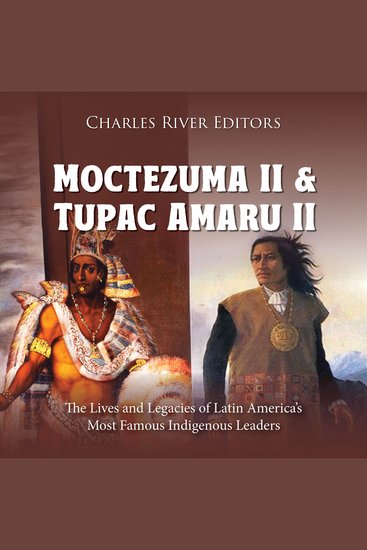
    From the moment Spanish conquistador Hernan Cortés first found and confronted them, the Aztecs have fascinated the world, and they continue to hold a unique place both culturally and in pop culture. Nearly 500 years after the Spanish conquered their mighty empire, the Aztecs are often remembered today for their major capital, Tenochtitlan, as well as being fierce conquerors of the Valley of Mexico who often engaged in human sacrifice rituals.  
    	Ironically, and unlike the Mayans, the Aztecs are not widely viewed or remembered with nuance, in part because their own leader burned extant Aztec writings and rewrote a mythologized history explaining his empire’s dominance less than a century before the Spanish arrived. Naturally, Cortes and other Spaniards depicted the Aztecs as savages greatly in need of conversion to Catholicism. While the Mayans are remembered for their astronomy, numeral system, and calendar, the Aztecs have primarily been remembered in a far narrower way, despite continuing to be a source of pride to Mexicans through the centuries. 
    	As a result, even though the Aztecs continue to interest people across the world centuries after their demise, it has fallen on archaeologists and historians to try to determine the actual history, culture, and lives of the Aztecs from the beginning to the end, relying on excavations, primary accounts, and more. 
    	The Incas had consolidated their empire only a century before Pizarro and his Spanish conquistadores took control of Inca lands in the 1530s. The Incan heartland was the Andes Mountains from Ecuador down through Peru into parts of northern Chile, including what is now Bolivia, some of Argentina, and in the north, bits of what is now Colombia. It covered about 770,000 square miles, far larger than Spain, and held an estimated 14 million people, more than in Spain, comprised of many different indigenous groups.
    Show book
  • The American Operations in WW2: Po Valley - cover

    The American Operations in WW2:...

    History U.S. Army Center of...

    • 0
    • 0
    • 0
    World War II was the largest and most violent armed conflict in the history of mankind. Highly relevant today, World War II has much to teach us, not only about the profession of arms, but also about military preparedness, global strategy, and combined operations in the coalition war against fascism. This book follows military operations in Italy from 5 April to 8 May 1945. 
    The Allies had begun their invasion of the Italian mainland in early September 1943 with the promise of a quick drive north, up the "soft underbelly" of Europe and into the German heartland. Yet nineteen months later, after hard fighting up the rugged mountainous spine of the narrow Italian peninsula, such goals still eluded the Anglo-American military leaders of the Mediterranean Theater. To be sure, long before April 1945 Rome had fallen to Allied arms and fascist Italy had been knocked almost completely out of the war. But in the interval France had also been liberated, and the Soviet Union had reclaimed almost all of its territory previously conquered by the once invincible German war machine.
    Italy had in fact become a sideshow, a secondary theater, since the spring of 1944 when the western Allies had shifted their military resources north to support the buildup and execution of Operation OVERLORD, the invasion of Normandy. After that, there had been no turning back on the Anglo-American side, with its main effort directed east through the northern European plains. Thus, by April Germany was besieged on three sides, although the Allied forces in the south, those strung out along the northern Apennines overlooking the Po Valley, were now the farthest away from the tottering Third Reich. British Prime Minister Winston Churchill continued to strongly support an advance from northern Italy into the Balkans and southern Germany. However, the ability of the Italian-based Allied armies to sustain such an effort with minimal support in men and materiel seemed problematic…
    Show book