Join us on a literary world trip!
Add this book to bookshelf
Grey
Write a new comment Default profile 50px
Grey
Subscribe to read the full book or read the first pages for free!
All characters reduced
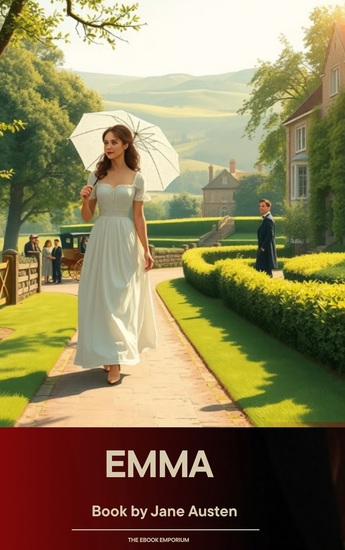
Emma - cover

Emma

Anonymous

Publisher: The Ebook Emporium

  • 0
  • 0
  • 0

Summary

"I am going to take a heroine whom no one but myself will much like." — Jane Austen

Emma Woodhouse is perfectly content with her life in the quiet village of Highbury. Wealthy, independent, and perhaps a bit too sure of her own judgment, she occupies her time by orchestrating the romantic lives of those around her. However, her well-intentioned meddling—particularly with her protégé, Harriet Smith—leads to a comedy of errors that threatens the happiness of her friends and herself. As Emma navigates a maze of social blunders and misplaced affections, she must confront the wisdom of her longtime friend and mentor, Mr. Knightley, and finally recognize the true desires of her own heart.

The Art of the "Comedy of Manners": Austen's sharp wit shines as she satirizes the social pretensions and gossip of 19th-century provincial life. Through Emma's eyes, we see a world where a misunderstood glance or a misinterpreted letter can change a person's fate. It is a brilliant study of human nature that remains as relevant today as it was in the Regency era.

A Heroine's Growth: Unlike many romantic leads of her time, Emma doesn't need to marry for money or status. Her journey is internal—it is a transformation from a spoiled, self-important young woman into a mature adult who understands the weight of her influence on others. The tension between her and the stoic, honorable George Knightley provides one of the most satisfying "slow-burn" romances in fiction.

Rediscover the wit and warmth of Austen's most playful work. Purchase "Emma" today.
Available since: 01/12/2026.
Print length: 577 pages.
Other books that might interest you

  • The Age of Innocence - cover

    The Age of Innocence

    Edith Wharton

    • 0
    • 0
    • 0
    Winner of the 1921 Pulitzer Prize, The Age of Innocence is Edith Wharton's masterful portrait of desire and betrayal during the sumptuous Golden Age of Old New York, a time when society people "dreaded scandal more than disease."
    
    This is Newland Archer's world as he prepares to marry the beautiful but conventional May Welland. But when the mysterious Countess Ellen Olenska returns to New York after a disastrous marriage, Archer falls deeply in love with her. Torn between duty and passion, Archer struggles to make a decision that will either courageously define his life—or mercilessly destroy it.
    Show book
  • The Age Of Innocence - cover

    The Age Of Innocence

    Edith Wharton

    • 0
    • 0
    • 0
    Edith Wharton's "The Age of Innocence" is a piercing exploration of the constraints and conventions of upper-class society in New York during the Gilded Age. The novel tells the story of Newland Archer, a privileged lawyer engaged to the conventional and lovely May Welland. However, the sudden arrival of May's cousin, Ellen Olenska, who has fled a disastrous marriage in Europe, disrupts Archer's settled life. As he grows increasingly captivated by Ellen, Archer grapples with his commitment to May and his deep longing for a life less bounded by societal norms. Wharton's novel, for which she won the Pulitzer Prize for Fiction in 1921, skillfully dissects the complexities of love, passion, and duty, all set against a backdrop of fading aristocratic values.
    Show book
  • A Slav Soul - From their pens to your ears genius in every story - cover

    A Slav Soul - From their pens to...

    Alexander Kuprin

    • 0
    • 0
    • 0
    Alexander Kuprin was born in Narovchat, Penza in Russia on 7th September 1870. 
    At 3 his Father died and he and mother moved to Moscow. By 10 he was enrolled at the Second Moscow Military High School and there his interest in literature began. The Alexander Military Academy followed and two years later he was a sub-lieutenant and posted to an Infantry Regiment for a further four years. 
    Despite his duties he was a now a keen writer and published his first short story at this time. His military duties also garnered him experiences for his breakthrough work ‘The Duel’.  Leaving the military he left for Kiev to work for local newspapers.  He continued to publish both stories and novels and by 1901 he was in St Petersburg becoming part of a group that included Chekhov, Ivan Bunin, Maxim Gorky and Leonid Andreyev.  
    In the years that followed further controversial works and acclaim followed.  His comments on the regime meant he was also put under secret police surveillance.   
    As World War I erupted, Kuprin opened a military hospital but was then given command of an infantry company in Finland. He was soon discharged on grounds of ill health.  
    The October Revolution saw him praise Lenin, but he warned that the Bolsheviks threatened Russian culture and might cause further widespread suffering to the peasants.  As Civil War raged he took his family to Helsinki and then on to Paris. 
    Exile saw his talents decline further and his succumbing to alcoholism. He became lonely and withdrawn. The family's poverty increased his malaise.   
    In May 1937, the Kuprin’s returned to Moscow.  He now saw his work published but wrote almost nothing new.  In 1938 his health rapidly deteriorated.  Already suffering from a kidney problems and sclerosis, he had now developed cancer of the oesophagus.  
    Alexander Kuprin died on 25th August 1938.
    Show book
  • The Horse Dealer's Daughter - cover

    The Horse Dealer's Daughter

    D H Lawrence

    • 0
    • 0
    • 0
    ‘The Horse Dealer's Daughter’ is a story, gripping in its content. It encompasses the terror of death and disgrace which is  redeemed by passion and sexuality. The question Lawrence leaves open is whether the doctor's avowal of love is genuine or driven by the awakening of his own sexuality and pity for the woman.
    Show book
  • The Odyssey - cover

    The Odyssey

    Homer Homer

    • 0
    • 0
    • 0
    The Odyssey is one of two major ancient Greek epic poems attributed to Homer. It is one of the oldest extant works of literature still widely read by modern audiences. As with the Iliad, the poem is divided into 24 books. It follows the Greek hero Odysseus, king of Ithaca, and his journey home after the Trojan War. After the war itself, which lasted ten years, his journey lasted for ten additional years, during which time he encountered many perils and all his crewmate were killed. In his absence, Odysseus was assumed dead, and his wife Penelope and son Telemachus had to contend with a group of unruly suitors who were competing for Penelope's hand in marriage.The Odyssey was originally composed in Homeric Greek in around the 8th or 7th century BCE and, by the mid-6th century BCE, had become part of the Greek literary canon. In antiquity, Homer's authorship of the poem was not questioned, but contemporary scholarship predominantly assumes that the Iliad and the Odyssey were composed independently, and the stories themselves formed as part of a long oral tradition.  Scholars still reflect on the narrative significance of certain groups in the poem, such as women and slaves, who have a more prominent role in the epic than in many other works of ancient literature. This focus is especially remarkable when considered beside the Iliad, which centers the exploits of soldiers and kings during the Trojan War.The Odyssey is regarded as one of the most significant works of the Western canon. The first English translation of the Odyssey was in the 16th century. Adaptations and re-imaginings continue to be produced across a wide variety of mediums. In 2018, when BBC Culture polled experts around the world to find literature's most enduring narrative, the Odyssey topped the list. Here is the great tale as an exciting extended Icon Audiobook!
    Show book
  • Very Old Folk The (Unabridged) - cover

    Very Old Folk The (Unabridged)

    H. P. Lovecraft

    • 0
    • 0
    • 0
    It is a recording of a dream, where the protagonist is a Roman military official in the Vascon country near Pompelo. The countryside is, every year, ravaged by terrible hill people who kidnap citizens and perform cruel rituals at a Sabbath. The narrator wishes to lead a military expedition to crush these hill folk, as a feeling of approaching evil has enveloped the countryside, due to a riot between the citizens and the hill people. These hill folk came to trade, yet some of these are killed and later, no disappearances occur before the time of the Sabbath. The incursion is guided by a local-born son of Roman parents. As the Romans approach the seat of the Sabbath rituals, something terrible attacks them and in an instant, horrible things come to pass: "He had killed himself when the horses screamed... He, who had been born and lived all his life in that region, and knew what men whispered about the hills. All the torches now began to dim, and the cries of frightened legionaries mingled with the unceasing screams of the tethered horses. The air grew perceptibly colder, more suddenly so than is usual at November's brink, and seemed stirred by terrible undulations which I could not help connecting with the beating of huge wings." The story ends with the narrator waking up and claiming that "it was the most vivid dream in years, drawing upon wells of the subconscious long untouched and forgotten".
    Show book