Join us on a literary world trip!
Add this book to bookshelf
Grey
Write a new comment Default profile 50px
Grey
Subscribe to read the full book or read the first pages for free!
All characters reduced
The American Indians in the Civil War - Unveiling Native American Contributions in the Civil War - cover

The American Indians in the Civil War - Unveiling Native American Contributions in the Civil War

Annie Heloise Abel

Publisher: Good Press

  • 0
  • 0
  • 0

Summary

In "The American Indians in the Civil War," Annie Heloise Abel presents a meticulous examination of the complex roles that Native American tribes played during one of the most tumultuous periods in American history. Abel employs a rich, narrative-driven style, interspersing thorough historical analysis with personal accounts and testimonies to illustrate the multifaceted involvement of American Indians amidst the conflict. The book situates itself within the broader context of Civil War literature while challenging commonly held perceptions about Native American agency, highlighting their strategic alliances, military contributions, and the profound impact of the war on their communities. Annie Heloise Abel, a pioneering historian and one of the few women in her field during the early 20th century, drew on her extensive research to advocate for a more nuanced understanding of American Indian history. Her background in the study of Indigenous peoples allowed her to present an underrepresented perspective, emphasizing their critical engagement in the Civil War as both allies and adversaries, shaped by the pressures of colonization and federal policies. Readers interested in American history, military studies, and Native American affairs will find Abel's work indispensable. "The American Indians in the Civil War" not only enriches our comprehension of an often-overlooked dimension of the war but also invites readers to reconsider the narratives that have shaped, and continue to shape, American identity.
Available since: 12/22/2023.
Print length: 312 pages.


Other books that might interest you

  • A Young Girl's Diary - cover

    A Young Girl's Diary

    Sigmund Freud

    • 0
    • 0
    • 0
    "A Young Girl's Diary" by Sigmund Freud offers a compelling psychological exploration of adolescence through the intimate diary entries of a teenage girl. Freud delves into the girl's inner world, unraveling the complexities of her thoughts, emotions, and experiences, shedding light on the profound impact of puberty and societal expectations on adolescent development. Read in English, unabridged.
    Show book
  • Twilight's Last Gleaming - Can America Be Saved? - cover

    Twilight's Last Gleaming - Can...

    Todd Starnes

    • 0
    • 0
    • 0
    "Todd Starnes is a fierce defender of freedom and a great patriot. He has seen, and understands, what is happening to our country like few others—his book is absolutely terrific, a must read!" —President Trump 


    President Biden ushered in a dark winter of malaise across our great nation. He snuffed out Lady Liberty's bright beacon of hope and brought despair to the land. And now we stand at a time of great choosing. Do we choose the path that leads to freedom or the path that leads to tyranny? 


    We face difficult days, but not hopeless days. Together, we can restore the Republic and reclaim our standing in the world. But first, we must remember our roots and return to the values that made our nation great. A deep and abiding desire for freedom and liberty, girded by faith in God, is the essence of who we are. Those are the precepts that must be reaffirmed if America is to be saved.
    Show book
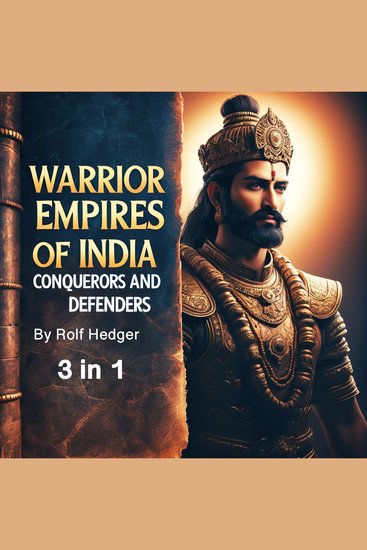
  • Warrior Empires of India - Conquerors and Defenders (3 in 1) - cover

    Warrior Empires of India -...

    Rolf Hedger

    • 0
    • 0
    • 0
    The history of India is filled with tales of powerful warrior empires that shaped the destiny of the subcontinent. Among them, the Hoysala Empire, the Rashtrakuta Empire, and the Kakatiya Dynasty stood as formidable forces in the Deccan region, each leaving behind a unique legacy of conquest, governance, and cultural patronage.  
    The Rashtrakutas, known for their military might, expanded their rule across vast territories, engaging in wars with the Pratiharas and Palas while fostering art and architecture, as seen in the magnificent Kailasanatha temple at Ellora.  
    The Hoysalas, emerging later, were fierce warriors and master builders, commissioning iconic temples such as those at Belur and Halebidu while defending their kingdom against rival invasions.  
    The Kakatiya Dynasty, renowned for its defensive strategies, constructed impressive fortifications like the Warangal Fort and resisted repeated invasions, including those from the Delhi Sultanate.  
    These warrior empires not only fought to expand and defend their territories but also enriched Indian culture, trade, and architecture, leaving an enduring impact on the history of the Deccan.
    Show book
  • Bad Company - Private Equity and the Death of the American Dream - cover

    Bad Company - Private Equity and...

    Megan Greenwell

    • 0
    • 0
    • 0
    * KIRKUS BEST NONFICTION BOOKS OF THE YEAR 2025* *ONE OF AV CLUB'S BEST BOOKS OF 2025* 
    "[An] indictment of an industry that has cannily tilted the playing field in its favor. Bad Company details how clichéd abstractions like ‘consolidation’ and ‘efficiency’ have given cover to real betrayals.” - The New York Times 
    A timely work of singular reportage and a damning indictment of the private equity industry told through the stories of four American workers whose lives and communities were upended by the ruinous effects of private equity takeovers. 
    Private equity runs our country, yet few Americans have any idea how ingrained it is in their lives. Private equity controls our hospitals, daycare centers, supermarket chains, voting machine manufacturers, local newspapers, nursing home operators, fertility clinics, and prisons. The industry even manages highways, municipal water systems, fire departments, emergency medical services, and owns a growing swath of commercial and residential real estate. 
    Private equity executives, meanwhile, are not only among the wealthiest people in American society, but have grown to become modern-day barons with outsized influence on our politics and legislation. CEOs of firms like Blackstone, Carlyle, KKR, and Apollo are rewarded with seats in the Senate and on the boards of the country’s most august institutions; meanwhile, entire communities are hollowed out as a result of their buyouts. Workers lose their jobs. Communities lose their institutions. Only private equity wins. 
    Acclaimed journalist Megan Greenwell’s Bad Company unearths the hidden story of private equity by examining the lives of four American workers that were devastated as private equity upended their employers and communities: a Toys R Us floor supervisor, a rural doctor, a local newspaper journalist, and an affordable housing organizer. Taken together, their individual experiences also pull back the curtain on a much larger project: how private equity reshaped the American economy to serve its own interests, creating a new class of billionaires while stripping ordinary people of their livelihoods, their health care, their homes, and their sense of security. 
    In the tradition of deeply human reportage like Matthew Desmond’s Evicted, Megan Greenwell pulls back the curtain on shadowy multibillion dollar private equity firms, telling a larger story about how private equity is reshaping the economy, disrupting communities, and hollowing out the very idea of the American dream itself. Timely and masterfully told, Bad Company is a forceful rebuke of America’s most consequential, yet least understood economic forces.
    Show book
  • What Really Happened In Wuhan - cover

    What Really Happened In Wuhan

    Anonymous

    • 0
    • 0
    • 0
    Walkley Award-winning journalist, Sharri Markson is the Investigations Editor at The Australian and host of prime-time show Sharri on Sky News Australia. 
      
    The origins of Covid-19 are shrouded in mystery. Scientists and government officials insisted, for a year and a half, that the virus had a natural origin, ridiculing anyone who dared contradict this view. Tech giants swept the internet, censoring and silencing debate in the most extreme fashion. Yet it is undeniable that a secretive facility in Wuhan was immersed in genetically manipulating bat-coronaviruses in perilous experiments. And as soon as the news of an outbreak in Wuhan leaked, the Chinese military took control and gagged all laboratory insiders. 
    Part-thriller, part-expose, What Really Happened in Wuhan is a ground-breaking investigation from leading journalist Sharri Markson into the origins of Covid-19, the cover-ups, the conspiracies and the classified research. It features never-before-seen primary documents exposing China's concealment of the virus, fresh interviews with whistleblower doctors in Wuhan and crucial eyewitness accounts that dismantle what we thought we knew about when the outbreak hit. 
    With unprecedented access to Washington insiders, Markson takes you inside the White House, with senior Trump lieutenants revealing first-hand accounts of fiery Oval Office clashes and new stories of compromised government advisors and censored scientists. 
    Bravely reported and chillingly laid out, Markson brings to light the stories of the pandemic from the people on the ground: the scientists and national security officials who raised uncomfortable truths and were labelled conspiracy theorists, until government agencies began to suspect they might have been right all along. These brave individuals persisted through bruising battles and played a crucial role in investigating the origins of Covid-19 to finally, in this book, bring us closer to the truth of what really happened in Wuhan.
    Show book
  • Race to Mars The: The History of the American and Soviet Attempts to Land on the Red Planet - cover

    Race to Mars The: The History of...

    Charles River Editors

    • 0
    • 0
    • 0
    In 1960, when Eisenhower’s administration began planning and funding for the famous Apollo program that would land the first men on the Moon in 1969, the Soviet Union was already thinking further ahead, literally. In one of the worst kept secrets of the Space Race, the Soviet Union launched two probes, Korabl 4 and Korabl 5, toward Mars in October 1960. Meanwhile, throughout the 1960s, NASA would spend tens of billions on missions to the Moon, the most expensive peacetime program in American history to that point, and Apollo was only made possible by the tests conducted through earlier missions, including the historic Ranger Program.  
    	When the Soviet Union attempted to launch probes to Mars in 1960, the goals were considerably less ambitious than saying hello to little green men. Those first two probes were intended merely to fly by Mars and transmit photos of the planet. In addition to getting closer looks at the Red Planet than ever before, the true value of those 1960 missions was the propaganda victory the Soviets hoped to score, obtaining yet another notch in their Space Race belt. Though the Soviets’ missions failed that year, they were still years ahead of the United States.  
    	In November 1971, NASA’s Mariner 9 became the first spacecraft to enter Mars’ orbit, but the Soviets’ Mars 2 and Mars 3 spacecrafts were hot on its heels. Mariner 9 was designed to orbit around Mars, but the Soviets’ spacecrafts had descent modules designed to actually land on the Red Planet’s surface. The descent module aboard Mars 2 crash landed on Mars’ surface on November 27, but less than a week later, Mars 3’s descent module began its historic descent down to the surface. On December 2, 1971, after a few hours of descending, it successfully completed its “soft landing.”
    Show book