Join us on a literary world trip!
Add this book to bookshelf
Grey
Write a new comment Default profile 50px
Grey
Subscribe to read the full book or read the first pages for free!
All characters reduced
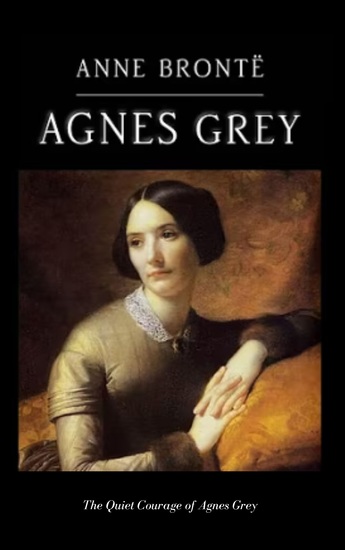
Agnes Grey - cover

Agnes Grey

Anne Brontë, Zenith Crescent Moon Press

Publisher: Zenith Crescent Moon Press

  • 0
  • 0
  • 0

Summary

"Discover the inspiring journey of a young governess in Anne Brontë's heartfelt classic, 'Agnes Grey.'"

Step into the shoes of Agnes Grey, a determined and compassionate young woman who faces the trials and tribulations of life as a governess in Victorian England. This poignant tale, penned by Anne Brontë, delves into themes of social class, morality, and the strength of the human spirit. With its rich character development and vivid portrayal of 19th-century society, 'Agnes Grey' offers a captivating and thought-provoking reading experience.

Follow Agnes as she navigates the complexities of her employers' households, confronts societal expectations, and maintains her integrity and kindness in the face of adversity. Brontë's eloquent writing and keen social observations make this novel a timeless gem that resonates with readers even today.

Anne Brontë's 'Agnes Grey' has been lauded for its honest portrayal of the struggles and triumphs of a governess's life. The novel has been praised for its moral depth and emotional impact, earning its place as a beloved classic in English literature.

"A beautifully written and deeply moving story." – The Literary Review "Anne Brontë's 'Agnes Grey' is a testament to the enduring power of the human spirit." – Classic Literature Awards

Don't miss out on this powerful and evocative novel. Add 'Agnes Grey' to your collection today and immerse yourself in Anne Brontë's timeless story of resilience and moral strength. Click 'Buy Now' to begin your journey!
Available since: 03/01/2025.
Print length: 192 pages.
Other books that might interest you

  • The Adventures of Tom Sawyer - cover

    The Adventures of Tom Sawyer

    Mark Twain

    • 0
    • 0
    • 0
    "The Adventures of Tom Sawyer" by Mark Twain is a delightful and timeless coming-of-age tale that follows the mischievous exploits of Tom Sawyer, a spirited and imaginative young boy living in the small town of St. Petersburg, Missouri, along the banks of the Mississippi River. Tom Sawyer, known for his playful and rebellious nature, embarks on a series of thrilling adventures with his best friend, Huckleberry Finn, and his love interest, Becky Thatcher. From playing hooky and exploring caves to staging mock battles and searching for hidden treasures, Tom and his friends navigate the world of childhood with a sense of curiosity and a knack for finding trouble.
    Show book
  • Pickman’s Model - cover

    Pickman’s Model

    H.P. Lovecraft

    • 0
    • 0
    • 0
    Widely regarded as one of the one of the greatest horror writers of the twentieth century, H. P. Lovecraft's stories are known for their profound indifference to human beliefs and affairs. Here is "Pickman's Model," one of his more terrifying stories.  
    Richard Upton Pickman is a Bostonian painter, notorious for creating horrifying paintings. His ghoulish works are brilliant, but they're so graphic that his membership in the Boston Art Club is revoked and he finds himself shunned by his fellow artists. Then Pickman mysteriously disappears, and his friend finds himself on a mission of horror and evil to discover the truth. 
    Proceeds from sale of this title go to Reach Out and Read, an innovative literacy advocacy organization.
    Show book
  • The Complete Novels of Fyodor Dostoevsky - cover

    The Complete Novels of Fyodor...

    Fyodor Dostoevsky

    • 0
    • 0
    • 0
    Journey into the Depths of the Human Spirit.
    
    Fyodor Dostoevsky did not just write stories; he performed autopsies on the human soul. Recognized as one of the greatest psychologists in world literature, his work explores the turbulent intersection of faith, reason, and the darker impulses of the mind. This comprehensive collection brings together his complete novels, offering a profound exploration of the questions that define our existence.
    
    This collection captures the diverse brilliance of a Russian titan:
    
    The Pioneer of the Psychological Novel: Experience the groundbreaking "inner monologues" and complex moral dilemmas that influenced everyone from Nietzsche to Freud.
    
    The Struggle for Faith and Morality: Delve into the intense spiritual debates between nihilism and belief, exploring the consequences of a world without moral absolutes.
    
    The Anatomy of Crime and Guilt: Witness the harrowing psychological journeys of men and women pushed to the brink of madness by their own actions and social isolation.
    
    Portraits of Imperial Russia: Immerse yourself in the gritty streets of St. Petersburg and the quiet tension of provincial towns, where the old world and modern ideas clash with explosive force.
    
    Dostoevsky's ability to find beauty in suffering and light in the darkest corners of the heart makes his work timeless. Whether you are seeking a tense intellectual thriller or a deep meditation on the nature of good and evil, this volume is an essential cornerstone for any library of world literature, philosophy, and classic fiction.
    
    Face the ultimate questions. Buy "The Complete Novels of Fyodor Dostoevsky" today and own the library of a literary giant.
    Show book
  • The Snowstorm - Author of War & Peace Anna Karenina and countless other classics Russian realist Tolstoy brings a harsh look at life in Winter - cover

    The Snowstorm - Author of War &...

    Leo Tolstoy

    • 0
    • 0
    • 0
    Leo Tolstoy was born in 1828 in the Russian province of Tula to a wealthy noble family. As a child, he had private tutors but he showed little interest in any formal education. When he went to the University of Kazan in 1843 to study oriental languages and law, he left without completing his courses.  Life now was relaxed and idle but with some writing also taking place.  Gambling debts forced an abrupt change of path and he joined the army to fight in the Crimean War.  He was commended for his bravery and promoted but was appalled at the brutality and loss of life.  He recorded these and other earlier experiences in his diaries which formed the basis of several of his works. 
     
    In 1852 ‘Childhood’ was published to immediate success and was followed by ‘Boyhood’ and ‘Youth’. 
     
    His experience in the army and the horrors he witnessed resulted in ‘The Cossacks’ in 1862 and the trilogy ‘Sevastopol Tales’. After the war he travelled around Europe, visiting London and Paris and meeting such luminaries as Victor Hugo and Charles Darwin.  
     
    It was now that Tolstoy began his masterpiece, ‘War and Peace’. Published in 1869 it was an epic work that changed literature. He quickly followed this with ‘Anna Karenina’.  
     
    These successes made Tolstoy rich and helped him accomplish many of his dreams but also brought problems as he grappled with his faith and the lot of the oppressed poor. These revolutionary views became so popular that the authorities now kept him under surveillance.  
     
    He led a life of asceticism and vegetarianism and put his socialist ideals into practice by establishing numerous schools for the poor and food programmes. He also believed in giving away his wealth, which caused much discord with his wife.  
     
    His writing continued to bring forth classics such as ‘The Death of Ivan Ilyich’ and many brilliant and incisive short stories such as ‘How Much Land Does A Man Need’.  
     
    In 1901 Tolstoy was excommunicated from the Church and controversially deselected for the Nobel Prize for Literature. 
     
    Whilst undertaking a pilgrimage by train in October 1910 with his daughter Aleksandra he caught pneumonia in the nearby town of Astapovo.  Leo Tolstoy died on November 9th, 1910, he was 82. 
     
    In this much acclaimed short story Tolstoy’s characters are engulfed by a huge snowstorm which descends upon them and puts the successful conclusion of their journey into perilous doubt.
    Show book
  • The Return - From their pens to your ears genius in every story - cover

    The Return - From their pens to...

    Algernon Blackwood

    • 0
    • 0
    • 0
    Algernon Blackwood was born on 14th March 1869 in Shooter’s Hill, South East London, to a religious middle-class family. His mother was a widowed Duchess and his father was a Post Office administrator.  
    Blackwood was interested in the paranormal and the supernatural at an early age, and had a thirst for anything on Buddhism, other Oriental philosophies, mysticism and occultism.  In his writings the weaving of the supernatural into his various works, from ghost stories and children’s stories to plays and long novels is clearly seen, his writings beautifully enriched by his long and diversified life experience.  
    After leaving university and visiting parts of Europe, mainly Switzerland, the young writer went to Canada and the United States where he took on jobs including work as a farmer, a bartender, a secretary, a journalist, a reporter, running a hotel and teaching the violin.  He was voracious in meeting new people and absorbing new ideas.  
    In his late thirties, he returned to England where he published two of his supernatural stories in Pall Mall Magazine. As more of his highly entertaining stories were published so did his reputation and his bank balance.  All those years of curiosity and experiences were starting to emerge from his writing. 
    In 1906, ‘The Empty House & Other Ghost Stories’ was published with tremendous success.  Further volumes of short stories followed and with it a larger audience and bigger paydays. He also published children’s stories. 
    Blackwood also had ideas for novels and to explore on a larger canvas the paranormal world and the relationship between man and metaphysical powers including, in 1911, ‘The Centaur’.  
    With the outbreak of the First World War, Blackwood was assigned to British intelligence to write propaganda to support the war effort. 
    He was a prolific author with a quite staggering output which was also to include many plays. The exact number of his works is unknown as he would frequently write a story for a newspaper or periodical at very short notice.  
    In 1949, Blackwood was made a Commander of the Order of the British Empire in recognition of his literary talents and his services during the First World War.  
    Algernon Blackwood died on 10th December 1951 after a series of strokes.
    Show book
  • Frankenstein; or the Modern Prometheus - cover

    Frankenstein; or the Modern...

    Mary Wollstonecraft Shelley

    • 0
    • 0
    • 0
    Frankenstein; or, the Modern Prometheus 
    In the early nineteenth century, English author Mary Wollstonecraft (Godwin) Shelley penned a novel that would forever alter literature. Born in 1797, Mary’s unconventional upbringing shaped her worldview. During a summer near Lake Geneva in 1816, she conceived the tale of Victor Frankenstein, a brilliant but tormented scientist. 
    Driven by relentless ambition, Victor embarked on an unorthodox experiment: creating life itself. The result—the Creature, often called “Frankenstein’s Monster”—was stitched together from various body parts. Seeking understanding and acceptance, the Creature grappled with its existence and harsh treatment. 
    The novel delves into profound themes: ambition, nature vs. nurture, responsibility, and loneliness. Beyond horror, “Frankenstein” challenges us to consider science’s boundaries and creators’ roles. It serves as a cautionary tale, warning against unchecked ambition and dehumanization. 
    Because of time, some words in the novel may have changed meanings.
    Show book