Join us on a literary world trip!
Add this book to bookshelf
Grey
Write a new comment Default profile 50px
Grey
Subscribe to read the full book or read the first pages for free!
All characters reduced
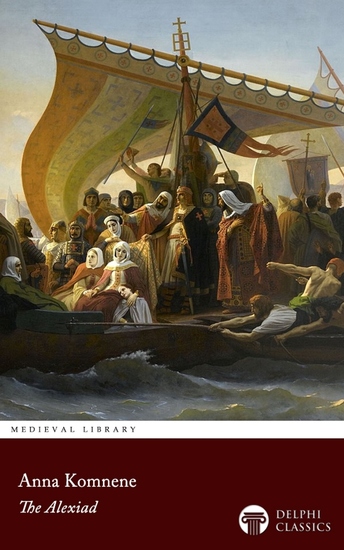
The Alexiad of Anna Komnene Illustrated - cover

The Alexiad of Anna Komnene Illustrated

Anna Komnene

Publisher: Delphi Publishing Ltd

  • 0
  • 0
  • 0

Summary

Anna Komnene was a Byzantine Greek princess and historian, whose ‘Alexiad’ provides a detailed account of the reign of her father, Emperor Alexios I Komnenos. Her work constitutes the most important primary source of Byzantine history of the late eleventh and early twelfth centuries, as well as of the early Crusades. Delphi’s Medieval Library provides eReaders with rare and precious works of the Middle Ages, with noted English translations and the original texts.  This eBook presents the complete text of ‘The Alexiad’, with illustrations, a concise introduction and the usual Delphi bonus material. (Version 1)

 
* Beautifully illustrated with images relating to Anna's life and works* Features the complete text of ‘The Alexiad’, in both English translation and the original Greek* Elizabeth Dawes’ 1928 translation* Concise introduction to Anna Komnene and her work* Excellent formatting of the texts* Easily locate the sections you want to read with individual contents tables* Provides a special dual English and Greek text, allowing readers to compare the chapters paragraph by paragraph — ideal for students* Features a bonus biography — discover Anna’s Byzantine world

 
CONTENTS:

 
The TranslationThe Alexiad

 
The Original TextContents of the Greek Text

 
The Dual TextDual Greek and English Text

 
The BiographyIrene and Anna Comnena (1913) by Joseph McCabe
Available since: 10/22/2024.
Print length: 2265 pages.


Other books that might interest you

  • Countdown to Socialism - The National Democratic Revolution in South Africa Since 1994 - cover

    Countdown to Socialism - The...

    Anthea Jeffery

    • 0
    • 0
    • 0
    With growth stalling, joblessness at crisis levels, and governance unravelling, most South Africans cannot fathom why the ANC does not embark on meaningful reform. The answer lies in what is seldom raised: the ruling party's unwavering determination to take the country by incremental steps from capitalism to socialism.
    This transformation is being implemented via a Moscow-inspired 'national democratic revolution' (NDR) dating back many decades. Despite the Soviet Union's collapse in 1991, the ANC/SACP alliance still sees the NDR as offering the 'most direct route' to socialism in South Africa – and hence as its bedrock strategy.
    The NDR has been implemented in many different spheres since 1994. By way of example, NDR interventions have already made millions of people unemployable and the mining sector largely 'uninvestable'. They now aim at land expropriation without compensation (EWC) and the effective nationalisation of private healthcare and pensions.
    The NDR is the key to understanding ANC rule over some 30 years – yet most South Africans have been kept in the dark on it. This book aims to fill that gap. Written in clear and simple language, it provides an indispensable primer on the NDR and its role in the countdown to socialism in South Africa.
    Show book
  • Algren - A Life - cover

    Algren - A Life

    Mary Wisniewski

    • 0
    • 0
    • 0
    Chicago Writers Association Nonfiction Book of the Year (2017) Society of Midland Authors Literary Award in Biography (2017)
    
    A tireless champion of the downtrodden, Nelson Algren, one of the most celebrated writers of the 20th century, lived an outsider's life himself. He spent a month in prison as a young man for the theft of a typewriter; his involvement in Marxist groups earned him a lengthy FBI dossier; and he spent much of his life palling around with the sorts of drug addicts, prostitutes, and poor laborers who inspired and populated his novels and short stories. Most today know Algren as the radical, womanizing writer of The Man with the Golden Arm, which won the first National Book Award, in 1950, but award-winning reporter Mary Wisniewski offers a deeper portrait. Starting with his childhood in the City of Big Shoulders, Algren sheds new light on the writer's most momentous periods, from his on-again-off-again work for the WPA to his stint as an uninspired soldier in World War II to his long-distance affair with his most famous lover, Simone de Beauvoir, to the sense of community and acceptance Algren found in the artist colony of Sag Harbor before his death in 1981. Wisniewski interviewed dozens of Algren's closest friends and inner circle, including photographer Art Shay and author and historian Studs Terkel, and tracked down much of his unpublished writing and correspondence. She unearths new details about the writer's life, work, personality, and habits and reveals a funny, sensitive, and romantic but sometimes exasperating, insecure, and self-destructive artist. The first new biography of Algren in over 25 years, this fresh look at the man whose unique style and compassionate message enchanted readers and fellow writers and whose boyish charm seduced many women is indispensable to anyone interested in 20-century American literature and history.
    Show book
  • Saving Michelangelo’s Dome - How Three Mathematicians and a Pope Sparked an Architectural Revolution - cover

    Saving Michelangelo’s Dome - How...

    Wayne Kalayjian

    • 0
    • 0
    • 0
    1742: the famous dome atop Saint Peter's Basilica, designed by Michelangelo, is fractured and threatened with collapse. The dome is the pride of Italy and the largest of its kind anywhere in the world. And no one knows how to fix it. 


    This engaging and colorful narrative tells the overlooked story of how Michelangelo's Dome was saved from disaster by three mathematicians and Pope Benedict XIV, who had asked them for help. It is a gripping story of decisive leadership, crisis management, and scientific innovation, and the resistance that was faced when sailing into the headwinds of conventional thought. 


    In Saving Michelangelo's Dome, Stanford-trained engineer Wayne Kalayjian illustrates how new ideas in science and mathematics established an entirely new way of looking at the world—as well as solving its complex problems. In the end, listeners will appreciate that in saving Michelangelo's Dome from collapse, these three mathematicians and one determined pope unknowingly invented the profession of engineering as we practice it today. With it, they transformed the architectural world and ushered in generations of future buildings and structures that, otherwise, would never have been built.
    Show book
  • The Nature of the Beast - cover

    The Nature of the Beast

    David J. Anderson

    • 0
    • 0
    • 0
    Does your dog get sad when you leave for the day? Does your cat purr because she loves you? Do bears attack when they’re angry? You can’t very well ask them.  
     
    In fact, scientists haven’t been able to reach a consensus on whether animals even have emotions like humans do, let alone how to study them. Yet studies of animal emotion are critical for understanding human emotion and mental illness. 
     
    In The Nature of the Beast, pioneering neuroscientist David J. Anderson describes a new approach to solving this problem. He and his colleagues have figured out how to study the brain activity of animals as they navigate real-life scenarios, like  
    fleeing a predator or competing for a mate. His research has revolutionized what we know about animal fear and aggression. Here, he explains what studying emotions and related internal brain states in animals can teach us about human  
    behavior, offering new insights into why isolation makes us more aggressive, how sex and violence connect, and whether there’s a link between aggression and mental illness. 
     
    Full of fascinating stories, The Nature of the Beast reconceptualizes how the brain regulates emotions—and explains why we have them at all.
    Show book
  • Only Wanna Be with You - The Inside Story of Hootie & the Blowfish - cover

    Only Wanna Be with You - The...

    Tim Sommer

    • 0
    • 0
    • 0
    In 1985, Mark Bryan heard Darius Rucker singing in a dorm shower at the University of South Carolina and asked him to form a band. For the next eight years, Hootie & the Blowfish—completed by bassist Dean Felber and drummer Soni Sonefeld—played every frat house, roadhouse, and rock club in the mid-Atlantic and Southeast, becoming one of the biggest independent acts in the region. 


    In Only Wanna Be with You, Tim Sommer, the ultimate insider who signed Hootie to Atlantic Records, pulls back the curtain on a band that defied record-industry odds to break into the mainstream by playing hacky sack music in the age of grunge. He chronicles the band's indie days; the chart-topping success—and near-cancelation—of their major-label debut, cracked rear view; the year of Hootie (1995) when the album reached no. 1, the "Only Wanna Be with You" music video collaboration with ESPN's SportsCenter became a sensation, and the band inspired a plotline on the TV show Friends; the lean years from the late 1990s through the early 2000s; Darius Rucker's history-making rise in country music; and one of the most remarkable comeback stories of the century. Featuring extensive new interviews with the band members, some of their most famous fans, and stories from the recording studio, tour bus, and golf course, this book is a must-listen for Hootie lovers and music buffs.
    Show book
  • The Buddha’s Practical Teaching - cover

    The Buddha’s Practical Teaching

    John D. Ireland

    • 0
    • 0
    • 0
    "To summarise what has been indicated above, our aim should be complete deliverance from suffering, or stated positively, the unconditioned and perfect happiness of Nibbāna; to be differentiated from other forms of happiness which are imperfect because ‘conditioned’ by impermanence, and thus liable to revert to suffering when circumstances or ‘the conditions’ change. By an understanding of the Four Noble Truths of Buddhism we are set in the right direction to achieve this aim. But to reach this understanding the mind must be carefully prepared by moral discipline and other virtues, released from the grip of worldly pleasures and emotions and reach a state of clarity and purity through meditation and wise discrimination. Then by reflection on the three characteristics of existence, the impermanence, suffering and absence of an underlying entity, this understanding will arise giving assurance and confidence. The practical nature of the Buddha’s teaching is that it leads one gradually step by step, like a building raised brick by brick upon secure foundations." —John D. Ireland
    Show book