Join us on a literary world trip!
Add this book to bookshelf
Grey
Write a new comment Default profile 50px
Grey
Subscribe to read the full book or read the first pages for free!
All characters reduced
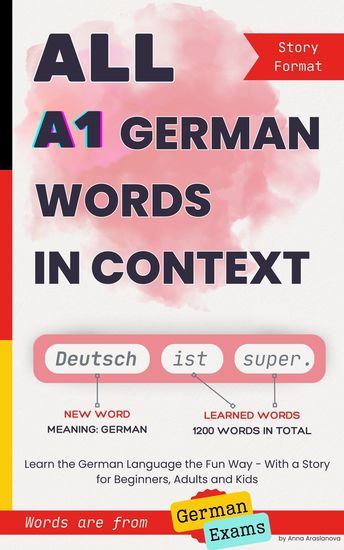
All A1 German Words in Context - Learn the German Language the Fun Way - With a Story for Beginners Adults and Kids Words are from German exams - cover

We are sorry! The publisher (or author) gave us the instruction to take down this book from our catalog. But please don't worry, you still have more than 500,000 other books you can enjoy!

All A1 German Words in Context - Learn the German Language the Fun Way - With a Story for Beginners Adults and Kids Words are from German exams

Anna Araslanova

Publisher: Publishdrive

  • 0
  • 0
  • 0

Summary

Are you struggling to learn German as a beginner? Tired of boring textbooks that don't stick? Does tackling vocabulary and grammar feel overwhelming?
 
If so, All A1 German Words in Context is the solution you've been searching for.
 
Learn German the Smart Way!
 
This German learning book introduces a fun and effective approach to mastering the German language: the spaced repetition technique used in the book helps you achieve 80% retention of the vocabulary with ease.
 
Featuring 1200 carefully selected words directly from the most famous German A1 exams, this story-driven book combines vocabulary and grammar into one learning experience. This book will prepare you to read and speak in real-life communication and German exams.
 
You will learn vocabulary quickly and easily with this book. It includes all the 1200 A1 words used in 1800 simple sentences, all within a 22-chapter story. Along the way, you'll also pick up A1 grammar through 13 grammar tables and 38 useful grammar tips. Learning has never been so simple and fun!
 
In All A1 German Words in Context, you'll discover:
 
💡 Learn German vocabulary fast. Your vocabulary expands gradually, with sentences that use only words you've already learned.
 
🧠 Focus on vocabulary. Multiple repetitions, especially of verbs, reinforce memory for long-term retention.
 
🎯 This book is well-organized to serve as your ultimate guide. A story with context-driven examples immerses you in the language, with grammar explanations along the way.
 
👱 Conversational phrases from real life prepare adults and kids for real-life conversations.
 
📕 Designed to be clear, concise, and portable - perfect for on-the-go study or even a thoughtful birthday gift or Christmas gift for aspiring learners.
 
Whether you're looking for German for everyone and every day, or simply a practical language learning book, this is your gateway to mastering the A1 German language with ease.
 
Start reading today to master German Vocabulary and Grammar Effortlessly with Context-Based Learning.
 
Frequently Asked Questions
 
 Is the book suitable for beginners?
 
Absolutely! It's very easy to read. We start with the most basic words and gradually introduce the full vocabulary you'll need.
 
 How can I be sure that I have really learned all the words?
 
The words are taken from the official requirements of the two most popular German language exams, so you can be confident that everything is covered.
 
 Will there be more books?
 
Yes! Expect the All A2 German Words In Context in summer 2025 and a B1 level book by Christmas 2025. You won't need to switch to another series to learn German efficiently.
 
 Will I remember all the words after reading the book?
 
The typical retention rate for books with repetition is 60-80% of the vocabulary after the first reading. This will be enough for everyday communication and official exams.
 
Start reading today to master German Vocabulary and Grammar Effortlessly with Context-Based Learning.
Available since: 02/01/2025.
Print length: 169 pages.

Other books that might interest you

  • Mysteries and Myths of Norse Mythology - Myth and Magic: Understanding the Symbolism and Significance of Norse Mythology - cover

    Mysteries and Myths of Norse...

    Joseph Nelson

    • 0
    • 0
    • 0
    "Mysteries and Myths of Norse Mythology: Myth and Magic: Understanding the Symbolism and Significance of Norse Mythology,” which explains deep truths about life as told through gods, giants, and mystical worlds, whisks readers away into the powerful and mysterious world of Norse stories. This book discusses the meaning behind historically enduringly captivating and inspirational characters, tales, and symbols by laying bare the layers of Norse mythology. Readers learn how Norse beliefs regarding fate, magic, life, and death remain relevant in our world today through this examination. From the creation stories and the worlds of existence to the functions of gods like Odin, Thor, Freyja, and Loki, each chapter explores a different facet of Norse mythology. The deep meaning of objects like Mjolnir, Thor's powerful hammer that represents power and protection, and Yggdrasil, the cosmic tree that unites all realms, shall reveal itself for readers. Book discusses the happening of the end times known as Ragnarok - prophecies of end-times educating us about cycles of rebirth and destruction. This book finds ancient tales that express timeless qualities of courage, honor, and resiliency by marrying academia with storytelling in an accessible narrative. It does this, most efficiently, by making old tales from Norse mythology come alive for the reader, allowing them to gain a richer understanding of Norse culture and a new approach to how much mythology is embedded in our lives. Whether one is an old-time reader of the genre or perhaps curious to learn more, pages of such will immerse you into the satisfying richness and timelessness of Norse mythology.
    Show book
  • Knead to Know - A History of Baking - cover

    Knead to Know - A History of Baking

    Neil Buttery

    • 0
    • 0
    • 0
    In Knead to Know: A History of Baking, food historian and chef Neil Buttery takes the reader on a journey exploring the creation, evolution and cultural importance of some of our most beloved baked foods, whether they be fit for a monarch's table, or served from the bakestone of a lowly farm labourer. This book charts innovations, happy accidents and some of the most downright bizarre baked foods ever created.
    
    Everything has a history, but food history is special because it tells so much about our culture and society, our desires and our weaknesses, from the broad sweep of bread creating human civilisation to the invention of the wedding cake, the creation of the whisk, the purpose of the fish heads in a star-gazy pie, or the fact that mince pies used to be meaty.
    
    When we think of the evolution of something, we think every step is an improvement, an incremental elevation toward some peak of perfection as technology improves. This is not always the case. Sometimes things have to become simpler, sometimes knowledge is lost and skills forgotten. As a baker of historical foods, Neil Buttery demonstrates that forgotten recipes and traditional techniques are worth trying out (and mention a few that should perhaps be left in the past).
    
    The reader will be inspired by the characters, creations and inventions of the past to be better and more adventurous bakers.
    Show book
  • The Resilience Recipe - A Parent's Guide to Raising Fearless Kids in the Age of Anxiety - cover

    The Resilience Recipe - A...

    PhD Philip C. Kendall, PhD...

    • 0
    • 0
    • 0
    We live in an age of anxiety. Amidst climate change and natural disasters, a troubled economy, and one of the largest global pandemics in modern history—is it any wonder our kids are anxious and stressed out? Add in the pressures inherent in social media and consumerist culture, as well as the pressure of academic success, and you've got a recipe for disaster. The good news is that you can help your child manage anxiety and stress—no matter what life throws their way. This book will show you how. 


    Written by two pioneering experts in child psychology and anxiety, The Resilience Recipe offers an evidence-based plan grounded in cognitive behavioral therapy (CBT) to help kids build emotional resilience and adaptability, worry less, and thrive—despite the stressors of modern life. With this guide, you'll learn to help kids feel more in control of their moods and emotions; cope with difficult experiences; and recognize the first signs of stress and anxiety in both their mind and body, so they can find quick relief. You'll also discover a wealth of tips and strategies to help you manage your own anxiety. 


    Most importantly, you'll find a solid action plan to help your child feel strong and capable in the face of unprecedented challenges.
    Show book
  • 1914: The History and Legacy of World War I’s First Year - cover

    1914: The History and Legacy of...

    Editors Charles River

    • 0
    • 0
    • 0
    Needless to say, the First World War came at an unfortunate time for those who would fight in it. After an initial period of relatively rapid maneuver during which the German forces pushing through Belgium and the French and British forces attempting to stymie them made an endless series of abortive flanking movements that extended the lines to the sea, a stalemate naturally tended to develop. The infamous trench lines soon snaked across the French and Belgian countryside, creating an essentially futile static slaughterhouse whose sinister memory remains to this day. 
    If trench warfare was an inevitability during the war, it is only because the events leading up to the First Battle of the Marne were quite different. The armies at the beginning of the war moved quickly through the land, but the First Battle of the Marne devolved into a bloody pitched battle that led to the construction of trenches after the Germans retreated, blocked in their pursuit of Paris. When the aftermath disintegrated into a war between trenches, some Germans thought they had the upper hand since they were occupying French territory, but with fewer soldiers than the combined Allied nations and fewer resources and supplies, it was possibly only a matter of time before they were ultimately defeated. The commander of the German armies, General Helmuth von Moltke, allegedly said to Kaiser Wilhelm II immediately after the First Battle of the Marne, "Your Majesty, we have lost the war." Winston Churchill himself would later reference that anecdote, writing, “Whether General von Moltke actually said to the Emperor, ‘Majesty, we have lost the war,’ we do not know. We know anyhow that with a prescience greater in political than in military affairs, he wrote to his wife on the night of the 9th, ‘Things have not gone well. The fighting east of Paris has not gone in our favour, and we shall have to pay for the damage we have done.’"
    Show book
  • Foster the Family - Encouragement Hope and Practical Help for the Christian Foster Parent - cover

    Foster the Family -...

    Jamie C. Finn

    • 0
    • 0
    • 0
    There are great rewards that come along with being a foster parent, yet there are also great challenges that can leave you feeling depleted, alone, and discouraged. The many burdens of a foster parent's day—hurting children, struggling biological parents, and a broken system—are only compounded by the many burdens of a foster parent's heart—confusion, anxiety, heartache, anger, and fear. 


    With the compassion and insight of a fellow foster parent, Jamie C. Finn helps you see your struggles through the lens of the gospel, bringing biblical truths to bear on your unique everyday realities. In these short, accessible chapters, you'll find honest, personal stories and practical lessons that provide encouragement and direction from God's Word as you walk the journey of foster parenting.
    Show book
  • Mission to Mao - US Intelligence and the Chinese Communists in World War II - cover

    Mission to Mao - US Intelligence...

    Sara B. Castro

    • 0
    • 0
    • 0
    From 1941 to 1947, the United States planted a liaison mission in the headquarters of Chinese Communist forces behind the lines. Nicknamed the "Dixie Mission," for its location in "rebel" territory, it was an interagency delegation that included intelligence officers from the Office of Strategic Services (OSS). 


    Mission to Mao is a social history of the OSS officers in the field that reveals the weakness of United States intelligence diplomacy in the 1940s. Drawing on over 14,000 unpublished records from five archives as well as white papers and memoirs from the participants, Sara B. Castro demonstrates how the OSS officers clashed with political appointees and Washington over the direction of the United States relationship with the Chinese Communists. Initially, the OSS officers were sent to gather intelligence that would help the war effort against Japan, but interagency and political conflicts erupted over whether the mission would later involve operations with the Communists. Castro shows how potential benefits for the war effort were thwarted by politicization and the OSS officers' own biases and blind spots. 


    Mission to Mao is a fresh look at United States intelligence in World War II China and takes listeners beyond the history of "China hands" versus American anticommunists, introducing more nuance.
    Show book