Join us on a literary world trip!
Add this book to bookshelf
Grey
Write a new comment Default profile 50px
Grey
Subscribe to read the full book or read the first pages for free!
All characters reduced
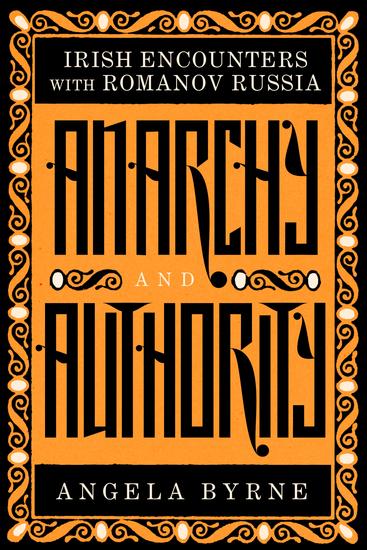
Anarchy and Authority - Irish Encounters with Romanov Russia - cover

Anarchy and Authority - Irish Encounters with Romanov Russia

Angela Byrne

Publisher: The Lilliput Press

  • 0
  • 0
  • 0

Summary

From the ascent of Peter the Great to the Russian Revolution. From the Battle of the Boyne to the Easter Rising. Between these epochal events were two astounding centuries of war, diplomacy, intrigue, innovation and international radical political movements, the reverberations of which are still felt in both Ireland and the former territories of the Russian empire today.
In Anarchy and Authority, readers follow contemporaneous accounts of Irish men and women who ventured into the Russian empire during the long centuries of Romanov rule. Human connections, political intrigues, cultural cross-pollination mesh with sweeping historical narratives in the story of the island and the empire.
Meticulously researched and energetically told, these are the stories of Irish residents, travellers and migrants to Russia from that time, ranging from diplomats and governesses, to early tourists, travel writers, soldiers, servants and even a revolutionary music-teacher. From the Irishmen and women who benefitted from the imperial wars waged by the Russian state, to those Irish observers who bore witness to the horrors of serfdom and the oppression of dissenting voices.
Anarchy and Authority brings to vivid life these Irish perspectives. Their fascinating insights and unique depths of field give increasing relevance to the turbulent geo-politics of modern times.
Available since: 09/26/2024.
Print length: 244 pages.


Other books that might interest you

  • A Rare Recording of Evelyn Waugh - cover

    A Rare Recording of Evelyn Waugh

    Evelyn Waugh

    • 0
    • 0
    • 0
    Arthur Evelyn St. John Waugh (October 28, 1903 - April 10, 1966) was an English writer of novels, biographies, and travel books; he was also a prolific journalist and book reviewer. His most famous works include Decline and Fall (1928) and A Handful of Dust (1934), the novel, Brideshead Revisited (1945). He is recognized as one of the great prose stylists of the English language in the 20th century. In this recording, Waugh discusses God, religion, writing, and his conversion to Catholicism.
    Show book
  • A Rare Recording of Ian Fleming and Raymond Chandler - cover

    A Rare Recording of Ian Fleming...

    Ian Fleming, Raymond Chandler

    • 0
    • 0
    • 0
    Ian Lancaster Fleming (May 28, 1908 to August 12, 1964) was an English writer, best known for his James Bond series of spy novels, and his only children's novel, Chitty-Chitty-Bang-Bang. Fleming came from a wealthy family connected to the merchant bank Robert Fleming & Co., and his father was the Member of Parliament (MP) from 1910 until his death on the Western Front in 1917. Fleming himself was heavily involved in British intelligence during World War II. Raymond Thornton Chandler (July 23, 1888 to March 26, 1959) was an American novelist and screenwriter. His first novel, The Big Sleep, was published in 1939. All but one of his eight novels have been made into motion pictures. Chandler had an immense stylistic influence on American popular literature, including pioneering the hardboiled school of detective fiction. The protagonist of his novels, Philip Marlowe, is considered by some to be synonymous with "private detective." The following recording is from the late 1950s.
    Show book
  • Prudence - The Wise Decision-Maker - cover

    Prudence - The Wise Decision-Maker

    Esther Jameson

    • 0
    • 0
    • 0
    Prudence is more than just caution; it is the ability to make thoughtful, well-reasoned decisions that lead to the best possible outcomes. It is a virtue that balances wisdom, foresight, and practicality, guiding individuals to act with both intelligence and responsibility. Unlike impulsiveness, which often results in short-term satisfaction but long-term regret, prudence encourages patience and careful consideration before taking action. 
    Throughout history, great thinkers have recognized prudence as a cornerstone of wisdom. Aristotle considered it one of the cardinal virtues, essential for leading a virtuous life. In his view, prudence allows individuals to weigh their choices carefully, taking into account both moral and practical consequences. Similarly, in many religious and philosophical traditions, prudence is seen as a guiding principle that helps people navigate the complexities of life with clarity and integrity. 
    The importance of prudence becomes evident in everyday decision-making. Whether managing finances, handling relationships, or planning for the future, the ability to make wise choices is crucial. A prudent person does not simply react to circumstances but instead evaluates potential risks and benefits before making a move. This deliberate approach leads to stability and success, allowing individuals to avoid unnecessary mistakes and setbacks.
    Show book
  • A Country Called Prison - Mass Incarceration and the Making of a New Nation Second Edition - cover

    A Country Called Prison - Mass...

    Mary D. Looman, John D. Carl

    • 0
    • 0
    • 0
    In the first edition of A Country Called Prison, Mary Looman and John Carl presented persuasive data calling for downsizing of America's prisons. Their novel approach continues in their second edition, shifting the beliefs many people have about prisons and their role in the American society. Since the original edition was published, the landscape of incarceration has been changing. 


    In their second edition, Carl and Looman discuss the significant world events, such as the COVID epidemic, that impacted the American society in the past decade, which lead to an overall twenty percent reduction in prison populations across the board. The second edition includes a new chapter covering the history of prisons that clearly establishes the fact that prisons have always been about making money and less about rehabilitating offenders. They also introduce the new era of decarceration and desistance, encouraging courts to defer sentences and keep minor offenders at home with their families and in their communities while they work, attend education classes, and receive mental health treatment. Once again Carl and Looman end their book with a rational and daring proposal—Marshall Plan 2024—that envisions a way to bring the criminal justice system into the twenty-first century focusing on social equity and humane compassion for those who want to emigrate out.
    Show book
  • Coronavirus Criminals and Pandemic Profiteers - Accountability for Those Who Caused the Crisis - cover

    Coronavirus Criminals and...

    John Nichols

    • 0
    • 0
    • 0
    A furious denunciation of coronavirus criminals 


    The rogues gallery begins with Donald Trump, who deliberately downplayed the coronavirus crisis despite knowing its dangers, as well as his international political allies, above all Boris Johnson. Billionaire politicians like Georgia senator Kelly Loeffler moved stocks at the same time they were telling Americans all was well. Political charlatans like Education Secretary Betsy DeVos undermined public safety in order to advance their agenda. Libertarian "think tanks" like the Ayn Rand Institute decried public expenditures but were first in line to get bailout checks. Pharmaceutical companies gamed the vaccine race, and the most rapacious global corporations like Facebook, Visa, and Pfizer have found the pandemic to be very profitable indeed, vastly enriching the already grotesquely bloated fortunes of trillionaires like Jeff Bezos, Mark Zuckerberg, and Charles Koch. 


    Guilty Men closes with a call for a version of the Pecora Commission, initiated by newly elected Franklin Roosevelt, that took aim at what FDR called "speculation, reckless banking, class antagonism, and profiteering" that stoked the Depression. The commission led to some of the most far-reaching reforms in US history, as well as sensational hearings that led to the fall of the leading bankers and financiers of that era.
    Show book
  • Vedic Philosophy of the Kali Yuga - Through the Lens of Gnostic Wisdom - cover

    Vedic Philosophy of the Kali...

    HENRY ROMANO

    • 0
    • 0
    • 0
    According to Vedic philosophy, there are four eras in every world cycle. They represent a gradual decline from enlightenment (Satya Yuga) to chaos and ignorance (Kali Yuga) before it starts again. Each of these eras lasts roughly 2160 years. 
    You're probably familiar with the four ages of Hindu philosophy: Satya Yuga, Treta Yuga, Dwapara Yuga, and Kali Yuga. The golden age is when pure knowledge is widespread, and people live in harmony. The dark age is when everything goes wrong—the World falls into chaos, and humanity descends into ignorance. But what happens next? 
    What is the meaning of "the end of the world"?
    Show book