Join us on a literary world trip!
Add this book to bookshelf
Grey
Write a new comment Default profile 50px
Grey
Subscribe to read the full book or read the first pages for free!
All characters reduced
The Latter-Day Saint Republican Series - cover

The Latter-Day Saint Republican Series

Andrew Langford

Publisher: Publishdrive

  • 0
  • 0
  • 0

Summary

The Latter-Day Saint Republican is a content series began during the Christmas season of 2024. Part of the work includes a promotional piece written for The Latter-Day Saint Republican, "The Living Waters of Republicanism."
 
The Latter-Day Saint Republican Series consists of 24 essays. These essays span between December 15, 2024 and May 25, 2025. It is a philosophical work on my views on Politics & Government and other topics in connection with my religious faith.
Available since: 07/11/2025.
Print length: 111 pages.

Other books that might interest you

  • Social Engineering - Manipulating People into Divulging Confidential Information - cover

    Social Engineering -...

    Cito Harder

    • 0
    • 0
    • 0
    Social engineering is the art of manipulating individuals into divulging confidential or personal information by exploiting their psychological vulnerabilities. Unlike traditional forms of hacking, which rely on technical skills to break into systems, social engineering takes advantage of human behavior to gain access to sensitive data. Whether through deceit, persuasion, or psychological manipulation, social engineers often prey on an individual’s trust, emotions, or fear, making it a more subtle yet highly effective form of attack. This introduction will explore what social engineering is, its methods, and why it has become such a significant threat in today’s digital landscape. 
    The core idea behind social engineering is simple: it is the manipulation of people rather than technology. In this approach, an attacker bypasses security measures and instead focuses on exploiting the weakest link in any organization or system—the people. These attacks can take many forms, ranging from phishing emails to impersonating authority figures, all designed to get the victim to willingly provide information, click on malicious links, or take actions that compromise their security. The success of social engineering relies not on breaking through firewalls or hacking encryption systems but on exploiting the trust and naivety of human beings. 
    Social engineering attacks can have serious consequences, especially as more of our personal and professional lives move online. Cybercriminals can gain access to sensitive personal information, financial data, or corporate secrets, leading to identity theft, financial loss, or damage to an organization’s reputation. In the corporate world, social engineering is often used as a gateway to larger cyberattacks. For instance, once an attacker gains access to an employee’s credentials through a phishing scheme, they can infiltrate company systems, potentially compromising valuable data.
    Show book

  • I Was Never Here - My True Canadian Spy Story of Coffees Code Names and Covert Operations in the Age of Terrorism - cover

    I Was Never Here - My True...

    Andrew Kirsch

    • 0
    • 0
    • 0
    An ex-spy lifts the lid on life in the secret serviceA Globe and Mail and Toronto Star bestseller!Andrew Kirsch didn’t grow up watching spy movies, or dreaming about being a real-life James Bond. He was hardly aware that Canada even had its own intelligence service—let alone knew what its officers did. But when a terrorist attack occurred near the office of his financial services job, all of a sudden fighting terrorism meant a lot more to him than the markets. Within 18 months he had landed a job with the Canadian Security Intelligence Service (CSIS)—where he spent the next decade of his life.In I Was Never Here, Kirsch (now an in-demand security consultant) spills the secrets of what life as an intelligence officer is really like, and dispels a few myths along the way. With humour, honesty, and candour, Kirsch shares his on-the-ground experience (or as much of it as he’s allowed to) of becoming a member of CSIS: from his vetting and training, to his initial desk job as a policy analyst, to his rise up the ranks to leading covert special operations missions. If you’ve ever wondered whether spies can have real dating lives, how they handle family responsibilities, or how they come up with cover stories or aliases, you’re in luck.From the time he tried to get the code names “Burgundy” and “Anchorman” assigned to human sources (with no luck), to the night a covert operation was almost thwarted by a flyer delivery man, Kirsch takes you behind the scenes with an authentic view of Canada’s spy agency, and the intricate intelligence-sharing apparatus that works day and night to keep us safe. I Was Never Here is also a testament to one man’s drive to serve his country, and the sacrifices, big and small, that he made along the way.
    Show book
  • Defectors - How the Illicit Flight of Soviet Citizens Built the Borders of the Cold War World - cover

    Defectors - How the Illicit...

    Erik R. Scott

    • 0
    • 0
    • 0
    Defectors fleeing the Soviet Union seized the world's attention during the Cold War. Their stories were given sensational news coverage and dramatized in spy novels and films. Upon reaching the West, they were entitled to special benefits, including financial assistance and permanent residency. In contrast to other migrants, defectors were pursued by the states they left even as they were eagerly sought by the United States and its allies. Taking part in a risky game that played out across the globe, defectors sought to transcend the limitations of the Cold War world. 


    Defectors follows their treacherous journeys and looks at how their unauthorized flight via land, sea, and air gave shape to a globalized world. It charts a global struggle over defectors that unfolded among rival intelligence agencies operating in the shadows of an occupied Europe, in the forbidden border zones of the USSR, in the disputed straits of the South China Sea, on a hijacked plane 10,000 feet in the air, and around the walls of Soviet embassies. 


    Although defection all but disappeared after the Cold War, this innovative work shows how it shaped the governance of global borders and helped forge an international refugee system whose legacy and limitations remain with us to this day.
    Show book
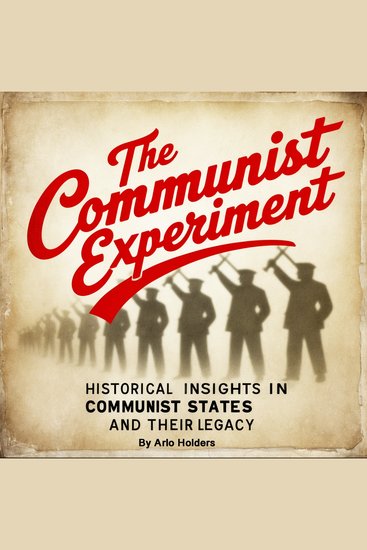
  • The Communist Experiment - Historical Insights in Communist States and Their Legacy - cover

    The Communist Experiment -...

    Arlo Holders

    • 0
    • 0
    • 0
    Communism is one of the most influential and controversial ideologies in modern history. At its core, communism seeks to establish a classless society in which the means of production are collectively owned, and wealth is distributed according to need. This vision of equality and social justice has inspired revolutions, political movements, and significant social change across the globe. However, it has also sparked intense debate, criticism, and conflict, making it a complex and multifaceted subject. 
    The origins of communism trace back to the 19th century, with the works of German philosophers Karl Marx and Friedrich Engels laying its intellectual foundation. Their seminal text, The Communist Manifesto (1848), outlined the principles of communism and called for the working class, or proletariat, to rise against the bourgeoisie, the ruling capitalist class. Marx and Engels argued that capitalism inherently exploits workers, creating vast inequalities that would eventually lead to its collapse and the emergence of a socialist society as a transitional phase toward communism. 
    A key concept in Marxist theory is historical materialism, which posits that societal progress is driven by the struggle between opposing economic classes. According to this view, history has evolved through stages—such as feudalism and capitalism—each defined by its mode of production and class relations. Communism represents the final stage, where class distinctions disappear, and humanity achieves true freedom and equality.
    Show book
  • Our Common Cause - Establishing the Political Power We Lack - cover

    Our Common Cause - Establishing...

    Étienne Chouard

    • 0
    • 0
    • 0
    I want to talk to you about democracy. The real one. The one that does not exist, and the one we really need today. My research method is that of Hippocrates, who said, look for the cause of causes. In other words, to cure a disease, to solve a problem, it is useless to attack the consequences, it is useless to attack the different causes. There is always a determining cause (the one that determines all the others)—and that is our common cause.
    The first decisive battle is to push the important words "right side up":
    First. I am not a "citizen" (a citizen is autonomous; he votes himself his laws). I am only a "voter;" that is to say, a political child—because I am subject to the law voted into existence by someone other than me.
    Second. My "parents" in politics, the elected officials, do not want me to emancipate myself from them—they do not allow me to vote for or against the laws to which I have to submit myself.
    We are "the incompetents." They treat us like children. But it is our fault, because children also believe in "Santa Claus," and so voters believe in "universal suffrage," which we accept to call "democracy" (demos kratos, power belongs to the people). The so-called modern "democracy".
    Show book
  • Leadership from Bad to Worse - What Happens When Bad Festers - cover

    Leadership from Bad to Worse -...

    Barbara Kellerman

    • 0
    • 0
    • 0
    Leadership from Bad to Worse is about how leadership that is bad, invariably, inexorably, gets worse—unless it is somehow, by someone or something, stopped or slowed. 


    This work draws on four cases of bad leadership—two in political leadership, two in business leadership—to show how it goes from bad to worse. Kellerman finds that bad leadership and bad followership go through four phases of development: 1) Onward and Upward; 2) Followers Join In; 3) Leaders Start In; and 4) Bad to Worse. These findings correctly suggest that the book, in addition to being of theoretical interest, is of practical import. It is intended, deliberately, to serve as an early warning system. By breaking bad leadership and followership into phases—each more ominous and ultimately dangerous than the one preceding—their progression will be easier to predict and detect. And easier, therefore, to slow or, preferably, to stop before they turn toxic. 


    Bad leadership is a social disease. But unlike diseases that are physical or psychological, it remains at the margins of our collective concerns. Leadership from Bad to Worse is, then, a corrective. Knowing that bad leadership can be checked before it corrupts is knowing that bad and then worse can be, if not completely precluded, then sometimes short-circuited.
    Show book