Join us on a literary world trip!
Add this book to bookshelf
Grey
Write a new comment Default profile 50px
Grey
Subscribe to read the full book or read the first pages for free!
All characters reduced
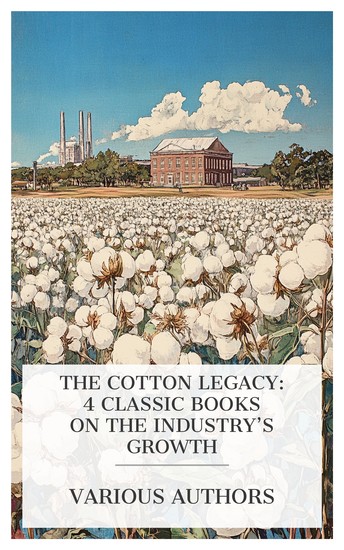
The Cotton Legacy: 4 Classic Books on the Industry's Growth - The Story of the Cotton Plant Bremen Cotton Exchange 1872 1922 The Rise of Cotton Mills in the South The Early English Cotton etc - cover

The Cotton Legacy: 4 Classic Books on the Industry's Growth - The Story of the Cotton Plant Bremen Cotton Exchange 1872 1922 The Rise of Cotton Mills in the South The Early English Cotton etc

Andreas Wilhelm Cramer, Frederick Wilkinson, Broadus Mitchell, George W. Daniels

Publisher: e-artnow

  • 0
  • 0
  • 0

Summary

The Cotton Legacy: 4 Classic Books on the Industry's Growth offers an intricate tapestry of insights into the cotton industry, exploring its extensive impact on global economies and societies. This anthology delicately weaves together narratives from diverse literary traditions, examining the economic, social, and cultural dimensions of cotton's evolution. The collection brings an encyclopedic dialogue, highlighting the industry's intricate relationships with technological advancements and globalization. While each piece retains its distinct voice, together they form a cohesive exploration of an industry pivotal to historical and contemporary trade. The anthology assembles the works of Frederick Wilkinson, Andreas Wilhelm Cramer, Broadus Mitchell, and George W. Daniels, each a luminary in their respective fields. Through their writings, readers traverse the historical landscapes of the Industrial Revolution, colonial expansion, and economic theories that shaped the modern world. Spanning various literary movements, the authors present a multifaceted portrayal of cotton's influence, from its role in industrialization to its effect on labor practices and international relations. This rich confluence of perspectives unveils cotton as both a commodity and a catalyst for change, enhancing comprehension of its legacy and ongoing relevance. This collection stands as a vital resource for anyone interested in the intricate webs of global industry. The Cotton Legacy extends an invitation to explore a myriad of perspectives within the cotton narrative, offering educational insights into the fabric of economic history. As readers delve into these classic works, they engage with an illuminating dialogue on the industry's growth, benefiting from the breadth of expertise and the relatable human stories that underpin the cotton saga. This anthology encourages readers to appreciate the profound impact of cotton and urges contemplation on its future trajectories.
Available since: 03/04/2025.
Print length: 1300 pages.
Other books that might interest you

  • Real Japanese Part 1 - cover

    Real Japanese Part 1

    Max Whittle

    • 0
    • 0
    • 0
    If you need to know the key differences between POLITE and FRIENDLY Japanese, then keep reading…...Real Japanese is an easy-to-read blend of short stories, key phrases and language learning tips to get you started in Japanese. It also shows you the key differences between formal and everyday Japanese, which is a game changer and completely lacking from most Japanese language books.Lonely planet Japan author Chris Rowthorn says"Max Whittle's Real Japanese would be a great introduction for anyone looking to get started with Japanese, or anyone who wants to learn some Japanese before visiting Japan."If you are living in Japan or planning on travelling to Japan for a trip, this book will help you break down the language and culture into the real and everyday essentials. It will help you lay a strong foundation for fluency, as opposed to textbook knowledge without good communication skills. Inside the Real Japanese audio book you will discover:??Understanding friendly Vs polite Japanese?? Hear all the phrases read by a native Japanese speaker??The key phrases you’ll need in Japan??Key concepts underlying the Japanese culture??How to read some key Kanji (in the accompanying pdf)??Proven strategies for easy language learningJapans premium English Magazine “Kateigaho International” says…"Your trip to Japan will be very special if you can speak just a bit of everyday Japanese. Real Japanese is a useful and interesting guide that's fun to read with helpful tips and articles about the Japanese culture". The author has lived in Japan for over 20 years and has worked in translation for some of Japans top companies. He passed the Japanese proficiency test (level 1) in just two years using the methods outlined in this book. If you want to get the most out of your Japan experience, then scroll up and click the Add to Cart button.
    Show book
  • The Fathers of the Soviet Union - cover

    The Fathers of the Soviet Union

    Editors Charles River

    • 0
    • 0
    • 0
    Among the leaders of the 20th century, arguably none shaped the course of history as much as Vladimir Lenin (1870-1942), the Communist revolutionary and political theorist who led the Bolshevik Revolution that established the Soviet Union. In addition to shaping the Marxist-Leninist political thought that steered Soviet ideology, he was the first Soviet premier until his death and set the Soviet Union on its way to becoming one of the world’s two superpowers for most of the century, in addition to being the West’s Cold War adversary. 
    As it turned out, the creation of the Soviet Union came near the end of Lenin’s life, as he worked so hard that he had burned himself out by his 50s, dying in 1924 after a series of strokes had completely debilitated him. In the initial aftermath of Lenin’s death, Trotsky had been his ally’s heir apparent, and for those inclined to believe the Soviet experiment had started promisingly but gone astray, Trotsky became the embodiment of the betrayed promise of the early Bolshevik revolution. There were certain ironies in this widespread sympathetic interpretation of Trotsky’s legacy, because Trotsky had overseen and spearheaded campaigns of persecution against Russians suspected of “counterrevolutionary” leanings, and he had written a long tract defending these “terroristic” measures as necessary safeguards of the revolution. 
    Near the end of his life, Lenin expressly stated that the regime's power should not be put in the hands of the current General Secretary of the Communist Party, Joseph Stalin. Of course, Stalin managed to do just that, modernizing the Soviet Union at a breakneck pace on the backs of millions of poor laborers and prisoners. If Adolf Hitler had not inflicted the devastation of World War II upon Europe, it’s quite likely that the West would consider Stalin (1878-1953) the 20th century’s greatest tyrant.
    Show book
  • A Wicked Woman - From their pens to your ears genius in every story - cover

    A Wicked Woman - From their pens...

    Jack London

    • 0
    • 0
    • 0
    John Griffith Chaney was born on January 12th, 1876 in San Francisco.   
    His father, William Chaney, was living with Flora Wellman when she became pregnant.  Chaney insisted she have an abortion.  Flora's response was to turn a gun on herself.  Although her wounds were not severe the trauma made her temporarily deranged. 
    In late 1876 his mother married John London and the young child was brought to live with them as they moved around the Bay area, eventually settling in Oakland where now, calling himself Jack, he completed grade school. 
    Jack worked hard at several jobs, sometimes 12-18 hours a day, but his dream was university.  He studied hard and borrowed the money to enrol in the summer of 1896 at the University of California in Berkeley. 
    In 1897, at 21, Jack searched out newspaper accounts of his mother's suicide attempt and for the name of his biological father. He wrote to Chaney, then living in Chicago, who claimed he could not be Jack’s father because he was impotent and casually asserted that London's mother had relations with other men.  Jack, devastated by the response, quit Berkeley and went to the Klondike. Other accounts suggest that his dire finances presented Jack with the excuse he needed to leave. 
    In the Klondike Jack began to gather material for his writing but also accumulated many health problems, including scurvy, which together with hip and leg problems he would carry for the rest of his life. 
    During the late 1890's Jack was regularly publishing short stories and by the turn of the century full blown novels. 
    By 1904 Jack had married, fathered two children and was now in the process of divorcing.  A stint as a reporter on the Russo-Japanese war of 1904 was equal amounts trouble and experience. But that experience was always put to good use in a continuing and remarkable output of work. 
    In 1905 he married Charmian Kittredge who at last was a soul and companion who brought him some semblance of peace despite his advancing alcoholism and his incurable wanderlust. 
    Twelve years later Jack had amassed both wealth and a literary reputation through such classics as ‘The Call of the Wild’, ‘White Fang’ and many others. He had a reputation as a social activist and was a tireless friend of the workers.   
    Jack London died suffering from dysentery, late-stage alcoholism and uremia, aged only 40, on November 22nd 1916 at his property in Glen Elen in California.
    Show book
  • My Nile Odyssey - A memoir - cover

    My Nile Odyssey - A memoir

    Kamil Idris

    • 0
    • 0
    • 0
    Kamil Idris, a man proud of his nomad ancestry, survived child labouring in darkened factories, boyhood journeys to Cairo balanced on the top of trains, hazardous treks to Europe in his teens, capture and death threats from piratical Nile fishermen who thought he was an evil spirit or djinn, and even being stranded in the ferocious heat of the Nubian desert. In later life, he was arrested and placed under house surveillance with his immediate family, because of his views on human rights and political reform. 
    Inspired by a promise to Nelson Mandela to write his memoir, the book is a cameo of a loving family devastated by a series of tragedies, of ancient souks, camel markets, eccentric characters, philosopher kings, and his father's tales of the earliest days of Africa, Nubia and the first wanderings of mankind. As a child, Kamil was taken to Meroe to gaze at the remains of the fabulous Kingdom of Kush which boasts twice as many pyramids as Egypt. Moreover, recent excavations are lifting a veil on the rediscovery of Sudan's astonishing Black Pharaohs, who once ruled over the whole of north east Africa and beyond over two and a half thousand years ago. 
    Above all the memoir is a magnificent celebration of and a tribute to Kamil's beloved and enduring River Nile, which he sees as a metaphor for all our destinies. It is an incredible story.
    Show book
  • Charmides - A Philosophical Discussion on Temperance – Exploring the Meaning of Inner Peace - cover

    Charmides - A Philosophical...

    Plato, Tim Zengerink

    • 0
    • 0
    • 0
    What if your peace of mind was the highest form of wisdom? 
    In Charmides, Plato presents a timeless dialogue that gently peels back the layers of self-control, modesty, and knowledge. Socrates engages the charming and reflective youth Charmides in a quest to define “temperance”—a word that touches everything from our moral compass to our emotional balance. 
    Through careful questions and subtle insights, this modern audiobook brings to life a powerful but often overlooked dialogue—one that asks whether the truest form of strength lies in knowing, and governing, oneself. 
    What you’ll discover inside: 
    •	A subtle but profound inquiry into temperance, modesty, and inner harmony 
    •	Socratic questioning at its most reflective, unraveling assumptions with grace 
    •	A fresh look at the link between virtue and knowledge 
    •	A translation that retains the poetic charm and intellectual clarity of the original 
    Whether you’re seeking calm in a chaotic world or pondering the nature of self-discipline, Charmides is a philosophical mirror worth holding up to the soul.
    Show book
  • Awake! - William Blake and the Power of the Imagination - cover

    Awake! - William Blake and the...

    Mark Vernon

    • 0
    • 0
    • 0
    In the 200 years since Blake's death, the visionary artist, poet, and writer has become a household name, often beloved. Yet many struggle to comprehend his kaleidoscopic ideas; how they speak to human longings and the challenges of living in anxious times.Philosopher and psychotherapist Mark Vernon provides a fresh route into Blake, taking him at his word. Exploring this brilliant thinker's passionate writings, arresting artworks, and fascinating life, Vernon illuminates Blake's vivid worldview. Like us, he lived in a tumultuous era of war, discontent, rapid technological change, and human estrangement from nature. He exposed the dark sides of political fervor and social moralizing, while unashamedly celebrating love and liberty. But he also conversed with prophets and angels, and was powerfully, if unconventionally, religious. If we take this seriously—not easy, in secular times—then Blake can help us to unlock the transformative power of imagination.Written for both longstanding fans and those unfamiliar with his work, Awake! reveals Blake as an invigorating and hopeful guide for our modern age.
    Show book