Join us on a literary world trip!
Add this book to bookshelf
Grey
Write a new comment Default profile 50px
Grey
Subscribe to read the full book or read the first pages for free!
All characters reduced
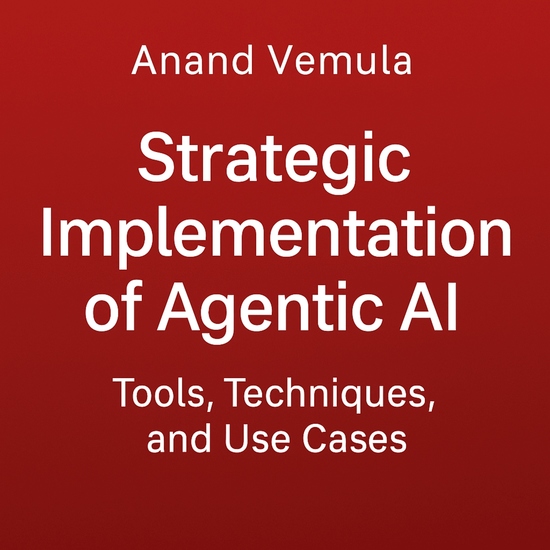
Strategic Implementation of Agentic AI - Tools Techniques and Use Cases - cover

Strategic Implementation of Agentic AI - Tools Techniques and Use Cases

Anand Vemula

Publisher: Publishdrive

  • 0
  • 0
  • 0

Summary

Strategic Implementation of Agentic AI provides a comprehensive, practice-driven roadmap for deploying autonomous agents across real-world enterprise environments. The book is structured into four major parts—principles and deployment, tools and techniques, enterprise use cases, and strategic foresight—offering a 360-degree view of agentic AI from foundational theory to advanced integration.
 
Beginning with the core capabilities of agentic systems such as autonomy, proactivity, and goal orientation, the book lays out design methodologies that align AI behavior with organizational intent. It covers infrastructure design, from cloud-native deployments to agent platforms like LangChain and AutoGen, while addressing security, privacy, and responsible governance.
 
The second section explores the technical backbone of agentic AI: agent-oriented programming, prompt engineering, memory architectures, multi-agent coordination, and telemetry feedback loops. Each chapter demonstrates how to build scalable, modular agents with adaptive learning and decision-making capacity.
 
Real-world applications take center stage in the third part. Readers gain insight into agent deployment in business operations, sales, healthcare, education, manufacturing, and more—uncovering how agents optimize workflows, support decision-making, and enable human-machine collaboration at scale.
 
The final part focuses on strategic alignment, scaling ecosystems, ethics, regulatory impacts, and future planning. It offers tools to assess maturity, define KPIs, and envision a path toward intelligent, resilient, and ethical agentic ecosystems.
 
Written for technologists, architects, and enterprise leaders, this book bridges vision and implementation—offering a pragmatic guide to turning autonomous AI into a core strategic capability.
Available since: 06/18/2025.
Print length: 66 pages.

Other books that might interest you

  • Oxycontin - The Pain Killer that Kills People - cover

    Oxycontin - The Pain Killer that...

    Mike Blake

    • 0
    • 0
    • 0
    Oxycontin: The Pain Killer, that Kills People. 
    Whats this Poem about ? Overdoses, withdrawals, futures blighted, the highs & the lows. 
    Killers without guns, just bullets of prose. 
    ***** Please leave your Review/feedback, many thanks. 
    ***** To see more Poems by the same Author please click the Link HERE: 
    https://www.amazon.com/-/e/B00SG40RM8 
    To contact the Author: Please add me Mike Miko on Facebook & then message me, thanks. https://www.facebook.com/mike.cco1 
    I will then contact the Author your behalf. or on  
    Twitter: miko_1_dollar ~ Tumblr : ccobes ~ 
    Instagram: Wild_Poetrys  //  wild.poetry.webs 
    FB:  https://www.facebook.com/New.Poets.Corner/
    Show book
  • The Field Guide to Understanding 'Human Error' - cover

    The Field Guide to Understanding...

    Sidney Dekker

    • 0
    • 0
    • 0
    When faced with a ’human error’ problem, you may be tempted to ask 'Why didn’t these people watch out better?' Or, 'How can I get my people more engaged in safety?' You might think you can solve your safety problems by telling your people to be more careful, by reprimanding the miscreants, by issuing a new rule or procedure and demanding compliance. These are all expressions of 'The Bad Apple Theory' where you believe your system is basically safe if it were not for those few unreliable people in it. Building on its successful predecessors, the third edition of The Field Guide to Understanding ’Human Error’ will help you understand a new way of dealing with a perceived 'human error' problem in your organization. It will help you trace how your organization juggles inherent trade-offs between safety and other pressures and expectations, suggesting that you are not the custodian of an already safe system. It will encourage you to start looking more closely at the performance that others may still call 'human error', allowing you to discover how your people create safety through practice, at all levels of your organization, mostly successfully, under the pressure of resource constraints and multiple conflicting goals. The Field Guide to Understanding 'Human Error' will help you understand how to move beyond 'human error'; how to understand accidents; how to do better investigations; how to understand and improve your safety work. You will be invited to think creatively and differently about the safety issues you and your organization face. In each, you will find possibilities for a new language, for different concepts, and for new leverage points to influence your own thinking and practice, as well as that of your colleagues and organization. If you are faced with a ’human error’ problem, abandon the fallacy of a quick fix. Read this book.
    Show book
  • ClustERPuck - 21 Critical ERP Implementation Mistakes and what to do instead - cover

    ClustERPuck - 21 Critical ERP...

    Shane Williams

    • 0
    • 0
    • 0
    Want to keep your ERP on track? 
    In ClustERPuck, Shane Williams breaks down the common pitfalls that can derail even the most well-intentioned enterprise resource planning (ERP) projects. This insightful guide reveals the often chaotic and problematic nature of mismanaged ERP implementations, offering practical advice and strategies to avoid turning your ERP project into a costly disaster. Written for small to medium-sized enterprise (SME) manufacturers, this book provides clear, actionable steps to ensure successful ERP adoption, helping business leaders navigate the turbulent waters of digital transformation with confidence and clarity.
    Show book
  • Mastering Blockchain - Unlocking the Power of Cryptocurrencies Smart Contracts and Decentralized Applications - cover

    Mastering Blockchain - Unlocking...

    Daniel Cawrey, Lorne Lantz

    • 0
    • 0
    • 0
    The future will be increasingly distributed. As the publicity surrounding Bitcoin and blockchain has shown, distributed technology and business models are gaining popularity. Yet the disruptive potential of this technology is often obscured by hype and misconception. This detailed guide distills the complex, fast moving ideas behind blockchain into an easily digestible reference manual, showing what's really going on under the hood. 


    Finance and technology pros will learn how a blockchain works as they explore the evolution and current state of the technology, including the functions of cryptocurrencies and smart contracts. This book is for anyone evaluating whether to invest time in the cryptocurrency and blockchain industry. Go beyond buzzwords and see what the technology really has to offer. 


    In this book, you'll learn why Bitcoin was fundamentally important in blockchain's birth; how Ethereum has created a fertile ground for new innovations like Decentralized Finance, Non-Fungible Tokens, and Flash Loans; how cryptocurrencies are used by criminals to carry out nefarious activities; and how enterprise and governments are leveraging the blockchain. You'll also discover the challenges of scaling and forking a blockchain; find out how different blockchains work; and learn the language of blockchain as industry terms are explained.
    Show book
  • Introduction to General Relativity - Basic Concepts and Applications of General Relativity - cover

    Introduction to General...

    Mark Hedges

    • 0
    • 0
    • 0
    General Relativity, proposed by Albert Einstein in 1915, revolutionized our understanding of gravity. It describes gravity not as a force in the traditional sense, as in Newtonian physics, but as a curvature of spacetime caused by mass and energy. This groundbreaking theory was not only a significant departure from previous models of gravity but also the foundation for modern cosmology and astrophysics. 
    At the core of General Relativity is the concept that massive objects like planets, stars, and galaxies bend the fabric of spacetime around them. This curvature influences the movement of objects within it, including light, which explains phenomena such as gravitational lensing, where light bends around massive objects. The equation that governs this curvature is Einstein’s famous field equation, which mathematically relates the geometry of spacetime to the energy and momentum of whatever matter and radiation are present. 
    Before Einstein’s work, gravity was understood in terms of Newton’s law of universal gravitation, which described gravitational force as an instantaneous action at a distance between two masses. While this model worked well for many practical applications, it had limitations, especially in extreme conditions such as those near very massive objects or moving at high velocities. General Relativity resolved these issues by providing a more accurate description of gravitational phenomena, particularly in scenarios involving high gravitational fields, such as near black holes or in the context of cosmology.
    Show book
  • AWS Certified Cloud Practitioner Study Guide With 500 Practice Test Questions: Foundational (CLF-C02) Exam 2nd Edition - cover

    AWS Certified Cloud Practitioner...

    Ben Piper, David Clifton

    • 0
    • 0
    • 0
    In the newly revised second edition of AWS Certified Cloud Practitioner Study Guide: Foundational (CLF-C02) Exam, a team of veteran IT professionals and educators delivers an up-to-date and easy-to-follow introduction to Amazon's industry-leading cloud technology and the introductory certification exam that demonstrates your understanding of it. 


    Used by thousands of companies across the globe, Amazon Web Services (AWS) is an integral part of business IT operations at firms in virtually every industry and sector. In this book, you'll prepare to pass the recently updated AWS Certification Exam and prove your knowledge of critical AWS cloud technologies and capabilities. You'll find complete and thorough coverage of every topic included on the exam, from infrastructure to architecture and cybersecurity. You'll also discover comprehensive discussions of the AWS Cloud value proposition, as well as billing, account management, and pricing models. 


    The AWS Certified AWS Certified Cloud Practitioner Study Guide is an essential resource for any IT professional that works directly with Amazon Web Services, as well as students in IT fields, and non-technical professionals who work with and alongside technical experts.
    Show book