Join us on a literary world trip!
Add this book to bookshelf
Grey
Write a new comment Default profile 50px
Grey
Subscribe to read the full book or read the first pages for free!
All characters reduced
Banking Crisis Lessons - cover

Banking Crisis Lessons

Amelia Scott

Translator A AI

Publisher: Publifye

  • 0
  • 0
  • 0

Summary

Banking Crisis Lessons explores the persistent challenge of banking crises in the global economy, despite regulatory efforts. It emphasizes the critical role of systemic risk, where the failure of one institution can trigger widespread collapse. The book examines various crisis prevention measures, such as enhanced regulation and early intervention, to mitigate these risks. Understanding that these crises is essential for policymakers, financial professionals, and anyone navigating economic volatility. 

 
The book adopts a historical perspective, analyzing past events like the Great Depression and the 2008 Global Financial Crisis to derive practical lessons. It argues that inherent vulnerabilities in the global banking system persist, creating opportunities for new crises. By synthesizing historical data, regulatory reports, and academic studies, Banking Crisis Lessons assesses the effectiveness of current regulatory frameworks and suggests improvements, including macroprudential policies and international cooperation. This book is valuable for translating academic research into actionable policy.

 
The book progresses by first introducing fundamental concepts, then analyzing historical case studies, and finally synthesizing lessons to improve regulatory frameworks. It avoids complex models, prioritizing clear insights for a broad audience, including students, professionals, and policymakers interested in understanding the dynamics and risks of the global financial system.
Available since: 02/20/2025.
Print length: 85 pages.

Other books that might interest you

  • The Montessori Potential - How to Foster Independence Respect and Joy in Every Child - cover

    The Montessori Potential - How...

    Paula Lillard Preschlack

    • 0
    • 0
    • 0
    Children’s future successes depend on developing the abilities to innovate, be resilient in the face of their mistakes, problem-solve creatively, and collaborate with peers effectively. However, standard American educational practices—stressing memorization, grades, and testing—are failing to foster these skills. There is one complete system of education that effectively supports the natural development of such essential abilities: Montessori. Montessori education expert Paula Lillard Preschlack offers a clear explanation of how the Montessori approach helps children. By looking closely at authentic Montessori practices, she shows the tight correlation between the Montessori system in action and children practicing and strengthening the very traits they will need for adulthood.
    Show book
  • The Beginner's Guide To Ketamine Therapy For Mental Health - cover

    The Beginner's Guide To Ketamine...

    Leah Benson

    • 0
    • 0
    • 0
    Imagine you could take a medically ordered prescription and an afternoon off for a temporarily mind-altering experience. By doing this once a week for several weeks, you might dramatically increase the effectiveness of your psychotherapy. It would have no medical risk, wouldn’t cost a lot (comparatively speaking) and might even save time and money by speeding the therapeutic process. During the experience, a friend would be with you for safety and support. Later, you would discuss each experience with your therapist to ensure you fully integrated what you’d gone through. Would you do it?The goal of this book is to help you decide.
    Show book
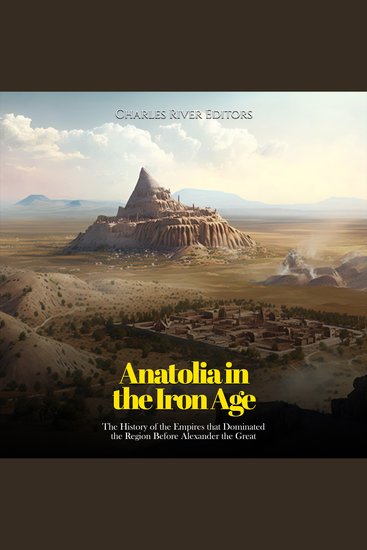
  • Anatolia in the Iron Age: The History of the Empires that Dominated the Region Before Alexander the Great - cover

    Anatolia in the Iron Age: The...

    Editors Charles River

    • 0
    • 0
    • 0
    During the Late Bronze Age, from about 1500-1200 BCE, the Near East was a time and place where great kingdoms and empires vied for land and influence, playing high stakes diplomatic games, trading, and occasionally going to war with each other in the process. The Egyptians, Hittites, Babylonians, Assyrians, and several smaller Canaanite kingdoms were all part of this system, which was one of the first true “global” systems in world history and also one of the most materially prosperous eras in antiquity.  
    Thus, the transition from the Bronze to the Iron Age during the late 13th and early 12th centuries BCE arguably changed the structure and course of world history more fundamentally than any period before or since, and at the center of this period of turmoil was a group of people known today as the Sea Peoples, the English translation of the name given to them by the Egyptians. Despite their prominent role in history, however, the Sea Peoples remain as mysterious as they were influential; while the Egyptians documented their presence and the wars against them, it has never been clear exactly where the Sea Peoples originated from, or what compelled them to invade various parts of the region with massive numbers. Whatever the reason, the Sea Peoples posed an existential threat to the people already living in the region, as noted by an Egyptian inscription: “The foreign countries made a conspiracy in their islands. All at once the lands were removed and scattered in the fray. No land could stand before their arms: from Hatti, Qode, Carchemish, Arzawa and Alashiya on, being cut off at one time. A camp was set up in Amurru. They desolated its people, and its land was like that which has never come into being. They were coming forward toward Egypt, while the flame was prepared before them."
    Show book
  • Sapiens: Book Summary & Analysis - cover

    Sapiens: Book Summary & Analysis

    Briefly Summaries

    • 0
    • 0
    • 0
    This is a concise summary and analysis of Sapiens, by Yuval Noaḥ Harari. It is not the original book and is not affiliated with or endorsed by Yuval Noaḥ Harari. Ideal for those seeking a quick and insightful overview.
     
    This thought-provoking book explores the sweeping history of humankind, from our earliest ancestors to the modern era. Blending anthropology, history, and science, it examines how Homo sapiens became the dominant species on Earth and how cultural, technological, and economic revolutions shaped human societies. With engaging storytelling and deep insights, it challenges conventional perspectives on progress, power, and the future of humanity.
    Show book
  • On Operations - Operational Art and Military Disciplines - cover

    On Operations - Operational Art...

    B. A. Friedman

    • 0
    • 0
    • 0
    On Operations: Operational Art and Military Disciplines traces the history of the development of military staffs and ideas on the operational level of war and operational art from the Napoleonic Wars to today, viewing them through the lens of Prussia/Germany, the Soviet Union, and the United States. B. A. Friedman concludes that the operational level of war should be rejected as fundamentally flawed, but that operational art is an accurate description of the activities of the military staff, an organization developed to provide the brainpower necessary to manage the complexity of modern military operations. Rather than simply serve as an intercession between levels, the military staff exists as an enabler and supporting organization to tacticians and strategists alike. 


    On Operations examines the organization of military staffs, which has changed little since Napoleon's time. Historical examinations of the functions staffs provided to commanders, and the disciplines of the staff officers themselves, leads to conclusions about how best to organize staffs in the future. Friedman demonstrates these ideas through case studies of historical campaigns based on the military discipline system developed.
    Show book
  • The Battle of Priorities - Politics versus The Planet - cover

    The Battle of Priorities -...

    Paula B. Johnson

    • 0
    • 0
    • 0
    Embark on a critical journey with "The Battle of Priorities: Politics versus The Planet," a gripping exploration of the urgent global climate crisis. Delve into the complexities of environmental politics, exposing how political dynamics often overshadow scientific truths. Uncover the economic intricacies of climate policy, examining affordability, the cost of inaction, and the influence of lobbyists. Through case studies like the Paris Agreement, grasp the high-stakes decisions shaping our planet's fate. This book doesn't just present a crisis; it unveils the transformative power of public opinion, media, and grassroots movements. Culminating in a powerful call to action, it inspires readers to be catalysts for change, aligning political strategies with environmental imperatives. For those ready to take a stand, "The Battle of Priorities" is an essential guide to understanding and engaging in the fight for our planet's future.
    Show book