Join us on a literary world trip!
Add this book to bookshelf
Grey
Write a new comment Default profile 50px
Grey
Subscribe to read the full book or read the first pages for free!
All characters reduced
World Leaders Rivalries - cover

World Leaders Rivalries

Amelia Khatri

Translator A AI

Publisher: Publifye

  • 0
  • 0
  • 0

Summary

World Leaders Rivalries explores how personal animosities among influential figures have significantly shaped global politics and history. The book analyzes key rivalries, such as that of Roosevelt and Stalin during World War II, revealing how personal clashes can escalate into geopolitical tensions and even trigger wars. It emphasizes that these high-stakes relationships are not incidental but often a driving force behind major historical events.

 
The book delves into the psychological underpinnings of these rivalries, examining leaders' personalities and motivations through historical records and biographical accounts. By focusing on the interpersonal dynamics of leadership, often overlooked in traditional analyses, it provides a unique perspective on international relations.

 
The analysis incorporates elements of political psychology to understand the behaviors of powerful figures. Structured chronologically and thematically, the book begins by defining rivalry in international relations and progresses through specific case studies, each dedicated to a significant rivalry. It concludes by synthesizing these studies to offer insights into contemporary international relations, making it valuable for students, policymakers, and anyone interested in the human side of history and leadership dynamics.
Available since: 02/15/2025.
Print length: 57 pages.

Other books that might interest you

  • Big Book of Virginia Ghost Stories - cover

    Big Book of Virginia Ghost Stories

    L. B Taylor

    • 0
    • 0
    • 0
    “Packs big entertainment, from famous ghosts and weird hauntings to bizarre but riveting true stories that will give you quite a chill.” —Rosemary Ellen Guiley, author of The Encyclopedia of Ghosts and Spirits   Hauntings lurk and spirits linger in the Old Dominion State . . .    Reader, beware! Turn these pages and enter the world of the paranormal, where ghosts and ghouls alike creep just out of sight. Author L. B. Taylor shines a light in the dark corners of Virginia and scares those spirits out of hiding in this thrilling collection. From poltergeists that make trouble at Blue Ridge Pottery, to a phantom light on Holston Mountain, to specters haunting the battlefield of Cedar Creek, there’s no shortage of bone-chilling tales to keep you up at night. Around the campfire or tucked away on a dark and stormy night, this big book of ghost stories is a hauntingly good read.
    Show book
  • Energy Politics in the Mena Region - From Hydrocarbons to Renewables? - cover

    Energy Politics in the Mena...

    Valeria Talbot

    • 0
    • 0
    • 0
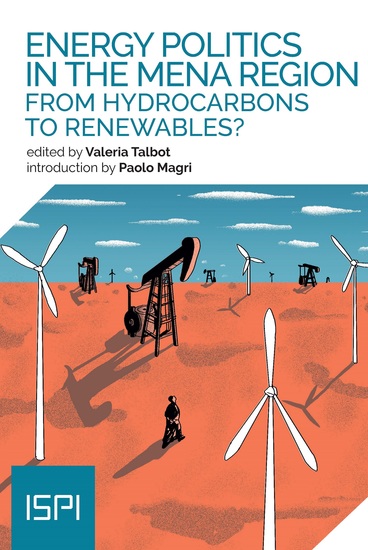
    The war in Ukraine has highlighted Europe's urgency to diversify its energy supplies and reduce dependence on Russia. While, in such context, energy security has become a top political priority for Europe, energy resources from the Middle East and North Africa (MENA) region have drawn European countries' renewed attention. Boasting abundant oil and gas reserves, the MENA region will likely play a
    leading role in Europe's current energy crisis. While MENA exporters' ability to increase their supply is limited in the short-term, more resources are likely to be available in a longer-term perspective.
    As Europeans are scrambling for alternatives, this Report analyses the different implications for a number of MENA exporters of fossil fuels. As these countries have become even more central to Europe's energy security, assessing their prospects is of paramount importance, including not only their short-term role as suppliers of fossil fuels, but also their opportunity to accelerate along the path of the green
    transition.
    How is the current energy crisis affecting the role of MENA hydrocarbons producers as Europe's energy suppliers? How will Europe's needs in additional resources redefine energy geopolitics in the Middle East and North Africa? Which new prospects for their green transition?
    Show book
  • European Integration Perspectives in Times of Global Crises - 13th Network Europe Conference Athens 19 – 22 June 2022 - cover

    European Integration...

    Andreas Kellerhals, Tobias...

    • 0
    • 0
    • 0
    With the White Paper on the Future of Europe, the European Commission had launched a debate on fundamental reforms of the Union structures in 2017. A total of five reform scenarios ranged from a reduction and focusing of the Union’s competences to increased integration in the sense of a United States of Europe. However, the White Paper did not have any consequences; none of the reform scenarios presented was implemented. However, current global challenges in the areas of health, climate change and energy resources as well as the shift in the global balance of power and related security issues demonstrate the increasing importance of a strong and united Europe. The idea of an “ever closer union”, as laid down in the preamble of the 1992 EU Treaty, could experience a renaissance. Against this background, the 13th Network Europe Conference addressed the importance of the integration project in times of global crises and the challenges in various policy areas, as well as the EU’s relations with its eastern and southern neighbors and its role vis-à-vis global actors such as China and Russia. This publication contains the conference contributions.
    Show book
  • The New History of Orkney - cover

    The New History of Orkney

    William P.L. Thomson

    • 0
    • 0
    • 0
    For much of its history, Orkney had its own language, culture and institutions. The prehistoric inhabitants created monuments which are unmatched anywhere in Europe, and the medieval period saw the magnificent earldom that expressed itself through the Orkneyinga Saga and the building of St Magnus Cathedral in Kirkwall. Like Shetland, Orkney was heavily influenced by Viking traders and raiders from Scandinavia, and for a long period it formed an outlying part of the kingdom of Norway.
    Over 500 years ago, however, the islands lost their Scandinavian links and since then have had a sometimes difficult association with mainland Scotland. More recent times have seen the use of Orkney as a strategic stronghold during two world wars, and the far-reaching impact of oil and gas exploitation in the North Sea. This classic book covers the whole fascinating story and will be of interest to readers far beyond the rocky shores of Orkney itself.
    Show book
  • Jewish War The: A Captivating Guide to the First Jewish-Roman War and How the Great Revolt of Judea Impacted Ancient Rome and Jewish History - cover

    Jewish War The: A Captivating...

    Captivating History

    • 0
    • 0
    • 0
    Learn about the Jewish revolts against the overwhelming domination of ancient Rome.  
    The Romans, through sheer military strength, turned Judea into a client state. They forced the Jews to submit to Roman law and Roman taxation and to countenance Roman religion. The Jews of Judea exhibited unbelievable strength in resisting assimilation into Roman Hellenistic culture. Their history of dealing with foreign overlords inspired the Jews to hold out and then revolt against the Romans.  
    Are you curious to learn more? Or are you interested in learning about the Roman siege of Jerusalem? Perhaps you are intrigued about Josephus, the man from whom we get most of our information about the Jewish War. We cover all of this and more.  
    In this audiobook, you will learn about the following:What the Maccabee family accomplished and how they set an example for future leaders of Jewish revolts against foreign powersHow Josephus turned from a patriotic Jew to a supporter of the Roman cause and how he avoided suicide by luck or excelling in mathematicsWhat Jerusalem was like in the midst of the Roman siegeHow the Romans succeeded by utilizing clever engineering in breaching the walls of JerusalemThe fate of the Second Temple and its treasuresThe final gasps of Jewish resistance to Roman ruleAnd so much more!  
     Don’t miss this opportunity to learn about the valiant struggle of the Jews to free themselves from Roman domination. Scroll up and click the “add to cart” button today!
    Show book
  • Prehistoric Warfare: The History of Early Human Conflicts - cover

    Prehistoric Warfare: The History...

    Editors Charles River

    • 0
    • 0
    • 0
    Raymond C. Kelly, an anthropologist and ethnologist who has written extensively on societal inequality and subsequent warfare suggests that among the hunter-gatherer groups of Homo erectus, the population density was low enough to avoid armed conflict in most cases. In the same vein, a perception has persisted that during this less populated time of Earth’s history, life among the Homo species was relatively peaceful. Archaeologists have supported this theory through early cave art, little of which ever depicts humans hunting or killing each other explicitly. Kelly theorized that the migration out of Africa by Homo erectus 1.8 million years ago was “a natural consequence of conflict avoidance.” He believes that this general period of “Paleolithic warlessness” was to persist until the appearance of Homo sapiens approximately 350,000 years ago, and that it began with the occurrence of “economic and social shifts associated with sedentism.” 
    However, depictions of humans pierced with arrows began to appear in the Aurignacian-Périgordian eras (30,000 years ago), and in the early Magdalenian era (17,000 years ago). A work of Mesolithic art (20,000 to 10,000 years ago) shows an explicit battle between groups of archers, and in Valencia, a group of three archers are seen surrounded by four of the similarly armed enemy in the Cova del Roure la Vella in Castellón. In the Ares del Maestrat in Alcañiz of Aragon, another work depicts warriors fleeing a group of eight archers, while a similar work at Val del Charco del Agua in Aragon shows seven archers with plumed headgear. Other examples show warriors in lines and columns with a “distinctly garbed leader at the front.”
    Show book