Join us on a literary world trip!
Add this book to bookshelf
Grey
Write a new comment Default profile 50px
Grey
Subscribe to read the full book or read the first pages for free!
All characters reduced
White House Traditions - cover

White House Traditions

Amelia Khatri

Translator A AI

Publisher: Publifye

  • 0
  • 0
  • 0

Summary

White House Traditions explores the history and significance of the rituals and customs that have shaped the American presidency. It delves into how events like the Easter Egg Roll and the White House Christmas tree have evolved, reflecting changing social norms and political landscapes. The book argues that these traditions are powerful symbols of continuity, leadership, and national identity, connecting each administration to the historical narrative of the American presidency.

 
The book examines the political implications of these traditions, such as how they have been used to project power and unite the nation. It also highlights the human element, focusing on the roles of First Families and White House staff in maintaining these customs.

 
Beginning with an introduction to White House traditions, the book progresses through prominent examples like holiday celebrations and state dinners, culminating in an assessment of their future relevance.
Available since: 02/15/2025.
Print length: 53 pages.

Other books that might interest you

  • Bite Club - Real-life attacks by sharks and other killer predators - cover

    Bite Club - Real-life attacks by...

    Douglas Wight

    • 0
    • 0
    • 0
    It’s a trauma like no other. 
    Being perceived as a threat or, worse, hunted as food makes an animal attack a unique ordeal. Suddenly you’re helpless, at its mercy. When an animal strikes it is lightning fast, determined and can’t be reasoned with. Often brutally violent, such an attack can leave horrific injuries, both physical and emotional that endure long after the encounter. 
    Whether it’s a great white shark, a bear, lion, or other deadly predator, the impact such attacks can have on the victim, their families, the communities, and the wider human psyche is often profound and enduring. And when you add the media attention that such incidents often attract, the actual bite might not be the only attack a survivor has to endure. 
    In Bite Club, we meet brave people from around the world who have come face to face with sharks or other deadly predators and lived to tell the tale. And we learn of the group of survivors who are supporting each other to navigate, recover and grow from what is for many, their most traumatic experience ever.
    Show book
  • The Life Worth Living - Disability Pain and Morality - cover

    The Life Worth Living -...

    Joel Michael Reynolds

    • 0
    • 0
    • 0
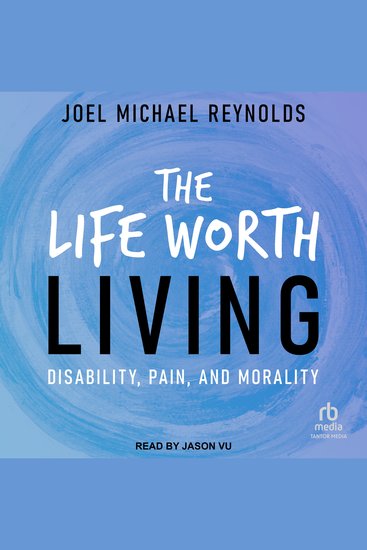
    More than 2,000 years ago, Aristotle said: "let there be a law that no deformed child shall live." This idea is alive and well today. During the past century, Supreme Court Justice Oliver Wendell Holmes Jr. argued that the United States can forcibly sterilize intellectually disabled women and philosopher Peter Singer argued for the right of parents to euthanize certain cognitively disabled infants. The Life Worth Living explores how and why such arguments persist by investigating the exclusion of and discrimination against disabled people across the history of Western moral philosophy. 


    Joel Michael Reynolds argues that this history demonstrates a fundamental mischaracterization of the meaning of disability, thanks to the conflation of lived experiences of disability with those of pain and suffering. Building on decades of activism and scholarship in the field, Reynolds shows how longstanding views of disability are misguided and unjust, and he lays out a vision of what an anti-ableist moral future requires. 


    The Life Worth Living is the first sustained examination of disability through the lens of the history of moral philosophy and phenomenology, and it demonstrates how lived experiences of disability demand a far richer account of human flourishing, embodiment, community, and politics in philosophical inquiry and beyond.
    Show book
  • Ancient Celtic Legends: The History of Celtic Folk Tales and Myths that Influenced European Mythology - cover

    Ancient Celtic Legends: The...

    Editors Charles River

    • 0
    • 0
    • 0
    The Celts are one of the most well-known groups in Europe and one of the least understood. Depending on which classifications are used, the Celts are also one of the oldest civilizations in Europe. In the centuries before Christ, the Celts were spread out across much of continental Europe, and though they are mostly identified with Gaul, evidence suggests they also spread as far as Portugal. Though they were spread out across Europe before the height of the Roman Empire, most people associate the Celts with the British Isles today, particularly Ireland and Scotland. After they had been relegated to those smaller regions as a result of the Romans and other migrations, the culture of the Celts as it is currently understood began to congeal during the Early Middle Ages, and Celtic culture, folklore, and legend have all become inextricably intertwined with Irish history and British history as a whole. 
    Historically, Celtic cultures differ from their English and French neighbors in a number of ways, including social organization, language, values and economic systems, but one of the most captivating of these has always been their myths. Celtic Myths, which can be read in translation without needing special training in grammar, are more accessible than the Celtic languages, and unlike the other distinctive features that have faded over the centuries, myths still have their immediacy and power when read today. While much has undoubtedly been lost from the ancient Celts over time, medieval manuscripts help scholars understand how Celtic myths have reached the form they have today. Like many ancient belief systems, Celtic mythology shares Indo-European roots, meaning Celtic beliefs have cousins in related societies like the Norse, Greeks, Romans and Slavs, with a foundation of shared mythmaking that goes back several millennia.
    Show book
  • The Great Dictionary French - English - 130000 Entries - cover

    The Great Dictionary French -...

    Benjamin Maximilian Eisenhauer

    • 0
    • 0
    • 0
    This dictionary contains around 130,000 French terms with their English translations, making it one of the most comprehensive books of its kind. It offers a wide vocabulary from all areas as well as numerous idioms. The terms are translated from French to English. If you need translations from English to French, then the companion volume "The Great Dictionary English - French" is recommended.
    Show book
  • Norman Invasion of England The: The History and Legacy of William the Conqueror’s Successful Campaign in 1066 - cover

    Norman Invasion of England The:...

    Editors Charles River

    • 0
    • 0
    • 0
    For hundreds of years, the Anglo-Saxons – who had been harassing the Saxon Shore as pirates –began to settle in Britain, creating a patchwork of little kingdoms and starting a new era of English history. Several early medieval historians, writing well after the events, said the Anglo-Saxons were invited to Britain to defend the region from the northern tribes and ended up taking over. The Venerable Bede (672 or 673-735) said in his Historia ecclesiastica gentis Anglorum (“Ecclesiastical History of the English People”) that in the year 449, “The British consulted what was to be done and where they should seek assistance to prevent or repel the cruel and frequent incursions of the northern nations. They all agreed with their king Vortigern to call over to their aid, from the parts beyond the sea, the Saxon nation. … The two first commanders are said to have been Hengist and Horsa.” 
    	However they came to control most of England, the Anglo-Saxons became the dominant power in the region for nearly 500 years, and the strength of their cultural influence could be felt even after William the Conqueror won the Battle of Hastings and became the first Norman ruler on the island. William is one of history’s most famous conquerors, but the efforts to consolidate his rule in England were complicated from the start, both due to external enemies and those jockeying for his position while he was still alive. William ultimately decided to split Normandy and England. His son Robert, still in open revolt, would nonetheless inherit Normandy, while the next in line, his second son William, would rule England. The two states that William left behind were hardly united or at peace. Soon after his death, Odo conspired with Robert to oust his brother from the English throne and re-establish a united state, but the revolt failed, and King William “Rufus” II would rule England until his suspicious death in 1100.
    Show book
  • Language and Mediated Masculinities - Cultures Contexts Constraints - cover

    Language and Mediated...

    Robert W Lawson

    • 0
    • 0
    • 0
    From television shows to the manosphere, and from alt-right communities to fatherhood forums, debates about masculinity have come to dominate the media landscape. This growing cultural tension around masculinities has been discussed and analyzed both for general audiences and in burgeoning academic scholarship. What has been typically overlooked, however, is the role that language plays in these mediated performances of masculinity. 


    In Language and Mediated Masculinities, Robert Lawson draws on data from newspapers, social media sites, television programs, and online forums to explore language and masculinities across a range of media contexts. The book offers a critical evaluation of the intersection between language, masculinities, and identities in contemporary society. Lawson furthers our understanding of how language is implicated in (re)creating gender ideologies and how it shapes contemporary gender relations. Against a cultural backdrop of rising neoliberalism, ethnic nationalism, online radicalization, networked misogyny, and fractious gender relations, this book is an important contribution to charting how language is used to monitor, evaluate, and police masculinities in online and offline spaces.
    Show book