Begleiten Sie uns auf eine literarische Weltreise!
Buch zum Bücherregal hinzufügen
Grey
Einen neuen Kommentar schreiben Default profile 50px
Grey
Jetzt das ganze Buch im Abo oder die ersten Seiten gratis lesen!
All characters reduced
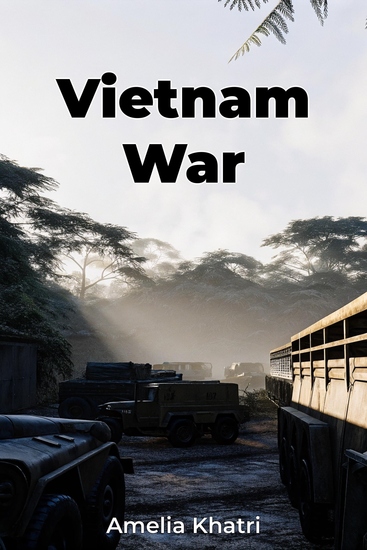
Vietnam War - cover

Vietnam War

Amelia Khatri

Übersetzer A AI

Verlag: Publifye

  • 0
  • 0
  • 0

Beschreibung

The Vietnam War explores the transformation of a regional conflict into a global ideological battleground, examining the military campaigns, political struggles, and widespread protests that defined a generation. It highlights the intricate web of guerrilla warfare tactics employed by the Viet Cong and North Vietnamese Army, the divisive political decisions of global powers, and the powerful anti-war movement that resonated across continents. The book emphasizes that the conflict was not merely a military engagement but a pivotal event that exposed the limitations of superpower intervention and fueled social upheaval globally.

 
The book begins by establishing the historical context, including the Cold War rivalry and French colonialism, before delving into the military strategies of both sides. It analyzes the political decisions of key players, such as the US and South Vietnamese governments, and dedicates a significant portion to exploring the anti-war movement and its impact. This comprehensive approach, drawing on primary and secondary sources, offers a fresh perspective by examining the war through the lens of both military strategy and social movements, ultimately assessing the long-term consequences of the war on Vietnam, the United States, and the global political order.
Verfügbar seit: 17.02.2025.
Drucklänge: 59 Seiten.

Weitere Bücher, die Sie mögen werden

  • Drawing the Line - What to Do with the Work of Immoral Artists from Museums to the Movies - cover

    Drawing the Line - What to Do...

    Erich Hatala Matthes

    • 0
    • 0
    • 0
    Recent years have proven rife with revelations about the misdeeds, objectional views, and, in some instances, crimes of popular artists. Given more access than ever thanks to social media and the internet in general, the public has turned an alert and critical eye upon the once-hidden lives of previously cherished entertainers. But what should we members of the public do, think, and feel in response to these artists' actions or statements? It's a predicament that many of us face: whether it's possible to disentangle the deeply unsettled feelings we have toward an artist from how we respond to the art they produced. As consumers of art, and especially as fans, we have a host of tricky moral question to navigate: do the moral lives of artists affect the aesthetic quality of their work? Is it morally permissible for us to engage with or enjoy that work? Can we separate an artist from their art? 


    In Drawing the Line, Erich Hatala Matthes offers insight and clarity to the ethical questions that dog us. He argues that it doesn't matter whether we can separate the art from the artist, because we shouldn't. Matthes argues both that the lives of artists can play an important role in shaping our moral and aesthetic relationship to the artworks that we love and that these same artworks offer us powerful resources for grappling with the immorality of their creators.
    Zum Buch
  • Determinism - cover

    Determinism

    John-Michael Kuczynski

    • 0
    • 0
    • 0
    Determinism is the doctrine that the world's condition at any given time is a consequence of its condition at some prior time. The world is predictable only to the extent that it is deterministic, but even a strictly deterministic world cannot possibly be entirely predictable. The reasons for this are stated in this fast-paced, tightly argued monograph, as are the reasons why, contrary to what is generally assumed, it can in fact be established with reasonable certainty that the world is at least approximately deterministic. The difference between indeterminism and randomness is also discussed, and some important but oft-overlooked consequences of this distinction are identified.
    Zum Buch
  • Admiral Alfred Thayer Mahan: The Life and Legacy of America’s Most Influential Naval Strategist - cover

    Admiral Alfred Thayer Mahan: The...

    Editors Charles River

    • 0
    • 0
    • 0
    Alfred Thayer Mahan is arguably the most influential military strategist in American history, and one of the world’s most important naval theorists. His work has been nearly as influential as the famous German military theorist Carl von Clausewitz (1780-1831), and the lesser-known but nearly as influential Swiss military writer Antoine-Henri Jomini (1779-1869). 
    Alfred decided to go to the Naval Academy in Annapolis, which he was admitted to via the influence of Secretary of War Jefferson Davis. He graduated in 1859 and started a career lasting almost 40 years. He served aboard a wide variety of ships, from a powerful frigate under sail to a variety of steam sloops, corvettes, and gunboats, many of which were side wheelers and all of which had auxiliary sails. 
    He started as a Midshipman and worked his way up the naval ranks to Captain and Commander. He also had several independent commands. He was stationed off the Atlantic Coast and in the Gulf of Mexico during the Union blockade of the Confederacy. He was on a sidewheeler tasked with keeping an eye on the French in Mexico, where Napoleon II had installed a Hapsburg archduke as emperor. He spent more than two years on station in the Far East, spent a couple of years with the South Atlantic Squadron based in Montevideo in Uruguay, and then a year off the west coast of South America, in a ship observing events during the War of the Pacific. 
    After a lengthy naval career, Mahan had assignments at the Naval Academy and the Brooklyn Naval Yard. He was invited to lecture at the Naval War College, and it was there that he collected together his notes and wrote a book, The Influence of Naval Power upon History, which somehow became an international bestseller in 1890. His book resulted in an invitation to dine with the Queen in Britain. It was translated into German and the Kaiser ordered a copy be placed on every German warship and in every school.
    Zum Buch
  • More Than a Doll - How Creating a Sports Doll Turned into a Fight to End Gender Stereotypes - cover

    More Than a Doll - How Creating...

    Jodi Bondi Norgaard

    • 0
    • 0
    • 0
    Can gender stereotypes in childhood be more destructive than our culture perceives and stand in the way of gender equality? 


    When Jodi Bondi Norgaard, an experienced entrepreneur, attempted to shake-up the toy industry with a sports doll that appeals to today's more athletic, adventurous girls, she came to realize the roadblocks to success weren't only reluctant toy buyers, but a patriarchal culture that perpetuates gender roles and sexism. More Than a Doll is about her mission to break gender stereotypes and challenge the status quo. 


    Through illuminating testimonials, data, research, interviews, and cultural observations, listeners will come away with clear examples of the dangers of early gender stereotyping and how we continue to fail to see the harm. 


    After all: "It's just a toy." "It's just a t-shirt." "It's just a show." 


    Bondi Norgaard is sounding the siren that gender inequality doesn't begin in our teens, it begins the moment a child can hold a toy or book or watch a screen. The programing starts early, and the impact is lifelong.
    Zum Buch
  • Vegetarianism and Occultism - cover

    Vegetarianism and Occultism

    C. W. Leadbeater

    • 0
    • 0
    • 0
    How does occultism regard vegetarianism? It regards it very favorably, and that for many reasons. These reasons may be divided into two classes: those which are ordinary and physical, and those which are occult or hidden. Let us see in detail why a vegetarian diet is emphatically the purest and the best. (Summary from Vegetarianism and Occultism)
    Zum Buch
  • Underground and Underwater in World War I: The History and Legacy of the Hidden Fighting during the Great War - cover

    Underground and Underwater in...

    Editors Charles River

    • 0
    • 0
    • 0
    Most books and documentaries about the war focus on the carnage of the trenches, depicting the ceaseless bombardment and sniping, and the assaults and counterattacks that took millions of lives. This was the experience of most frontline soldiers during that great conflict, but it was not the only experience. There was another war going on beneath the trenches, a war of tunnels and mines fought by men who didn’t see sunlight for days at a time and who lived in constant fear of cave-ins and enemy detection. These men, who had mostly been miners in civilian life, lived a twilight existence, working long hours in silence and near darkness while great battles raged overhead. They suffered from fatigue, stress, and the knowledge that they could be killed at any time by an unseen enemy. Despite this, they persevered, and the mines they laid under enemy trench systems turned the tide of at least one major battle.  
    	The sleek hunter-killers lurking beneath the waves, using periscopes to close in unnoticed on their prey, added a new, nerve-wracking element to naval warfare. The mere threat of submarine attack immediately altered naval tactics and strategies employed by both the Western Allies and the Central Powers, shifting them towards a more cautious approach, especially at the war’s start when the submarine threat remained untested. 	During World War I, German U-boats operated solo except on one occasion. Initially, the British and nations supplying England with food and materiel scattered vessels singly across the ocean, making them vulnerable to the lone submarines. However, widespread late war re-adoption of the convoy system tipped the odds in the surface ships' favor.
    Zum Buch