¡Acompáñanos a viajar por el mundo de los libros!
Añadir este libro a la estantería
Grey
Escribe un nuevo comentario Default profile 50px
Grey
Suscríbete para leer el libro completo o lee las primeras páginas gratis.
All characters reduced
Team Crisis Win - cover

Team Crisis Win

Amelia Khatri

Traductor A AI

Editorial: Publifye

  • 0
  • 0
  • 0

Sinopsis

Team Crisis Win explores how effective team dynamics during industrial accidents can drastically improve outcomes. It argues that a coordinated, culturally prepared team is more critical than individual expertise or technology. Drawing from safety board reports like those of the NTSB and CSB, the book analyzes communication, leadership, and decision-making in high-stress events. Interestingly, the book highlights that "success" isn't always about preventing the accident, but mitigating its consequences effectively, showcasing the importance of robust emergency management.

 
The book dissects successful crisis response teams, emphasizing the pivotal role of communication and organizational culture. It traces the evolution of industrial safety, revealing how human factors have gained prominence in accident response. Team Crisis Win progresses in three parts: introducing team dynamics, analyzing case studies of major industrial accidents, and synthesizing lessons into a framework for building high-performance crisis response teams. This approach provides actionable insights for business management, offering strategies to develop resilient and responsive teams.
Disponible desde: 16/02/2025.
Longitud de impresión: 107 páginas.
Otros libros que te pueden interesar

  • America’s Defeat - A Revolutionary War Won by the British - cover

    America’s Defeat - A...

    Marcus Draysun

    • 0
    • 0
    • 0
    The American colonies in the mid-18th century were a thriving part of the British Empire, but tensions had been brewing for decades. What began as minor grievances over trade and governance escalated into a full-scale rebellion. British policies, aimed at tightening control over the colonies, ignited widespread dissatisfaction, planting the seeds of revolution. 
    One of the earliest sources of discontent was the British system of taxation. The Sugar Act of 1764 and the Stamp Act of 1765 imposed direct levies on the colonies, enraging merchants, publishers, and legal professionals. The colonists, who had no direct representation in the British Parliament, saw these taxes as a blatant overreach. Their rallying cry—“No taxation without representation”—became a defining slogan of the growing resistance. The Stamp Act’s repeal in 1766 provided temporary relief, but the British government soon followed with new policies, including the Townshend Acts, which further strained relations. 
    The presence of British troops in colonial cities only exacerbated tensions. Stationed to enforce British laws and maintain order, soldiers were often viewed as an occupying force. Clashes between civilians and the military became frequent, culminating in the infamous Boston Massacre of 1770, where British troops fired into a crowd of unarmed colonists, killing five. This event, heavily publicized by Patriot leaders, fueled anti-British sentiment and strengthened calls for defiance.
    Ver libro
  • The New Leviathans - Thoughts After Liberalism - cover

    The New Leviathans - Thoughts...

    John Gray

    • 0
    • 0
    • 0
    Ever since its publication in 1651, Thomas Hobbes's Leviathan has unsettled and challenged how we understand the world. Condemned and vilified by each new generation, his cold political vision continues to see through any number of human political and ethical vanities. 


    In his wonderfully stimulating book The New Leviathans, John Gray allows us to understand the world of the 2020s with all its contradictions, moral horrors, and disappointments. The collapse of the USSR ushered in an era of near apoplectic triumphalism in the West: a genuine belief that a rational, liberal, well-managed future now awaited humankind and that tyranny, nationalism, and unreason lay in the past. Since then, so many terrible events have occurred and so many poisonous ideas have flourished, and yet our liberal certainties treat them as aberrations that will somehow dissolve. Hobbes would not be so confident. 


    Filled with fascinating and challenging observations, The New Leviathans is a powerful meditation on historical and current folly. As a species we always seem to be struggling to face the reality of base and delusive human instincts. Might a more self-aware, realistic, and disabused ethics help us?
    Ver libro
  • The Fallacy of Freedom - cover

    The Fallacy of Freedom

    Gregory Heary

    • 0
    • 0
    • 0
    How can you achieve true freedom in a society laden with diverse and often conflicting beliefs? This book cuts through the noise, offering clarity on what it means to be free in a world governed by ideologies.Exploring the notion of freedom, this book presents a riveting analysis of its impact on society and individual minds. It highlights the tension between the advocates of free speech and expression and those who perceive these freedoms as threats. By dissecting the actions and motivations of both supporters and critics of freedom, the book provides a unique lens through which to view our own beliefs. The book delves deep into the battleground of ideologies where freedom clashes with traditional and modern beliefs. Proponents of freedom argue for its necessity in expression and innovation, while its opponents criticize its potential for leading to chaos and moral decay. Through a detailed analysis of these conflicting viewpoints, this book illuminates the complexities of freedom in society. It examines how historical and religious teachings shape our understanding and practice of freedom, advocating for a balanced mental hygiene that aligns with divine guidance. By embracing this approach, you're not just informed but transformed, equipped to use your freedom wisely and in ways that contribute to personal and communal well-being. This astute analysis not only clarifies what it means to be truly free but also challenges you to examine your own beliefs and the societal norms that shape them. It navigates the intricate dynamics of freedom and control, offering you a path to a more enlightened, purpose-driven life.Unlock the path to true freedom and mental clarity by picking up this book today!
    Ver libro
  • Raising Ollie - How My Nonbinary Art-Nerd Kid Changed (Nearly) Everything I Know - cover

    Raising Ollie - How My Nonbinary...

    Tom Rademacher

    • 0
    • 0
    • 0
    Ollie, who used to hate weekends because they meant no school, was crying on the way to school almost every day. Sure, there were the slings and arrows of bullies and bad teachers, but, maybe worse, Ollie, a funny, anxious, smart kid, was gravely underchallenged and also struggling with identity and how to live totally as themselves. Ollie begged to switch to a new school with "kids like me," and so they made the change. 


    Raising Ollie is dad Tom Rademacher's story (really, many stories) of that eventful and sometimes painful school year, parenting Ollie and relearning every day what it means to be a father and teacher. As Ollie—who is nonbinary and uses they/them pronouns—flourishes in their new school, Rademacher is making an eye-opening adjustment to a new school of his own, one that's whiter and more suburban than anywhere he has previously taught, with a history of racial tension that he tries to address and navigate. 


    While Ollie is learning to finally feel comfortable at school, Rademacher increasingly sees how his own educational struggles, anxieties, and childhood upbringing are reflected in his teaching, writing, and parenting, as well as in Ollie's experience. He shows us how raising a kid changes everything—and how much raising a kid like Ollie can teach us about who we are and what we're doing in the world.
    Ver libro
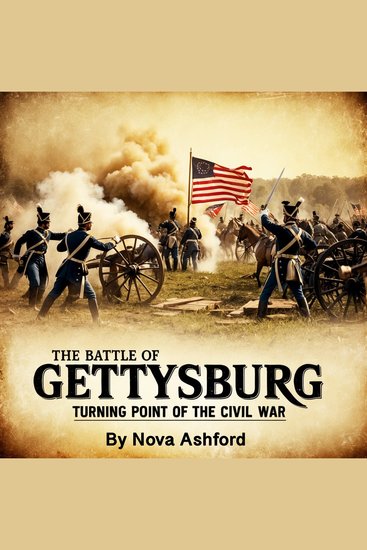
  • The Battle of Gettysburg - Turning Point of the Civil War - cover

    The Battle of Gettysburg -...

    Nova Ashford

    • 0
    • 0
    • 0
    The Battle of Gettysburg stands as one of the most significant events in the American Civil War. Fought from July 1 to July 3, 1863, it marked a turning point in the conflict, shifting momentum firmly in favor of the Union. It was the largest battle ever fought in North America, involving over 160,000 soldiers and resulting in nearly 50,000 casualties. The immense scale of the battle and the high human cost underscore its importance, but Gettysburg's significance goes beyond just the number of lives lost. It was a critical moment in the war, a pivotal clash that ultimately determined the future direction of the United States. 
    Before Gettysburg, the Confederate Army, led by General Robert E. Lee, had gained significant victories in the Eastern Theater, including the battles of Fredericksburg and Chancellorsville. Lee’s Army of Northern Virginia was emboldened by these successes and was determined to continue its efforts to win independence for the South. In the spring of 1863, Lee decided to take the fight to the North, hoping that a victory on Union soil would weaken Northern morale, pressure the U.S. government for a peace settlement, and gain international recognition for the Confederacy. His strategy was bold but fraught with risk, as it carried the potential to either decisively break the Union or set the stage for a resounding Confederate defeat. 
    On the other side, the Union Army, led by Major General George G. Meade, was in a period of transition. Meade had only recently been appointed to command, replacing General Joseph Hooker. The Union Army had been struggling to achieve decisive victories after a series of failures, and morale was low. However, the Union leadership understood that they could not afford another loss to the Confederacy. Gettysburg would become their test—a chance to halt Lee’s advance and potentially reverse the tide of the war.
    Ver libro
  • How to Raise Mentally Strong Children With ADHD - 100 Practical Strategies Every Parent Can Use to Reduce Stress Calm Chaos and Improve Family Life - cover

    How to Raise Mentally Strong...

    Talia Rowen

    • 0
    • 0
    • 0
    Do your days feel like a never-ending cycle of chaos, guilt, and exhaustion? 
    Mornings spiral out of control before breakfast is even on the table. Homework time ends in shouting matches. Bedtime turns into a battle of negotiations. And in between, you wonder if you’re failing your child, because nothing you try seems to stick. 
    You’re not failing. You just need tools that work in the real world. 
    Most parenting books talk in circles, offering vague advice like “be consistent” or “set routines.” This guide is different. It gives you 100 practical strategies, each one short, clear, and ready to use. Every tool is organized by category—routines, school, discipline, self-esteem, social skills, communication, health, technology, family life, and parent well-being—so you can jump straight to the area you need most and put it into practice today.
    Ver libro