Join us on a literary world trip!
Add this book to bookshelf
Grey
Write a new comment Default profile 50px
Grey
Subscribe to read the full book or read the first pages for free!
All characters reduced
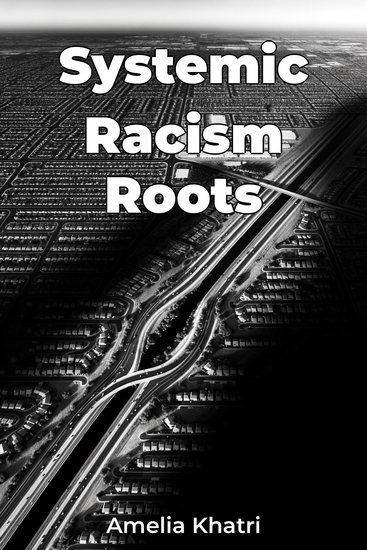
Systemic Racism Roots - cover

Systemic Racism Roots

Amelia Khatri

Publisher: Publifye

  • 0
  • 0
  • 0

Summary

"Systemic Racism Roots" offers a comprehensive examination of how institutional structures and historical policies have shaped and perpetuated racial inequalities in modern society. The book uniquely traces these patterns from their historical origins to present-day manifestations, distinguishing institutional racism from individual prejudice while demonstrating how seemingly neutral systems continue to maintain racial disparities.

 
Through a meticulous analysis of archival records, policy documents, and demographic data, the book reveals how historical practices like redlining, segregated education, and discriminatory lending have evolved into contemporary forms of inequality across housing, education, criminal justice, healthcare, and employment. The research presents compelling evidence that current racial disparities aren't merely echoes of past discrimination but are actively maintained through modern institutional practices and policies.

 
The book progresses chronologically, beginning with foundational concepts and moving through historical developments to present-day manifestations of systemic racism. What sets this work apart is its systematic approach to tracking how discriminatory practices have been reformulated rather than eliminated, combining quantitative analysis with qualitative examination of institutional decision-making processes.

 
Written for scholars, policymakers, and informed general readers, each chapter features specific case studies and practical frameworks for identifying and addressing institutional barriers, making it an invaluable resource for those working toward meaningful social change.
Available since: 01/08/2025.
Print length: 114 pages.
Other books that might interest you

  • The Tiger from Poznań - cover

    The Tiger from Poznań

    Richard Siegert

    • 0
    • 0
    • 0
    In the Second World War, Poznan was a key river crossing and railway junction on the Polish-German border. When the alarm was given indicating the Red Army's approach in January 1945, the city's 80-100,000 German civilians were speedily evacuated, leaving a garrison of some 15,000 men, mostly poorly-armed infantry, to face the rigors of a siege conducted by a massively superior and ruthless enemy anxious to acquire this transport center, which was vital for the advance on Berlin. 


    This is the account of Eastern Front veteran Richard Siegert, the gunner and later commander of the defenders' sole Tiger tank. Since the death of the driver in a futile attempt to escape from a PoW camp in Russia just after the end of the war, Siegert is the only survivor of that crew able to pass its record on to posterity. His account details how the crew fought gallantly against impossible odds, even when the Tiger was immobilized and could only act as a stationary antitank gun post or pillbox during the last heroic days' fighting for the citadel.
    Show book
  • The Wounds Are the Witness - Black Faith Weaving Memory into Justice and Healing - cover

    The Wounds Are the Witness -...

    Yolanda Pierce

    • 0
    • 0
    • 0
    From celebrated scholar Dr. Yolanda Pierce comes this indelible meditation on Black faith, suffering, hope, and the healing possibilities of justice, written in the venerable tradition of James Cone and Kelly Brown Douglas. 
      
    What do we do with wounds—our own, others', and a nation's? We can turn away, avert our gaze. We can make a spectacle of suffering. Or like the doubting disciple who longed to touch Jesus's side, we can acquaint ourselves with the wounds: both the story they tell and the healing they prefigure. 
      
    In The Wounds Are the Witness, Yolanda Pierce, dean of Vanderbilt University Divinity School and author of In My Grandmother's House, weaves together her own memories, vignettes from Black life, and scenes from scripture, especially the passion of Christ. To work for liberation in a broken world, we cannot look away from crucified flesh. Bones from the Middle Passage, GI Bill benefits denied to Black veterans, women inmates shackled while giving birth: we must take all such wounds seriously. They testify to both the pain and the faith of a people. 
      
    With the lyrical eye of a poet and the moral precision of a preacher, Pierce casts readers into the astounding story of God's healing. From the curative powers of a spiderweb to the work of justice in history, politics, medicine, higher education, and the Black church, Pierce asks: Where are the remedies for the battered and broken? What does accountability look like? Is there any cure? 
      
    Healing takes time, Pierce writes, and even the wounds of the risen Christ do not immediately close. When the wounds become the witness, we find a faith reimagined and a hope transfigured. They tell the truth: about the extent of the injury and the extraordinary work of healing.
    Show book
  • The Rise of Isis - The Formation and Impact of the Islamic State in the 21st Century - cover

    The Rise of Isis - The Formation...

    Fredrich Hazelton

    • 0
    • 0
    • 0
    The rise of the Islamic State of Iraq and Syria (ISIS) stands as one of the most significant and alarming phenomena of the 21st century. Emerging from the chaos of regional conflicts and geopolitical missteps, ISIS transformed from a little-known insurgent group into a global threat that captured the world’s attention. At its height, ISIS declared a self-styled caliphate, controlling vast territories across Iraq and Syria, and wielded its influence far beyond the Middle East. Through acts of brutality, strategic propaganda, and a sophisticated recruitment network, the group redefined the face of modern terrorism.  
      
    The story of ISIS is not one of sudden emergence but rather a culmination of decades of historical, political, and social factors. Its rise cannot be fully understood without examining the regional instability created by the Iraq War, the Arab Spring uprisings, and the Syrian Civil War. These events set the stage for the group’s ascent, enabling it to exploit power vacuums, sectarian divisions, and state failures. The role of key figures, such as Abu Musab al-Zarqawi and Abu Bakr al-Baghdadi, was pivotal in shaping the group’s ideology, operations, and global ambitions.  
      
    Equally crucial to understanding ISIS’s impact is its approach to governance and control. The group operated as more than a terrorist organization—it functioned as a quasi-state, establishing administrative systems, levying taxes, and providing services to populations under its rule. Its brutality, however, served as both a tool of fear and a declaration of its unyielding vision, attracting supporters and horrifying opponents. Through propaganda disseminated across digital platforms, ISIS extended its reach to every corner of the globe, inspiring attacks in cities far removed from its territorial base. 
    Show book
  • The Resilient Garden - Simple Cheap & Organic Tips on Home and Community Gardening in Poor Soil and Extreme Conditions from South Africa - cover

    The Resilient Garden - Simple...

    Charles Featherstone

    • 0
    • 0
    • 0
    Think you can't garden because your soil is poor, your water is scarce, and your space is limited? Think again. Drawn from the popular columns of Grocott's Mail, this handbook is packed with proven, hard-won wisdom from South Africa's Eastern Cape and KwaZulu-Natal.  
    This collection of bite-sized columns and stories is a practical guide to creating life and community from barren ground. Learn how to compost, drought-proof your beds, build parks from dumps, and harness ferments for richer soil, the secrets of xerophytes, the art of fermentation for plant health, and how to build a thriving garden from tyres, pallets, and recycled "graywater." 
    More than just a gardening manual, it's a testament to the power of a seed and a shovel to change not only a landscape but a community. This collection chronicles the ingenious, low-cost, and utterly organic methods locals use to coax life from the earth. 
    Filled with heartfelt stories like Cecil's transformation of a Currie Street dumping ground and practical advice for every season, this book is an essential companion for any gardener fighting their own odds. From the "Garden of the Week" at the Hayton Complex to the determined schoolchildren of the Feeding The Self project, these stories prove that a garden is more than food—it's a classroom, a community centre, and a beacon of hope. Packed with actionable advice on everything from graywater systems and winter warming to natural pest control, The Resilient Garden is a powerful call to pick up a trowel and start growing, no matter your circumstances. 
    Whether you're nurturing seedlings on a windowsill or mobilizing a community to turn a dump into a park, this book shows you how to grow against the odds. Your toughest growing conditions are about to become your greatest advantage.
    Show book
  • Self-Promote and Succeed - The No Boring Books Way to Build Your Brand Attract Your Audience and Market Your Non-Fiction Book - cover

    Self-Promote and Succeed - The...

    Julie Broad

    • 0
    • 0
    • 0
    Every nonfiction author dreams of being a bestselling author. This dream hinges on a well-positioned book and a savvy understanding of marketing. Many authors feel like they have tried everything in the world of self-publishing—launching mass press releases, designing attractive bookmarks, and attempting to run ads on Amazon. Yet the numbers crawl, the dream stalls, and the frustration mounts. 
    Julie Broad, author of Self-Publish and Succeed and Founder of Book Launchers, brings her high-energy approach and hold-nothing-back attitude with this compelling follow-up guide to Self-Publish & Succeed. Julie champions indie authors to book marketing success, showing you the secret goes beyond the narrow focus on book sales. She presents a map to use your book to become an industry thought leader, bolster your personal brand and leverage your book as a tool for business growth. 
    You’ll discover how to: 
    ·     Architect a layered marketing strategy, optimizing every aspect of your book production and marketing, for success. 
    ·     Position your author brand to appeal directly to your target audience. 
    ·     Choose your book launch strategy from four proven methods. 
    ·     Enhance your book’s visibility with the right pricing and keywords on platforms like Kindle Direct Publishing. 
    ·     Leverage speaking engagements to personally connect with readers and boost book sales. 
    It’s time to take your authorship to the next level. Navigate the intricacies of self-publishing and book marketing using the same methods clients pay her tens of thousands of dollars for. Get Self-Promote and Succeed and let this writer’s guide to promoting, marketing, and selling your nonfiction book be the reason your journey heads toward success.
    Show book
  • Urban Infrastructure - Planning and Management - cover

    Urban Infrastructure - Planning...

    Lyric Vale

    • 0
    • 0
    • 0
    Urban infrastructure forms the backbone of modern cities, shaping their development and function. It encompasses the essential systems and structures that ensure the smooth operation of urban life, from transportation networks and energy systems to water supply and waste management. The presence of effective infrastructure directly influences a city's ability to grow, innovate, and provide a high quality of life for its residents. In an increasingly urbanized world, the need for robust and efficient urban infrastructure has never been more critical. 
    Defining urban infrastructure is the first step in understanding its importance. At its core, urban infrastructure refers to the fundamental physical and organizational structures needed for a city to function. These include transportation systems like roads, bridges, and railways; utilities such as electricity, water, and sewage; and the telecommunications networks that connect people to one another. In more advanced urban environments, smart technologies, energy-efficient solutions, and waste recycling systems are becoming integral to how cities operate. This broad and diverse range of components forms the lifeblood of cities, supporting both day-to-day operations and long-term growth. 
    The role of urban infrastructure in city development cannot be overstated. Well-planned infrastructure enables cities to support larger populations, fuel economic growth, and adapt to changing environmental conditions. For instance, efficient public transportation systems reduce congestion and pollution while improving access to essential services. Likewise, a reliable energy grid ensures that businesses can operate without disruption, fostering innovation and productivity. As urban populations continue to grow, the demand for sustainable and resilient infrastructure becomes even more pressing.
    Show book