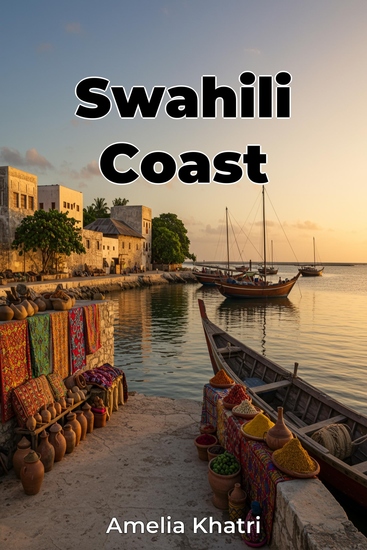
Swahili Coast
Amelia Khatri
Translator A AI
Publisher: Publifye
Summary
The Swahili Coast, a vibrant region of East Africa, played a pivotal role in shaping global history through maritime trade, the spread of Islam, and dynamic cultural exchange. More than just a geographical location, the Swahili Coast functioned as a crucial hub connecting Africa to the Indian Ocean world. "Swahili Coast" explores how pre-colonial Africa actively participated in globalization, challenging Eurocentric views that often overlook African contributions. The book argues that Swahili society was not merely a recipient of external influences but an active participant in shaping its own destiny.


The book examines the growth of trade networks and the impact of Islam on Swahili language, law, and architecture. Intriguingly, the Swahili language itself reflects a blend of African and Arabic influences, showcasing the synthesis of cultures. The book also investigates the reciprocal cultural exchanges between the Swahili people and diverse populations, including those from the Arabian Peninsula, Persia, India, and even China, highlighting the synthesis of ideas and practices that defined Swahili identity.


Beginning with the region's geographical and historical context, the book progresses through the growth of trade networks, the evolution of Islam, and the complex interplay of cultures. By drawing on archaeological findings, historical accounts, and linguistic analysis, "Swahili Coast" offers a nuanced perspective on the history of this influential region and its relevance to modern debates about cultural identity.
Available since: 03/19/2025.
Print length: 58 pages.