Join us on a literary world trip!
Add this book to bookshelf
Grey
Write a new comment Default profile 50px
Grey
Subscribe to read the full book or read the first pages for free!
All characters reduced
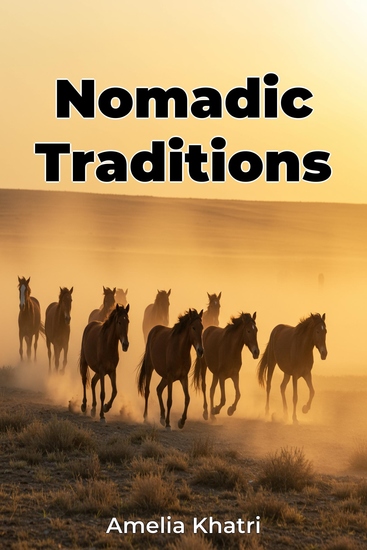
Nomadic Traditions - cover

Nomadic Traditions

Amelia Khatri

Translator A AI

Publisher: Publifye

  • 0
  • 0
  • 0

Summary

Nomadic Traditions offers a fresh perspective on world history by exploring the significant yet often overlooked role of nomadic societies. It challenges the traditional view of civilization by highlighting how these mobile empires, like the Mongols and Scythians, shaped cultural exchange, military strategies, and interregional networks. The book reveals how nomadic groups adapted to diverse environments and influenced settled societies, demonstrating their profound impact on global geopolitics.

 
This study delves into nomadic cultural adaptations, economic systems, and warfare tactics. Readers will discover how innovative military techniques, such as the use of cavalry and archery, allowed nomadic groups to project power across vast distances. Furthermore, the book examines how trade routes facilitated the exchange of goods and ideas, fostering both cooperation and conflict with settled civilizations.

 
The book progresses by first establishing the historical context of nomadic societies and then exploring their cultural practices, economic systems, and military innovations. Employing an interdisciplinary approach that integrates history, anthropology, and archaeology, Nomadic Traditions provides a nuanced understanding of these societies and their enduring relevance to contemporary issues.
Available since: 03/29/2025.
Print length: 55 pages.

Other books that might interest you

  • You Must Market Your Book - Increase Your Impact Sell More Books and Make More Money - cover

    You Must Market Your Book -...

    Honorée Corder

    • 0
    • 0
    • 0
    ONCE THE BOOK IS PUBLISHED . . . THE WORK BEGINSDo you know how to market your book? 
    Honorée has sold hundreds of thousands of books in ways most authors have never considered. She's coached authors to successful writing careers and has co-authored and managed many books (including The Miracle Morning series).Where to begin? 
    New and even experienced authors often feel overwhelmed by everything they're told they must do. It can be hard to know where one should be putting their energy. Honorée has a gift for teaching what's important in a way that's easy to understand and remember.You'll learn:How to think about book marketingHow to build your book marketing teamThe key tools for marketingWhy a long-term plan is importantThat your connections matter and how they can helpAbout the Book Marketing Action Plan you'll use as your roadmapAnd much more! 
    In this book, Honorée takes a complicated subject and makes it simple to put into practice. She will get you excited to start the journey from the first work to bestseller.Are You Ready to Find Readers? 
    You'll love this playbook for author marketing because the stories and examples will stick with you as you build your publishing brand. 
    Grab your copy today!
    Show book
  • Ghosts of Galveston - cover

    Ghosts of Galveston

    Kathleen Shanahan Maca

    • 0
    • 0
    • 0
    One of the oldest cities in Texas, Galveston has witnessed more than its share of tragedies. Devastating hurricanes, yellow fever epidemics, fires, a major Civil War battle, and more cast a dark shroud on the city's legacy. Ghostly tales creep throughout the history of famous tourist attractions and historical homes. The altruistic spirit of a schoolteacher who heroically pulled victims from the floodwaters during the great hurricane of 1900 roams the Strand. The ghosts of Civil War soldiers march up and down the stairs at night and pace in front of the antebellum Rogers Building. The spirit of an unlucky man decapitated by an oncoming train haunts the railroad museum, moving objects and crying in the night. Kathleen Shanahan Maca explores these and other haunted tales from the Oleander City.
    Show book
  • The Forbidden Daughter - The True Story of a Holocaust Survivor - cover

    The Forbidden Daughter - The...

    Zipora Klein Jakob

    • 0
    • 0
    • 0
    The unforgettable true story of a girl born in the Kovno Ghetto, and the dangerous risk her parents faced in defying the barbarous Nazi law prohibiting childbirth. 
    Elida Friedman was not supposed to have been born. In the Kovno Ghetto in Lithuania, Nazi law forbade Jewish women from giving birth. Yet despite the fear of death, Dr. Jonah Friedman and his wife Tzila, choose to bring a daughter into the world, a little girl they name Elida—meaning non-birth in Hebrew. 
    To increase their child’s chance of survival, the Friedmans smuggle the baby out of the ghetto and into the arms of a non-Jewish farm family when Elida is only three months old. It is the beginning of a life marked by constant upheaval. When the Nazis raze the entire Kovno Ghetto, Jonah and Tzila are among those killed. Their only child is left orphaned and alone, dependent on the kindness of strangers. 
    Despite her circumstances, Elida grows up, changing families, countries, continents, and even names, countless times. Surviving the war and the Holocaust that stole her parents, the young woman never gives up hope. In her lifelong pursuit to find love and belonging, she works to rebuild her identity and triumph over her terrible circumstances. 
    A moving, powerful chronicle of overcoming impossible odds, The Forbidden Daughter is the true story of one unforgettable woman and her will to survive. 
    Supplemental enhancement PDF accompanies the audiobook.
    Show book
  • The Middle Kingdom of Egypt - A Period of Restoration and Growth - cover

    The Middle Kingdom of Egypt - A...

    Omar Khalil

    • 0
    • 0
    • 0
    The Middle Kingdom of Egypt marked a transformative period following the turmoil of the First Intermediate Period. This era, spanning roughly from 2050 to 1710 BCE, saw the reunification of Egypt under the leadership of Mentuhotep II, the pharaoh who established stability after years of political fragmentation. As the nation emerged from chaos, the Middle Kingdom laid the foundations for a revitalized state, fostering political, cultural, and economic growth. 
    The collapse of the Old Kingdom had left Egypt divided, with rival factions vying for control. This power vacuum led to the rise of regional rulers known as nomarchs, whose increasing autonomy weakened central authority. The struggle for dominance between these local leaders marked the First Intermediate Period, characterized by instability and fragmented governance. However, the emergence of Mentuhotep II, a ruler from Thebes, marked a turning point. Determined to restore order, he led a series of military campaigns to reunite Upper and Lower Egypt. His victory over the Herakleopolitan kings signified the dawn of a new era. 
    Reunification under Mentuhotep II not only consolidated political power but also reestablished the role of the pharaoh as a central figure of authority. As the unifier of Egypt, Mentuhotep II portrayed himself as the restorer of ma'at—harmony and justice. His reign marked the beginning of the 11th Dynasty and set a precedent for strong, centralized rule. The restoration of internal stability allowed for significant cultural and artistic developments, reflecting a renewed sense of national identity.
    Show book
  • Thrive Women: Unleash Your Hidden Power - "Awaken your strengths with 'Thrive Women'—powerful audio lessons crafted to ignite your inner drive!"Solomon Wrecker - cover

    Thrive Women: Unleash Your...

    Solomon Wrecker

    • 0
    • 0
    • 0
    Thrive Women: Unleash Your Hidden Power  
    ⭐⭐ Simplified Guide & Explanations Included ⭐⭐  
    Are you striving to advance in your career and enhance your expertise to unlock your potential, achieve greatness, and inspire others?   
    In search of a thorough guide that encompasses everything you need to realize your aspirations?   
    Look no further!   
    This guide is your ultimate companion for deepening your insights, honing your skills, and engaging in practical activities. With this resource in hand, you're destined for success.   
    Updated to reflect the latest insights and strategies for personal growth.  
    Key features of this enriching guide:  
    - In-depth knowledge about unlocking your potential   
    - Comprehensive explanations of techniques for achieving greatness   
    - Effective strategies for preparation and execution   
    Our guide stands out through its extensive coverage, which is crucial for your path to success. Concepts are examined in detail rather than just superficially addressed.   
    Structured clearly and written in accessible language, our guide provides smooth transitions between topics. Bid farewell to complicated jargon and embrace clear, concise, and accurate content.   
    So, why wait? Click the BUY NOW button, secure your guide, and embark on your journey to achieve greatness today!   
    Thrive Women: Unleash Your Hidden Power awaits your exploration!
    Show book
  • Decoding Hindu Chronology - cover

    Decoding Hindu Chronology

    HENRY ROMANO

    • 0
    • 0
    • 0
    Since ancient times, the Hindus have had a lunisolar cycle based on the combination of solar and lunar years, determined by the course of the sun and the moon, but with the lunar year beginning near the solar year. Exactly how their earliest Calendar was arranged remains a mystery. Our focus is on the current form of their Calendar, developed around 400 under the influence of Greek astronomy and introduced into India at no long time. 
    There are two kinds of Hindu years, solar and lunar.  
    To understand the lunar Calendar, we will first explain the solar year, which governs the lunisolar system. Bengal, including Madras's Orissa, Tamil, and Malayalam districts, used solar years for civil purposes. General religious rites and festivals are regulated by the lunar year and the details of private and domestic life, such as choosing auspicious occasions for marriages and journeys, choosing lucky moments for shaving, etc. Almanacs that follow the lunar year contain details about the solar year, such as the sun's course through the zodiac signs. Despite following the solar year, almanacs include lunar year details.
    Show book