Join us on a literary world trip!
Add this book to bookshelf
Grey
Write a new comment Default profile 50px
Grey
Subscribe to read the full book or read the first pages for free!
All characters reduced
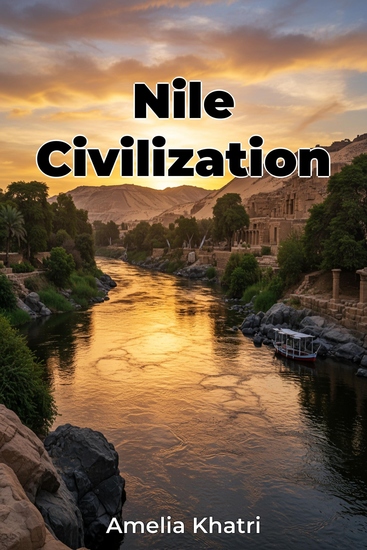
Nile Civilization - cover

Nile Civilization

Amelia Khatri

Translator A AI

Publisher: Publifye

  • 0
  • 0
  • 0

Summary

"Nile Civilization" explores the significant role the Nile River played in shaping ancient Egypt and Nubia. It examines how the river influenced crucial aspects of these societies, including agriculture and trade. The book highlights how predictable flooding enabled intensive agriculture, supporting dense populations, and how the Nile served as a vital trade route, connecting regions and fostering cultural exchange. Understanding the dynamics between the river and these civilizations offers insights into early state formation and the relationship between environment and human development.

 
The book delves into the construction of monumental architecture, like pyramids and temples, and the development of religious beliefs centered on the river. It uses archaeological evidence, such as ancient irrigation systems and artifacts, alongside textual sources like hieroglyphic inscriptions, to provide a comprehensive understanding.

 
The book progresses by first introducing the Nile's geography, then exploring agricultural techniques, trade networks, monumental construction, and religious evolution.
Available since: 03/19/2025.
Print length: 48 pages.


Other books that might interest you

  • Historic Triangle of Virginia The: The History of the Settlements and Battles at Jamestown Williamsburg and Yorktown - cover

    Historic Triangle of Virginia...

    Editors Charles River

    • 0
    • 0
    • 0
    Jamestown is fondly remembered today for being the first permanent English settlement in the colonies, but it was not fondly remembered by those who lived and died there. The English quickly learned it would be difficult to establish a permanent settlement because of the poor weather, the swampy terrain, the hostile natives living nearby, and the general inexperience and ineptitude of the English settlers. During their first winter, everyone nearly starved, and more than half of the settlers died. By the end of the winter of 1609-1610, known as the “starving time”, barely 10% of the settlers were still alive. Nevertheless, Jamestown is remembered today because the settlement did survive through the hardships and go on to serve as the capital of the English colony for much of the 17th century. At the same time, one of the biggest reasons for its survival and fame today can be attributed to the local Native Americans, particularly Pocahontas, who has added both a human and romanticized, mythological element to Jamestown.  
    	Along with Jamestown and Yorktown, Colonial Williamsburg is known today as part of the Historic Triangle of Virginia, but all three of these old Virginian sites are known for vastly different reasons. While Yorktown was the scene of the final climactic battle of the American Revolution and Jamestown is remembered for being the first English settlement to survive in Virginia, Colonial Williamsburg is now best known as a bridge to the past.  
     Williamsburg got its start as a fortified site, which was vitally necessary for English settlers to heavily outnumbered by nearby Native Americans, many of which were at times hostile. Known originally as Middle Plantation, the site served as the capital of the colony for much of the 18th century, and it bore witness to seminal events in the history of Revolutionary era America.
    Show book
  • Ludwig Wittgenstein - Language Logic and the Limits of Philosophy - cover

    Ludwig Wittgenstein - Language...

    Hector Davidson

    • 0
    • 0
    • 0
    Ludwig Wittgenstein, one of the most influential philosophers of the 20th century, profoundly shaped modern thought, particularly in the realms of language, logic, and the philosophy of mind. His philosophy spans two distinct periods, marked by an evolution in his views on the relationship between language, meaning, and reality. Wittgenstein’s work challenges the way we think about and use language, positing that philosophical problems often arise from misunderstandings of language and its limitations. 
    Wittgenstein’s early philosophy, as presented in his landmark work Tractatus Logico-Philosophicus, was grounded in the belief that language could mirror the structure of reality. According to his "picture theory of meaning," words and sentences are pictures that represent facts in the world. He argued that the limits of language are also the limits of the world, and anything that could not be meaningfully expressed through language was simply beyond the scope of philosophy. This view led him to conclude that many traditional philosophical problems were nonsensical, arising from a misuse of language. 
    However, Wittgenstein underwent a significant philosophical transformation after his work on the Tractatus, largely due to his dissatisfaction with the results of his early approach. By the time of his later work, particularly in Philosophical Investigations, Wittgenstein had rejected the picture theory of meaning and developed the concept of "language games." He argued that meaning is not inherent in words themselves but is derived from their use in various social contexts. Language, for Wittgenstein, is a tool embedded in human practices and activities. He claimed that understanding language requires understanding the ways it functions in specific contexts, challenging the idea of a fixed, underlying structure of meaning.
    Show book
  • Mrs Balfame - cover

    Mrs Balfame

    Gertrude Atherton

    • 0
    • 0
    • 0
    Enid Belfame: 42 years old, 22 of them as a married woman; eminently respectable; founder of The Friday Club; small town dignitary; a paragon of virtue. But does she have what it takes to commit murder? And will the young and handsome Dwight Rush benefit if she does?
    Show book
  • The Life & Words Of Bhaktisiddhanta Sarasvati Thakura - King Of Bhakti Yoga Lion Of Devotion - cover

    The Life & Words Of...

    Sripad Jaganantha Das

    • 0
    • 0
    • 0
    Bhaktisiddhanta Sarasvati, also known as Srila Prabhupāda, was a prominent spiritual leader and revivalist of the Gaudīya Vaisnava tradition in early 20th-century India. He was born Bimala Prasad Datt on 6 February 1874 in the town of Jagannath Puri, in the present-day state of Odisha, India. As a child, Bhaktisiddhanta Sarasvati showed great intellectual potential, and he received a thorough education in Sanskrit, philosophy, and theology from his father, a renowned scholar, and Vaishnava monk. After completing his studies, Bhaktisiddhanta Sarasvati became a professor of Sanskrit and philosophy at Calcutta University. 
     
    In 1918, Bhaktisiddhanta Sarasvati founded the Gaudiya Math, a religious institution aimed at reviving and promoting the teachings of the Gaudīya Vaisnava tradition. He also initiated a series of reforms within the tradition, emphasizing the importance of scriptural study, the necessity of devotional service to Krishna, and the rejection of sectarianism and caste-based discrimination. Bhaktisiddhanta Sarasvati was a prolific writer and scholar who authored numerous books and articles on Vaisnava philosophy and theology. He also trained many disciples, including A. C. Bhaktivedanta Swami Prabhupada, who later founded the International Society for Krishna Consciousness (ISKCON) and became a major figure in the spread of the Hare Krishna movement in the West. Sarasvati passed away on 1 January 1937, but his legacy continues to inspire and guide followers of the Gaudīya Vaisnava tradition. He is remembered for his tireless efforts to revive and promote the teachings of Chaitanya Mahaprabhu, the founder of the Gaudīya Vaisnava tradition, and for his commitment to spreading the message of devotional service and love of God.
    Show book
  • Colette - My Literary Mother - cover

    Colette - My Literary Mother

    Michele Roberts

    • 0
    • 0
    • 0
    The power of Colette's work comes from its modernist storytelling. 


    Colette was a pioneering, groundbreaking modernist writer, but has not always had her originality and worth recognized in Britain. Her work provocatively uses unstable narratives, gaps, silences, fairytale, mythical tropes, and sensual evocations of childhood, sex, and landscapes. 


    In this book, Michèle Roberts examines how Colette invents new forms to express her unsettling content on desire, perversion, aging, and different forms of love. Delving into four key texts, Roberts explores Colette's willingness to break open taboos about older woman and desire, as well as hidden and forbidden aspects of human longings and pleasures. 


    Through these re-readings, Roberts discovers that Colette's work is even more entrancing, more disturbing, and more original than she first thought.
    Show book
  • King's archtraitor roger casement - cover

    King's archtraitor roger casement

    William T McCartney

    • 0
    • 0
    • 0
    Roger Casement, the legendary leader of Irish Nationalism up to 1916, was also a formidable campaigner for humanitarian values. His investigations into human rights abuse lead directly to vast improvements in Congolese and Peruvian lives. He is the father of human rights protection. This is his story.
    Show book