Join us on a literary world trip!
Add this book to bookshelf
Grey
Write a new comment Default profile 50px
Grey
Subscribe to read the full book or read the first pages for free!
All characters reduced
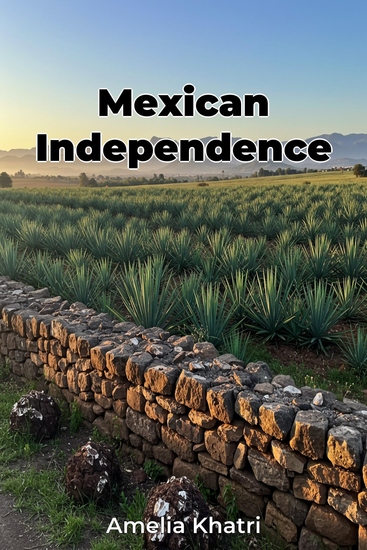
Mexican Independence - cover

Mexican Independence

Amelia Khatri

Translator A AI

Publisher: Publifye

  • 0
  • 0
  • 0

Summary

Mexican Independence explores the multifaceted struggle that led to Mexico's separation from Spain, moving beyond a simple recounting of events to examine the complex interplay of socio-political conditions, diverse ideologies, and key figures. The book highlights how the rigid social hierarchy of New Spain, particularly the discontent of the Criollo class excluded from high office, combined with Enlightenment ideals to fuel the independence movement. It delves into the roles of influential leaders like Miguel Hidalgo, José María Morelos, and Agustín de Iturbide, illustrating how their shifting alliances and ideological disagreements shaped the nascent nation. 

 
The book is structured to first explore New Spain's pre-1810 conditions, then analyze the independence movement's major battles and regional variations, and finally examine the turbulent aftermath, including the establishment of the First Mexican Empire. By drawing on primary sources and secondary scholarship, it provides a balanced treatment of the subject, revealing that Mexican nation-building was not a unified movement but a complex struggle with profound implications. Understanding Mexico's path to self-determination offers valuable insights into decolonization processes and the challenges faced by newly independent nations.
Available since: 03/19/2025.
Print length: 53 pages.

Other books that might interest you

  • Prelude to Philosophy - An Introduction for Christians - cover

    Prelude to Philosophy - An...

    Mark W. Foreman, J. P. Moreland

    • 0
    • 0
    • 0
    "The unexamined life is not worth living," according to Socrates, but pursuing the examined life strikes many as daunting, unappealing and even unnecessary. Is philosophy important? Why do I need philosophy if I have the Bible? Aren't philosophers simply engaged in meaningless disputes that are irrelevant to everyday life? 


    Mark Foreman addresses these and other questions in this "prelude" to the subject. Unlike a full introduction to philosophy, this book is a preliminary discussion that dispels misunderstandings and explains the rationale for engaging in philosophical reasoning. 


    In the first half of the book, Foreman defines the task of philosophy, compares it to other disciplines and demonstrates its practical value to Christians interested in developing a more thoughtful faith. The second half introduces the listener to logic and argumentation, the essential tools of a philosopher. Concise and straightforward, Prelude to Philosophy is a guide for those looking to embark on the "examined life."
    Show book
  • Democracy Unmoored - Populism and the Corruption of Popular Sovereignty - cover

    Democracy Unmoored - Populism...

    Samuel Issacharoff

    • 0
    • 0
    • 0
    The 2016 election of Donald Trump focused people's minds on populism, and most of the attention paid to the subject since has been on the threat it poses to wealthy democracies. In Democracy Unmoored, Samuel Issacharoff takes a far wider-angle view of the phenomenon, covering countries from across the globe: Brazil, Poland, Argentina, Turkey, India, Hungary, Venezuela, and more. Just as importantly, he focuses on populism's attack on the institutions of governance. Democracy requires two critical features: first, a commitment to repeat play such that political actors understand that what goes around comes around; and, second, institutional constraints so that the majority can prevail, albeit not by too much. Democracies must avoid the doomsday scenario in which the contending parties see the next election as the final choice between salvation and perdition. Issacharoff shows how populist governance undermines each of these two critical underpinnings of stable democracy, first by compressing the time horizon to the immediate, and second by eroding institutional constraints on strongman rule. At the same time, Issacharoff highlights the fact that ascendent populists were pushing in an open door as they found democracies in states of disrepair in the post-2008 world.
    Show book
  • Aunty Mae’s Punishment Book - cover

    Aunty Mae’s Punishment Book

    Paul Amann

    • 0
    • 0
    • 0
    Step back in time to 1960, when the quiet town of Upper Middleton was forever changed by the unyielding hand of Aunty Mae. Widowed and grieving, Aunty Mae stumbled upon a young thief in her garden – Emma Dixon. What began as a spontaneous act of discipline blossomed into a peculiar arrangement: Emma, at the tender age of 19, willingly toiled in Aunty Mae's garden, subject to regular bare-bottomed spankings.Aunty Mae  
    The twist in this tale unravels when Aunty Mae and a group of young women unearth an old punishment book in the dusty recesses of the community school. As fate would have it, the book becomes a token of a secret pact, binding these six 19-year-olds to Aunty Mae's disciplinary world. The echoes of their spankings lingered through the years, some returning willingly, others at the insistence of their husbands. 
    Aunty Mae's penchant for punishment took an unexpected turn in 1962 when she found herself offering advice as an agony aunt for the local church paper. Her columns, laden with the wisdom of a disciplinarian, skyrocketed in popularity. Aunty Mae's notoriety spread beyond Upper Middleton, as she fearlessly recommended spankings for the undisciplined, both young and old. 
    Enter the captivating world of "Aunty Mae's Punishment Book" by Paula Mann, where discipline meets nostalgia, secrets are exposed, and Aunty Mae's unorthodox methods leave an indelible mark on the quaint town of Upper Middleton. Spanning decades, this tale is a unique blend of history, humour, and a touch of spice, promising a journey through time that you won't soon forget.
    Show book
  • Craving Spring - A mother's quest a daughter's depression and the Greek myth that brought them together - cover

    Craving Spring - A mother's...

    Ann Batchelder

    • 0
    • 0
    • 0
    ANN IS CONVINCED SHE IS A GOOD MOTHER until her teenage daughter admits to suicidal thoughts. In a desperate attempt to rescue her child, she gathers wisdom from therapy, the 12 Steps, and Buddhist teachings, yet she finds her greatest solace from an unlikely source: the Greek myth of Demeter and Persephone. 
    Connecting this ancient story to her experience as a traumatized mother, Ann is vindicated in her desire to save her child but also learns the secret to returning to herself. A memoir about honesty, compassion, and trust, Craving Spring explores the pain and beauty of mother-daughter bonds and celebrates the universal desire for renewal. 
    “A masterful storyteller, Ann Batchelder takes us deep into the heart of a mother’s love while demonstrating the power of myth to illuminate a path toward healing. Craving Spring is a gift to anyone trying to navigate the complexities of the mother-daughter relationship.” —ANITA JOHNSTON, Ph.D., psychologist and author of Eating in the Light of the Moon 
    "...circles around the question of what it is to be a parent... Incredibly moving." --NICK FLYNN, award-winning author of Another Bullshit Night in Suck City 
    "Rich, layered, and insightful. An impressive work both of writing and spiritual reflection." --KEVIN GRIFFIN, author of One Breath at a Time: Buddhism and the Twelve Steps  
    "Batchelder's compelling story is an irresistible page-turner. This is memoir writing at its best." --LAURA CATHCART ROBBINS, podcast host and author of Stash  
    "...extraordinary with relevance and profound teachings. Craving Spring is a story of triumph. I highly recommend it.”--TOMMY ROSEN, founder of Recovery 2.0 
    "Exquisitely written...I will be suggesting Craving Spring for many years to come." --HANNAH SWARD, author of Strip: A Memoir
    Show book
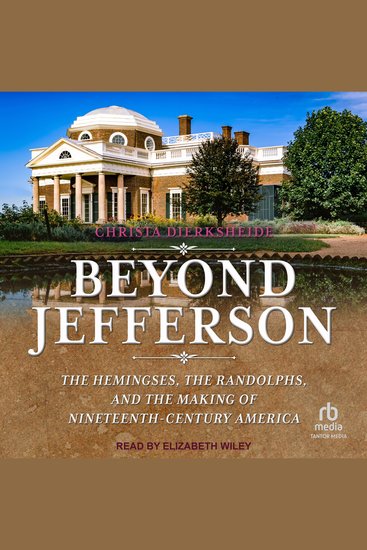
  • Beyond Jefferson - The Hemingses the Randolphs and the Making of Nineteenth-Century America - cover

    Beyond Jefferson - The Hemingses...

    Christa Dierksheide

    • 0
    • 0
    • 0
    A global history of how Thomas Jefferson's descendants navigated the legacy of the Declaration of Independence on both sides of the color line 


    The Declaration of Independence identified two core principles—independence and equality—that defined the American Revolution and the nation forged in 1776. Jefferson believed that each new generation of Americans would have to look to the "experience of the present" rather than the "wisdom" of the past to interpret and apply these principles in new and progressive ways. 


    Historian Christa Dierksheide examines the lives and experiences of a rising generation of Jefferson's descendants, Black and white, illuminating how they redefined equality and independence in a world that was half a century removed from the American Revolution. The Hemingses and Randolphs moved beyond Jefferson and his eighteenth-century world, leveraging their own ideas and experiences in nineteenth-century Britain, China, Cuba, Mexico, and the American West to claim independence and equal rights in an imperial and slaveholding republic.
    Show book
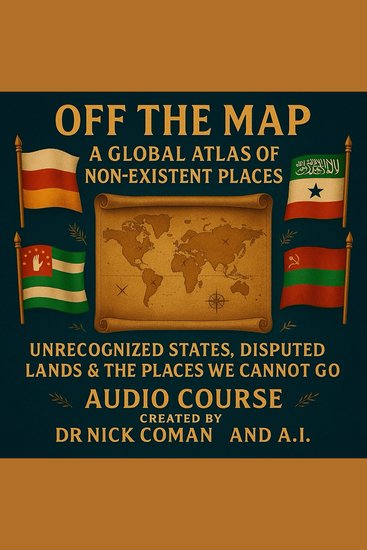
  • Off The Map: A Global Atlas of Non-Existent Places - Unrecognized States Disputed Lands & The Places We Cannot Go - cover

    Off The Map: A Global Atlas of...

    Dr. Nick Coman, I. A.I.

    • 0
    • 0
    • 0
    A 24‑lecture audio expedition into the world’s cartographic glitches—unrecognized states, disputed borders, legal voids, and places you can’t enter. We move from café‑tile sovereignty in Baarle, where a front door decides your country, to the 2015 India–Bangladesh enclave exchange, and the 2022 line cut across Hans Island’s ravine; from Ceuta and Melilla’s fences and tax codes to the Danube where hydrology argues with history; from the Bir Tawil/Hala’ib paradox to the Chernobyl Exclusion Zone and America’s twin sacrifice zones, Picher and Centralia.         
    We make the atlas legible: thalweg versus cadastre, uti possidetis and boundary commissions, counter‑enclaves and neutral roads, patrol lines, CBMs, and maritime geodesy. Trace Fergana’s water politics from Golovnoi gates to the Andijan/Kempir‑Abad bargain; India’s Himalayan hinge from Siachen and Galwan to Sugauli; the pastoral circuits and patrol lines that keep the Ilemi Triangle ambiguous; and the nested Nahwa‑in‑Madha‑in‑UAE trick.     
    Markets and politics are treated as geography constraints. Learn to read sovereignty by ferries, fuel receipts, and power bills; to separate romantic claims from operational control; to test what‑ifs—who could claim Bir Tawil, what shifts if Sir Creek moves—and to map chokepoints beyond lines: customs regimes, water releases, patrol logistics, recognition cycles. Then follow the consequences—duty‑free ledgers and bunkering margins, quotas and visas, surveillance and tragedy on the fence. Rigorous, narrative‑driven, and built for the intellectually ambitious, this course is an operator’s guide to the law, logistics, and lived frictions of a planet whose map won’t sit still.  
    Show book