Join us on a literary world trip!
Add this book to bookshelf
Grey
Write a new comment Default profile 50px
Grey
Subscribe to read the full book or read the first pages for free!
All characters reduced
Ice Storage - cover

Ice Storage

Amelia Khatri

Translator A AI

Publisher: Publifye

  • 0
  • 0
  • 0

Summary

Ice Storage explores the fascinating history of how humans harvested, stored, and utilized ice before the advent of modern refrigeration. Delving into a time when preserving food was a challenge, the book uncovers the ingenuity employed in creating ice houses and developing ice harvesting techniques. Intriguingly, the natural ice trade wasn't just about food; ice also played a vital role in medicine, brewing, and even early air conditioning. The book meticulously details the evolution of ice harvesting, from ancient methods to large-scale commercial operations, and investigates diverse ice storage techniques. It examines the architectural and scientific principles behind effective ice house design. Progressing chronologically, Ice Storage highlights the environmental and economic impacts of the natural ice trade. It also traces the transition to manufactured ice, offering a unique perspective by combining historical analysis with scientific explanations and showing how pre-refrigeration innovations laid the groundwork for modern cooling technology.
Available since: 02/12/2025.
Print length: 59 pages.

Other books that might interest you

  • Goodbye Globalization - The Return of a Divided World - cover

    Goodbye Globalization - The...

    Elisabeth Braw

    • 0
    • 0
    • 0
    A bold new account of the state of globalization today—and what its collapse might mean for the world economy 


    After the Cold War, globalization accelerated at breakneck speed. Manufacturing, transport, and consumption defied national borders, companies made more money, and consumers had access to an ever-increasing range of goods. But in recent years, a profound shift has begun to take place. 


    Business executives and politicians alike are realizing that globalization is no longer working. Supply chains are imperiled, Russia has been expelled from the global economy after its invasion of Ukraine, and China is using these fissures to leverage a strategic advantage. Given these pressures, what will the future of our world economy look like? 


    In this groundbreaking account, Elisabeth Braw explores the collapse of globalization and the profound challenges it will bring to the West. Drawing on interviews with prominent executives and policymakers from around the world, Braw poses the difficult questions all businesses and economies will face—and traces the intricate story of globalization from the exuberant 90s to the embattled present.
    Show book
  • Rise of Durham’s Black Wall Street The: The History of the South’s Most Prosperous African American Business District during Jim Crow - cover

    Rise of Durham’s Black Wall...

    Charles River Editors

    • 0
    • 0
    • 0
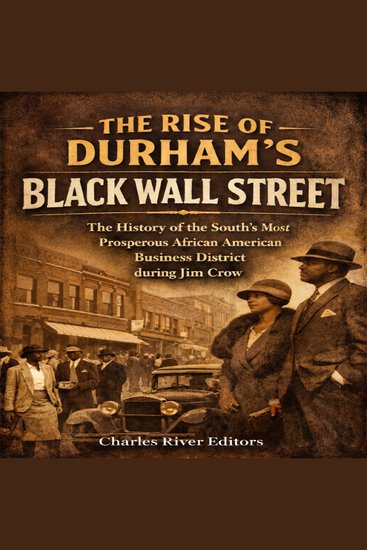
    In the wake of the Civil War, African Americans attained freedom from chattel slavery, but continued to suffer discrimination both legal in the form of Jim Crow laws and de facto in the continued perception among the vast majority of white Americans that African Americans were at the very least inferior and at the most a constant dangerous presence in their communities who must be carefully controlled.  
    Durham, North Carolina’s "Black Wall Street" exemplifies the flourishing of Black enterprise under the constraints of Jim Crow segregation. Parrish Street became a central hub for African American businesses and financial institutions in the early 20th century. The district achieved national recognition from leaders such as Booker T. Washington and W.E.B. Du Bois, who regarded it as a model of Black achievement. Washington noted Durham’s relatively progressive racial climate, while Du Bois emphasized the city’s organized Black community and the extensive network of Black-owned businesses that enabled residents to fulfil nearly all their needs within their own community.  
    The origins of Black Wall Street can be traced to Durham’s transformation into an industrial center after the Civil War. Once a modest railroad stop, Durham rapidly became known as the tobacco capital of the world, primarily due to the Duke family’s business activities. The growth of the tobacco and textile industries attracted both Black and white workers, coinciding with a period of significant racial and economic challenges for African Americans. Despite segregation and disenfranchisement, Durham’s expanding economy created rare opportunities for Black entrepreneurship and enabled a degree of coexistence between influential white industrialists and an emerging Black middle class.
    Show book
  • The Weight Of The Room - What Teachers Carry—and How to Keep Showing Up - cover

    The Weight Of The Room - What...

    James M Johnson

    • 0
    • 0
    • 0
    The Weight of the Room is a reflective and practical audiobook for teachers who care deeply, give constantly, and sometimes wonder how much more they can carry. 
     
    Drawing from more than three decades in the classroom, veteran music educator James M. Johnson speaks honestly about the emotional weight teachers absorb every day: student needs, classroom energy, difficult years, pressure from every direction, and the quiet exhaustion that can follow dedicated educators home. This is not a book about pretending everything is fine. It is about staying grounded, protecting your peace, and continuing to show up with purpose. 
     
    With a calm, human voice and hard-earned perspective, Johnson explores teacher resilience, emotional endurance, mindset, reflection, boundaries, and the importance of remembering that teachers are still people. The Weight of the Room offers encouragement without toxic positivity and practical perspective without blame. 
     
    For educators, music teachers, mentors, and anyone who has ever carried the invisible weight of a room, this audiobook is a reminder: you do not have to be perfect to make a difference. You only have to keep showing up with awareness, care, and enough strength to protect the part of you that still believes in the work.
    Show book
  • “Whatever It Is I’m Against It” - Resistance to Change in Higher Education - cover

    “Whatever It Is I’m Against It”...

    Brian Rosenberg

    • 0
    • 0
    • 0
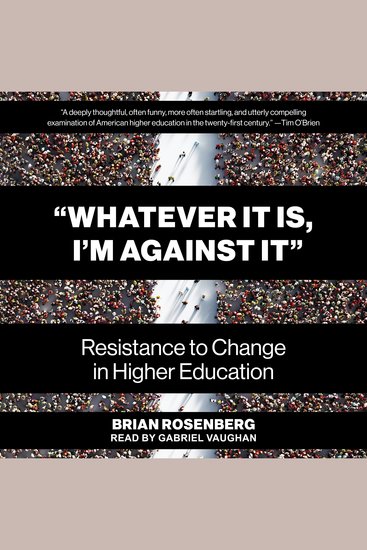
    In "Whatever It Is, I'm Against It," president emeritus of Macalester College Brian Rosenberg draws on decades of higher education experience to expose the entrenched structures, practices, and cultures that inhibit meaningful postsecondary reform, even as institutions face serious challenges to their financial and educational models. The book pinpoints factors that hinder the ability of United States colleges and universities to be creative and entrepreneurial amid calls to improve affordability, access, and equity for students. 


    Rosenberg illustrates internal and external dynamics that impede institutional evolution. Pressures such as declining enrollment, escalating costs, and an oversupply of PhDs in academia have long signaled a grave need for reform within a profession that lacks organizational flexibility, depends greatly on reputation and ranking, and retains traditions, from the academic calendar to grading systems, that have remained essentially the same for decades. 


    Rosenberg looks outside the United States system to find possible antidotes in innovative higher education models such as student-centered and experiential learning approaches. This thought-provoking work offers ample evidence for presidents, chancellors, deans, provosts, and faculty to consider as they plan to achieve institutional transformation.
    Show book
  • The Frontier Below - cover

    The Frontier Below

    Jeff Maynard

    • 0
    • 0
    • 0
    Triumphs and disasters in the deep sea 
    This is a journey through time and water, to the bottom of the ocean and the future of our planet. 
    We do not see the ocean when we look at the water that blankets more than two thirds of our planet. We only see the entrance to it. Beyond that entrance is a world hostile to humans, yet critical to our survival. The first divers to enter that world held their breath and splashed beneath the surface, often clutching rocks to pull them down. Over centuries, they invented wooden diving bells, clumsy diving suits, and unwieldy contraptions in attempts to go deeper and stay longer. But each advance was fraught with danger, as the intruders had to survive the crushing weight of water, or the deadly physiological effects of breathing compressed air. The vertical odyssey continued when explorers squeezed into heavy steel balls dangling on cables, or slung beneath floats filled with flammable gasoline. Plunging into the narrow trenches between the tectonic plates of the Earth’s crust, they eventually reached the bottom of the ocean in the same decade that men first walked on the moon. 
    Today, as nations scramble to exploit the resources of the ocean floor, The Frontier Below recalls a story of human endeavour that took 2,000 years to travel seven miles, then investigates how we will explore the ocean in the future. 
    Meticulously researched and drawing extensively on unpublished sources and personal interviews, The Frontier Below is the untold story of the pioneers who had the right stuff, but were forgotten because they went in the wrong direction. 
    The Frontier Below by Jeff Maynard is a captivating journey through the history of maritime expeditions, the science of physiology, and the economics of resource extraction. It is a testament to human endeavour and the indomitable spirit of exploration, offering a glimpse into the future of our oceans. 
    For fans of Buddy Levy (Realm of Ice and Sky), Julian Sancton (Madhouse at the End of the Earth), Rachel Lance (In the Waves), James Bradley (Ghost Species), and Helen Czerski (Blue Machine). 
    HarperCollins 2023
    Show book
  • Alcibiades I - A Young Politician’s Search for Self-Knowledge – Plato’s Dialogue on Ambition and the Soul - cover

    Alcibiades I - A Young...

    Plato, Tim Zengerink

    • 0
    • 0
    • 0
    What if true leadership begins with the courage to look inward? 
    In Alcibiades I, Plato stages a riveting dialogue between Socrates and the young, glory-seeking Alcibiades. As the young man prepares to enter politics and shape the fate of Athens, Socrates urges him to reflect on a deeper question: How can you lead others if you have not come to know yourself? 
    This modernized audiobook version brings clarity and intensity to one of Plato’s most inspiring philosophical encounters—where ambition meets wisdom and the path to greatness is revealed to lie within. 
    What you’ll discover inside: 
    •	A powerful dialogue on self-awareness as the foundation of leadership and justice 
    •	Alcibiades’ internal struggle between ego and ethics, fame and virtue 
    •	Socratic reasoning at its sharpest, uncovering truth through self-examination 
    •	A clear, accessible translation ideal for personal development and political thought 
    Whether you’re on a journey of growth or exploring the foundations of wise rule, Alcibiades I offers timeless insight for mastering the self before mastering the world.
    Show book