Join us on a literary world trip!
Add this book to bookshelf
Grey
Write a new comment Default profile 50px
Grey
Subscribe to read the full book or read the first pages for free!
All characters reduced
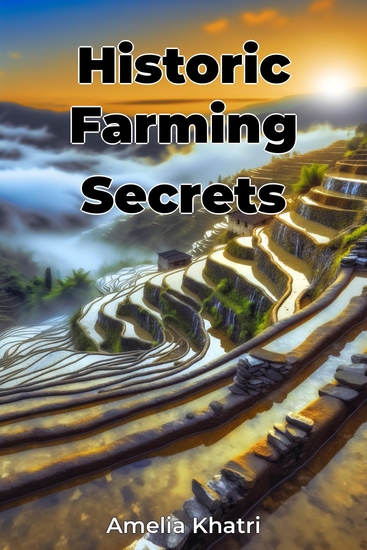
Historic Farming Secrets - cover

Historic Farming Secrets

Amelia Khatri

Translator A AI

Publisher: Publifye

  • 0
  • 0
  • 0

Summary

"Historic Farming Secrets" offers a fascinating exploration of ancient agricultural wisdom and its remarkable relevance to modern sustainable farming practices. Through meticulous research of archaeological evidence and historical documents, the book reveals how three major civilizations - Roman, Egyptian, and Mayan - developed sophisticated farming techniques that could help address today's agricultural challenges.

 
The work particularly emphasizes innovative water management systems, crop rotation methods, and resource-efficient planting techniques that have stood the test of time. The book progresses systematically through each civilization's unique contributions, from the Romans' advanced aqueduct and terrace farming systems to the Egyptians' masterful Nile flood management techniques, and the Mayans' ingenious forest garden systems.

 
What makes this work particularly valuable is its practical approach to bridging ancient wisdom with modern application, supported by contemporary case studies and scientific analysis of archaeological findings. Readers discover how these time-tested methods can be adapted using current technology while reducing environmental impact and resource consumption. The content moves seamlessly from historical context to technical analysis, concluding with actionable frameworks for implementation.

 
By establishing clear connections between historical practices and modern disciplines like hydraulic engineering and soil science, the book demonstrates how ancient solutions can be scaled and adapted for both small-scale organic farming and larger agricultural operations. This unique blend of historical insight and practical application makes it an invaluable resource for agricultural professionals, sustainable farming advocates, and scholars interested in historical technology.
Available since: 01/18/2025.
Print length: 115 pages.


Other books that might interest you

  • Beyond States - Powers Peoples and Global Order - cover

    Beyond States - Powers Peoples...

    Anthony Pagden

    • 0
    • 0
    • 0
    Today, the majority of the peoples of the planet live in nation-states, based upon the idea, if never the reality, of a single people, a single culture, a single rule of law, and a single source of sovereign authority. But will they continue to do so in the future? 


    None of the major challenges that confront humanity today—from climate change to disease, from terrorism to mass migration—can be handled effectively by single nation-states, no matter how powerful. The world is no longer made up only of states but also of an ever-increasing multitude of interstate networks and organizations which recognize no borders. We are beginning to be able to imagine the very real possibility of a new global civil society. But what political form should this take? 


    By examining the history of the evolution of human society from the world's first empires to today's world of interstate networks, this book argues that there now exists the possibility of the emergence of a new political form, a global 'federation of federations', that will bring the species closer to the possibility of a more harmonious, equitable, and secure future.
    Show book
  • You Are Gods - On Nature and Supernature - cover

    You Are Gods - On Nature and...

    David Bentley Hart

    • 0
    • 0
    • 0
    In recent years, the theological—and, more specifically, Roman Catholic—question of the supernatural has made an astonishing return from seeming oblivion. David Bentley Hart's You Are Gods presents a series of meditations on the vexed theological question of the relation of nature and supernature. In its merely controversial aspect, the book is intended most directly as a rejection of a certain Thomistic construal of that relation, as well as an argument in favor of a model of nature and supernature at once more Eastern and patristic, and also more in keeping with the healthier currents of mediaeval and modern Catholic thought. In its more constructive and confessedly radical aspects, the book makes a vigorous case for the all-but-complete eradication of every qualitative, ontological, or logical distinction between the natural and the supernatural in the life of spiritual creatures. 


    Hart, one of the most widely read theologians in America today, presents a bold gesture of resistance to the recent revival of what used to be called "two-tier Thomism," especially in the Anglophone theological world. In this astute exercise in classical Christian orthodoxy, Hart takes the metaphysics of participation, high Trinitarianism, Christology, and the soteriological language of theosis to their inevitable logical conclusions.
    Show book
  • Imperial Germany’s Invasions of France: The History of the German Invasions in the Franco-Prussian War and World War I - cover

    Imperial Germany’s Invasions of...

    Editors Charles River

    • 0
    • 0
    • 0
    Prussian leaders, especially Otto von Bismarck, the chancellor and advisor to Prussia’s king, believed Prussia could be a united and respected power, but only without the traditional Austrian dominance. At the time, the Austrian empire was a collection of ethnically diverse peoples and had been dominated by a socio-political conservatism that sought to keep the empire ruled in Hapsburg tradition.  
    After Prussia was victorious in the Austro-Prussian War, Bismarck played a waiting game where the unification of Germany was concerned, as the joining of the southern states - initially resistant to Prussian rule, friendly with Austria, and bent on independence - would have to be overcome. What was needed was “a clear case of French aggression” toward either Prussia or the southern states. Not only would such a move by Emperor Napoleon III trigger the terms of the treaty between the German states, but it would keep the remaining world powers out of the conflict. It would be a dispute over the throne of Spain that would cause Napoleon III to act. 
    	If trench warfare was an inevitability during the war, it is only because the events leading up to the First Battle of the Marne were quite different. The armies at the beginning of the war moved quickly through the land, but the First Battle of the Marne devolved into a bloody pitched battle that led to the construction of trenches after the Germans retreated, blocked in their pursuit of Paris. When the aftermath disintegrated into a war between trenches, some Germans thought they had the upper hand since they were occupying French territory, but with fewer soldiers than the combined Allied nations and fewer resources and supplies, it was possibly only a matter of time before they were ultimately defeated. The commander of the German armies, General Helmuth von Moltke, allegedly said to Kaiser Wilhelm II immediately after the First Battle of the Marne, "Your Majesty, we have lost the war."
    Show book
  • The Voyages of Captain Cook Around the World (All 7 Volumes) - cover

    The Voyages of Captain Cook...

    James Cook, Georg Forster, James...

    • 0
    • 0
    • 0
    This edition contains the descriptions of the three voyages of Captain Cook, which resulted in the complete round-the-world expedition. Captain and his team were the first Europeans to meet the indigenous people of Australia and Oceania. Captain Cook took a great interest in the locals' style of life and customs. Thus, the book doesn't just present an account of one of the most daring sea expeditions in history but also impressions of the first encounter of seamen with the people of unknown worlds and places.
    Show book
  • Summary of Daniel Spade's How To Analyze People - cover

    Summary of Daniel Spade's How To...

    Falcon Press

    • 0
    • 0
    • 0
    Buy now to get the main key ideas from Daniel Spade's How To Analyze People 
      
    Daniel Spade’s How to Analyze People (2019) showcases the 13 laws of manipulation, and offers 7 strategies that teach how to read body language and deal with a manipulator. Learn how to spot the manipulators in your life—or whether you've been guilty of using these methods yourself—by examining and analyzing the communication clues in your interactions. Once you see the signs of manipulation, you can examine the relationships in your life and make educated decisions about them. You’ll be able to exercise your right to be treated with respect, and reclaim an equal footing with your spouse. You can avoid being extorted or inadvertently manipulated if you can read people's body language and see through manipulative remarks. You will be less prone to be affected and motivated by the intentions of others, and more receptive to opportunities around you. 
     
    Show book
  • GIftedness: Tips and Tricks to Help Your Genius Child Stay Calm and Motivated (2 in 1 Combo) - cover

    GIftedness: Tips and Tricks to...

    Angela Wayning

    • 0
    • 0
    • 0
    This book consists of 2 titles, which are the following:Title 1: Is your child gifted? And how do you know that?In this comprehensive guide, you will learn more about common qualities of gifted children, and more specifically, the symptoms of such a distinct brain. Through the tips you will be given, you will be able to detect those attributes even in the earlier years, so that you can be prepared for the future. People have been using the term “gifted” in different ways, and it’s important to know what the differences are of those terms. You will learn more about those terms and their meanings.Additionally, this guide covers topics that relate to considering tests for giftedness, the advantages of specific classes in schools and gifted programs, and general tips for higher academic achievements. In short, this is a guide that can really help you along the path of discovery. Your child’s talents and skills can become a greater opportunity by detecting them and adjusting your educational choices according to them.Title 2: Giftedness can be a blessing or a struggle. The stimulation of the senses is different in a gifted child. They experience life, impulses and emotions differently. But there are ways to play into those talents and provoke curiosity and fascination in preschoolers and older children. This book covers some of those suggestions.Sometimes, parents think high grades is a good thing, and it can be. But did you know that this is not always the case? Did you know that some gifted children actually underachieve for various reasons? And then comes the big question: Should you tell a child that he or she is gifted? What are the pros and cons of doing so? Don’t remain in the dark. The achievements of gifted students are the consequences of their psyche, but it’s a vulnerable process to stimulate that intelligence in the right way. To do so, this book can help you along the way.
    Show book