Join us on a literary world trip!
Add this book to bookshelf
Grey
Write a new comment Default profile 50px
Grey
Subscribe to read the full book or read the first pages for free!
All characters reduced
Empire Collapses - cover

Empire Collapses

Amelia Khatri

Translator A AI

Publisher: Publifye

  • 0
  • 0
  • 0

Summary

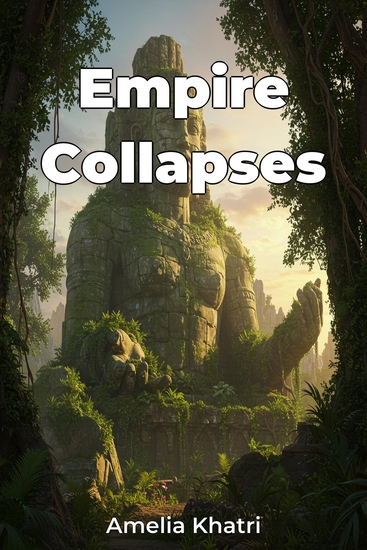
Empire Collapses explores why even the mightiest empires eventually fall, examining the intertwined internal and external factors that lead to their decline. It argues that imperial collapse isn't due to a single cause, but a convergence of vulnerabilities like economic instability, political corruption, and military overreach, combined with external pressures.

 
The book highlights intriguing facts, such as how social fragmentation within an empire can be just as destructive as external invasions, and how environmental pressures can exacerbate existing tensions, contributing to the ultimate downfall.

 
The book progresses systematically, first establishing a framework for analyzing empires before diving into detailed case studies, including the Roman Empire, the Mongol Empire, the Ottoman Empire, and the Soviet Union. By comparing these historical collapses, the author identifies recurring patterns and develops a model for understanding imperial dynamics.

 
The analysis draws from diverse historical sources and incorporates interdisciplinary perspectives, offering a unique and interconnected view of the rise and fall of empires, useful for understanding world history and our modern world.
Available since: 03/21/2025.
Print length: 63 pages.
Other books that might interest you

  • Culprit Fay and Other Poems - cover

    Culprit Fay and Other Poems

    Joseph Rodman Drake

    • 0
    • 0
    • 0
    A collection, The Culprit Fay and Other Poems, was published posthumously by his daughter in 1835. His best-known poems are the long title-poem of that collection and the patriotic "The American Flag" which was set as a cantata for two soloists, choir and orchestra by the Czech composer Antonin Dvorák in 1892-93, as his Op. 102. In the early part of the 19th Century both Drake and his friend Halleck were widely hailed by Americans as among the leading literary personalities and talents produced by this country. That they had been leading lights in the New York area was true, but the glimmer for both could not really hold. It was finally diminished by Edgar Allan Poe when he wrote a serious study of the two poets called The Halleck - Rodman Review. Looking at The Culprit Fay by Drake, Poe showed that the imagery many marveled at was quite second-rate and ordinary. In fact, he briefly invented new lines to show how easily it could be done. The reputations of both Drake and Halleck never recovered. (Summary excerpted from Wikipedia)
    Show book
  • Agreeing to Disagree - How the Establishment Clause Protects Religious Diversity and Freedom of Conscience - cover

    Agreeing to Disagree - How the...

    Nathan S. Chapman, Michael W....

    • 0
    • 0
    • 0
    The Establishment Clause of the First Amendment, "Congress shall make no law respecting an establishment of religion", may be the most contentious and misunderstood provision of the entire United States Constitution. What exactly is an "establishment of religion"? And what is a law "respecting" it? 


    Many commentators reduce the clause to "the separation of church and state." This implies that church and state are at odds, that the public sphere must be secular, and that the Establishment Clause is in tension with the Free Exercise of Religion Clause. All of these implications misconstrue the Establishment Clause's original purpose. The clause facilitates religious diversity and guarantees equality of religious freedom by prohibiting the government from coercing or inducing citizens to change their religious beliefs and practices. 


    In Agreeing to Disagree, Nathan S. Chapman and Michael W. McConnell detail the theological, political, and philosophical underpinnings of the Establishment Clause, state disestablishment, and the disestablishment norms applied to the states by the Fourteenth Amendment. In one of the most thorough accounts of the Establishment Clause, Chapman and McConnell argue that the clause is best understood as a constitutional commitment for Americans to agree to disagree about matters of faith.
    Show book
  • Mediums Psychics and Channelers Vol 2 - cover

    Mediums Psychics and Channelers...

    Jenniffer Weigel

    • 0
    • 0
    • 0
    Jenniffer interviews well-known healers, mediums, and psychics. Rebecca RosenCharlie GoldsmithMavis PatillaConcetta BertoldiPaul SeligPat LongoMarrice CoversonSuzanne GiesmannSusan RowlenMarla FreesAndrew AndersonSheri JewelMollie Morningstar
    Show book
  • The Buddhist Catechism - cover

    The Buddhist Catechism

    Henry S. Olcott

    • 0
    • 0
    • 0
    Brought to you by Altrusian Grace Media and human-narrated by Matthew Schmitz
     
    The Buddhist Catechism by Henry S. Olcott is a concise instructional guide to the core teachings of Buddhism, presented in a question-and-answer format meant to clarify the religion for both beginners and students. First published in the late 19th century, it outlines fundamental Buddhist ideas such as the life and example of the Buddha, the Four Noble Truths, karma, rebirth, ethical conduct, meditation, and the goal of nirvana, while emphasizing reason, self-discipline, compassion, and the non-theistic nature of Buddhist thought. Olcott’s work was especially influential in modern Buddhist revival movements, as it sought to organize Buddhist doctrine in a clear, accessible, and systematic way for a broad audience.
    Show book
  • Their First Vibrator Sex - Lesbian 1st Time Sex - cover

    Their First Vibrator Sex -...

    Conner Hayden

    • 0
    • 0
    • 0
    A girl finds her mother’s sex toys and shows her best friend. They decide to try one of the big vibrators, using the sex toy to f--k each other and make themselves orgasm. 
    Warning: This is an erotic short story for adults only! All characters are fictional and are over the age of 18, and the story contains sex scenes.
    Show book
  • The Sacred Pipe - Black Elk’s Account of the Seven Rites of the Oglala Sioux - cover

    The Sacred Pipe - Black Elk’s...

    Joseph Epes Brown

    • 0
    • 0
    • 0
    Black Elk of the Sioux has been recognized as one of the truly remarkable men of his time in the matter of religious belief and practice. 


    Black Elk was the only qualified priest of the older Oglala Sioux still living when The Sacred Pipe was written. This is his book: he gave it orally to Joseph Epes Brown during the latter's eight month's residence on the Pine Ridge Reservation in South Dakota, where Black Elk lived. Beginning with the story of White Buffalo Cow Woman's first visit to the Sioux to give them the sacred pip, Black Elk describes and discusses the details and meanings of the seven rites, which were disclosed, one by one, to the Sioux through visions. He takes the listener through the sun dance, the purification rite, the "keeping of the soul," and other rites 


    The wakan Mysteries of the Siouan peoples have been a subject of interest and study by explorers and scholars from the period of earliest contact between whites and Indians in North America, but Black Elk's account is without doubt the most highly developed on this religion and cosmography. The Sacred Pipe, published as volume thirty-six in the Civilization of the American Indian Series, will be greeted enthusiastically by students of comparative religion, ethnologists, historians, philosophers, and everyone interested in American Indian life.
    Show book